Last updated: March 13, 2026
Quick Answer: Finding the best laser hair removal clinic in Doncaster means looking beyond price. The right clinic combines medically qualified practitioners, clinically proven technology, and a personalised approach to your skin and hair type. At Dermacy Clinic, we combine advanced laser technology with expert clinical care to deliver safe, effective, and long-lasting results for all skin tones.
Key Takeaways
- Laser hair removal works by targeting melanin in the hair follicle with concentrated light energy, permanently reducing hair growth over multiple sessions.
- The best clinics use FDA-cleared or CE-marked devices operated by trained medical or aesthetic professionals, not beauty therapists alone.
- Most people need between 6 and 8 sessions for significant, lasting hair reduction, spaced 4 to 8 weeks apart depending on the treatment area.
- Modern laser systems with built-in cooling make treatments far more comfortable than older methods, and most clients describe the sensation as mild.
- Laser hair removal works across a wide range of skin tones and hair types when the correct wavelength is selected by a qualified practitioner.
- Cost varies by area and package, but laser hair removal is consistently more cost-effective than waxing or shaving over a 5-year period.
- A proper skin consultation and patch test before treatment are non-negotiable safety steps at any reputable clinic.
- Post-treatment care, including sun protection and moisturising, directly affects your results and skin health.
How Does Laser Hair Removal Actually Work?
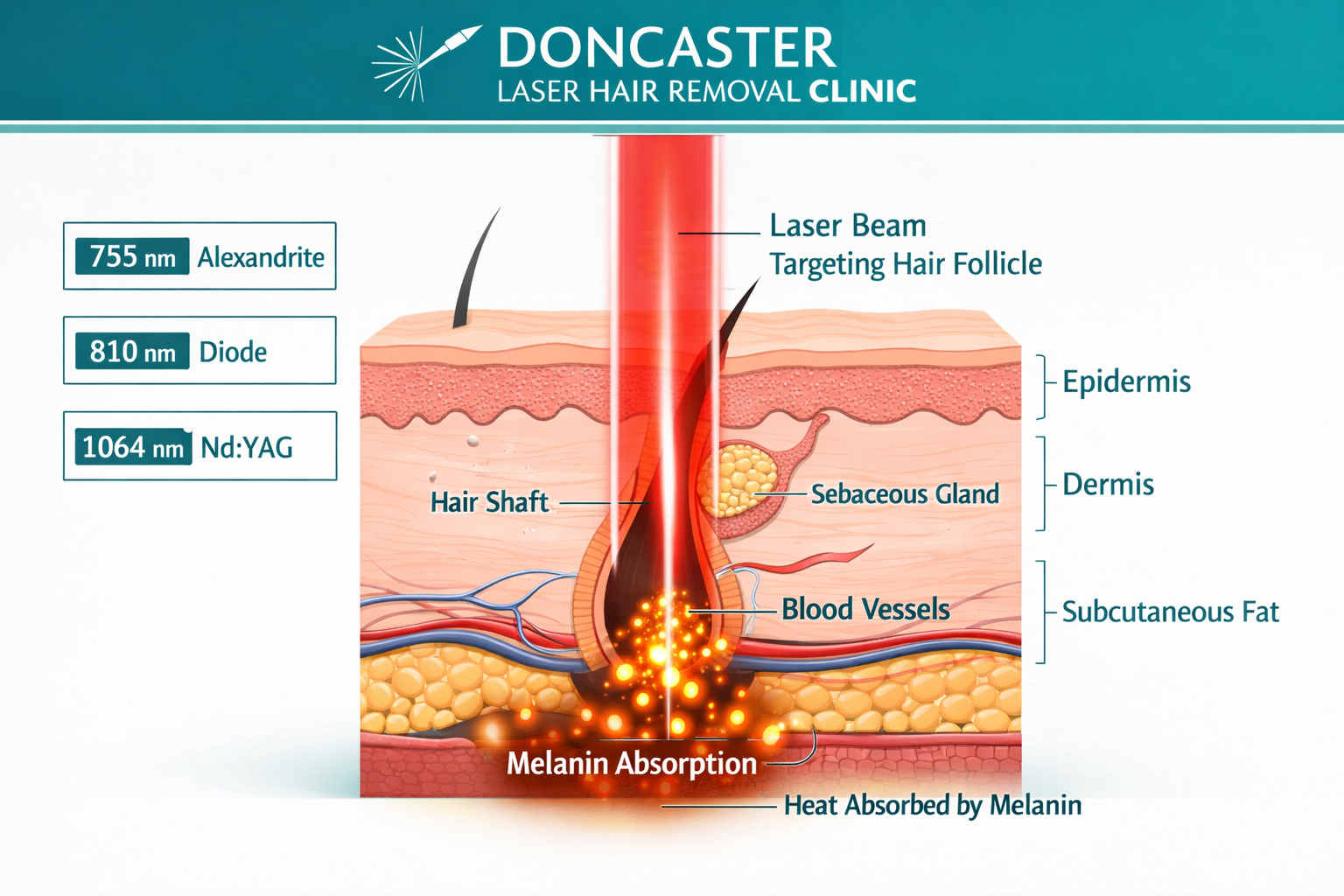
Laser hair removal uses concentrated light energy to target and destroy hair follicles at their root, preventing future hair growth. The laser emits a specific wavelength that is absorbed by melanin — the pigment found in hair — without damaging the surrounding skin tissue.
Here is what happens at the follicle level:
- Light absorption: The laser beam passes through the skin and is absorbed by the melanin in the hair shaft.
- Heat conversion: That light energy converts to heat, which travels down to the hair follicle.
- Follicle destruction: The heat damages the follicle’s ability to produce new hair, a process called selective photothermolysis.
- Growth cycle targeting: Only follicles in the active growth phase (anagen) are effectively treated, which is why multiple sessions are needed.
Because hair grows in cycles, a single treatment only affects a portion of follicles at any one time. This is why consistent, spaced sessions are essential for comprehensive results.
Clinical note: The principle of selective photothermolysis — matching laser wavelength to the target chromophore (melanin) while protecting surrounding tissue — is the scientific foundation of safe, effective laser hair removal.
What Makes the Best Laser Hair Removal Clinic in Doncaster Stand Out?
The best laser hair removal clinic in Doncaster offers more than just a laser device and a booking form. Several specific factors separate a high-quality medical aesthetic clinic from a basic beauty salon offering laser treatments.
What to look for:
- Qualified practitioners: Look for clinics staffed by medical professionals, trained aesthetic therapists, or practitioners holding Level 4 or above laser safety qualifications. In the UK, laser treatments should be performed under appropriate clinical governance.
- Medical-grade technology: Devices should be FDA-cleared or CE-marked for laser hair removal. Ask specifically which laser system the clinic uses and whether it is suitable for your skin tone.
- Skin consultation before treatment: A reputable clinic will never proceed without a full skin and hair assessment, a patch test, and a review of your medical history.
- Transparent pricing: Honest clinics provide clear, itemised pricing for individual sessions and packages without hidden fees.
- Aftercare support: Quality clinics provide written post-treatment care instructions and follow-up support between sessions.
Common mistake: Choosing a clinic based on the lowest price alone. Cheaper treatments often mean older technology, less qualified staff, or skipped safety steps — all of which increase the risk of burns, pigmentation changes, or poor results.
Which Laser Technology Is Right for Your Skin Type?
Not all laser systems work equally well across all skin tones. Choosing the correct wavelength for your skin type is one of the most important clinical decisions in laser hair removal.
| Laser Type | Wavelength | Best For | Fitzpatrick Skin Types |
|---|---|---|---|
| Alexandrite | 755 nm | Fair to medium skin, fine hair | I–III |
| Diode | 808–810 nm | Medium to olive skin | II–V |
| Nd:YAG | 1064 nm | Darker skin tones | IV–VI |
| IPL (Intense Pulsed Light) | Broad spectrum | Fair skin, coarser hair | I–III |
Important distinction: IPL (Intense Pulsed Light) is not technically a laser. It uses a broad spectrum of light rather than a single focused wavelength, which makes it less precise and generally less effective, particularly on darker skin tones. A clinic offering only IPL is not the same as a clinic offering true laser hair removal.
At Dermacy Clinic, we use advanced multi-wavelength laser systems that allow our practitioners to select the precise wavelength for your individual skin tone and hair type. This personalised treatment mapping is what makes the difference between adequate results and exceptional ones.
Choose Nd:YAG if you have a darker skin tone (Fitzpatrick IV–VI). It bypasses surface melanin and targets the follicle more safely, significantly reducing the risk of pigmentation changes.
What Areas Can Be Treated, and How Much Does It Cost?
Laser hair removal can be applied to almost any area of the body where unwanted hair grows. The exceptions are areas immediately around the eyes, due to laser safety regulations.
Common treatment areas include:
- Face: Upper lip, chin, jawline, sideburns, full face
- Body: Underarms, arms, chest, back, stomach, shoulders
- Legs: Full legs, lower legs, upper legs, bikini line, Brazilian, Hollywood
- Sensitive areas: Bikini, intimate areas (treated with appropriate laser settings)
Estimated cost ranges (UK, 2026):
| Area | Per Session (Estimate) | Course of 6 (Estimate) |
|---|---|---|
| Upper lip | £40–£80 | £200–£400 |
| Underarms | £60–£100 | £300–£500 |
| Full legs | £150–£300 | £750–£1,500 |
| Back (full) | £150–£250 | £750–£1,200 |
| Brazilian/Hollywood | £80–£150 | £400–£750 |
Note: Prices vary by clinic, technology used, and practitioner experience. These are indicative estimates based on current UK market rates and should not be taken as a fixed quote.
Cost-benefit reality: A person who waxes their legs every 6 weeks spends an estimated £600–£1,200 per year on waxing alone, not counting time and discomfort. A full laser course, while a higher upfront investment, typically pays for itself within 2 to 3 years — and results can last many years with occasional top-up sessions.
How Many Sessions Will You Need, and What Should You Expect?
Most people need between 6 and 8 sessions for significant, lasting hair reduction. Some areas or hair types may require additional sessions.
Session spacing guidelines:
- Face and underarms: Every 4–6 weeks (faster hair growth cycles)
- Body and legs: Every 6–8 weeks
- Back and chest: Every 8–10 weeks
What to expect session by session:
- Sessions 1–2: You may notice shedding of treated hairs within 1–3 weeks. Some regrowth will occur, but it is often finer and lighter.
- Sessions 3–4: Noticeable reduction in hair density. Regrowth becomes sparser.
- Sessions 5–6: Significant reduction in most treated areas. Many clients see 70–90% reduction by this stage.
- Maintenance: Hormonal changes (pregnancy, menopause, polycystic ovary syndrome) can stimulate new follicles over time. Occasional top-up sessions every 12–24 months maintain results.
Is laser hair removal permanent? Laser hair removal is classified as permanent hair reduction, not permanent hair removal. The British Association of Dermatologists and regulatory bodies in the UK use this distinction because, while the majority of treated follicles are permanently disabled, some may reactivate due to hormonal changes or other factors. That said, most clients experience a dramatic and long-lasting reduction that significantly reduces or eliminates the need for other hair removal methods.
Is Laser Hair Removal Painful, and Is It Safe?
Modern laser hair removal is considerably more comfortable than older systems, and most clients describe it as tolerable. The sensation is often compared to a light snap of a rubber band against the skin.
Comfort factors:
- Integrated cooling systems: High-quality laser devices include contact cooling, cryogen spray, or air cooling to protect the skin surface and reduce discomfort during treatment.
- Adjustable settings: A skilled practitioner adjusts energy levels based on your skin tone, hair density, and comfort threshold.
- Topical anaesthetic: For sensitive areas, a numbing cream can be applied 30–45 minutes before treatment.
Safety considerations:
- Avoid sun exposure and self-tanning products for at least 4 weeks before and after treatment.
- Inform your practitioner of any medications, particularly photosensitising drugs such as certain antibiotics or retinoids.
- Hormonal conditions such as PCOS can affect treatment outcomes and should be disclosed during consultation.
- Laser hair removal is not recommended during pregnancy.
Who is not suitable for laser hair removal?
- Individuals with very light, white, grey, or red hair (insufficient melanin for the laser to target)
- Those with active skin infections or open wounds in the treatment area
- People on certain photosensitising medications without medical clearance
- Pregnant women
- Individuals with a history of keloid scarring (requires careful clinical assessment)

What Should You Do Before and After Each Session?
Pre- and post-treatment care directly affects both your safety and your results. Following these steps is not optional — it is part of the treatment itself.
Before your session:
- Shave the treatment area 24–48 hours before your appointment (do not wax, thread, or epilate for at least 4 weeks prior, as the root must be present)
- Avoid sun exposure, sunbeds, and fake tan for 4 weeks before treatment
- Arrive with clean, product-free skin in the treatment area
- Disclose all medications and supplements to your practitioner
After your session:
- Apply a gentle, fragrance-free moisturiser to soothe the skin
- Use SPF 30 or higher on any treated areas exposed to sunlight, consistently for at least 4 weeks post-treatment
- Avoid heat — saunas, hot baths, and intense exercise — for 24–48 hours
- Do not pick or scratch treated skin; some redness and minor swelling is normal and typically resolves within a few hours
- Avoid retinoids and active skincare ingredients (such as AHAs and BHAs) on treated areas for at least 5–7 days
Post-treatment nutrition and lifestyle: While no food will dramatically change your laser results, maintaining healthy skin through adequate hydration, a diet rich in antioxidants, and avoiding excessive alcohol (which can increase skin sensitivity) supports faster recovery and better skin health overall.
Why Choose Dermacy Clinic for Laser Hair Removal in Doncaster?
At Dermacy Clinic, we believe that choosing a laser hair removal provider is a medical decision, not just a beauty one. Our approach combines clinical expertise with genuine patient care.
What sets Dermacy Clinic apart:
- Advanced laser technology: We use medical-grade laser systems with multi-wavelength capability, ensuring safe and effective treatment across all skin tones, including darker complexions that require specialist care.
- Qualified clinical team: Our practitioners hold recognised qualifications in laser and light-based therapies and operate under full clinical governance.
- Personalised treatment plans: Every client receives a thorough skin and hair analysis before any treatment begins. We map your treatment areas, assess your Fitzpatrick skin type, and design a session plan tailored specifically to you.
- Transparent, honest communication: We will always tell you what results are realistic for your skin and hair type. We do not make promises we cannot keep.
- Comprehensive aftercare: From your first session to your last, our team is available to answer questions, monitor your progress, and adjust your treatment plan as needed.
The psychological benefit: Many of our clients tell us that the confidence gained from effective hair removal extends well beyond aesthetics. Feeling comfortable in your skin — at the gym, on the beach, in professional settings — has a genuine and meaningful impact on daily life. That is something we take seriously.
Frequently Asked Questions
How does laser hair removal work? Laser hair removal uses a concentrated beam of light that is absorbed by melanin in the hair follicle. The light converts to heat, which damages the follicle and inhibits future hair growth. Only follicles in the active growth phase are affected, which is why multiple sessions are needed.
Is laser hair removal permanent? Laser hair removal produces permanent hair reduction in most treated follicles. Some follicles may reactivate due to hormonal changes over time, but the vast majority of clients experience a dramatic, long-lasting reduction that significantly reduces or eliminates the need for regular hair removal.
How many sessions will I need? Most people need 6 to 8 sessions for significant results. The exact number depends on your hair colour, hair density, treatment area, and individual response to treatment.
Who is not suitable for laser hair removal? Laser hair removal is not suitable for people with white, grey, or very light blonde/red hair (insufficient melanin to target), pregnant women, those with active skin infections in the treatment area, or individuals on certain photosensitising medications without medical clearance.
Does laser hair removal hurt? Most clients describe the sensation as a mild snap or warmth. Modern laser systems with integrated cooling make the treatment considerably more comfortable than older devices. Sensitive areas may benefit from topical numbing cream applied before the session.
Can laser hair removal be done on dark skin? Yes. The Nd:YAG laser (1064 nm wavelength) is specifically suited to darker skin tones and is the clinically recommended option for Fitzpatrick skin types IV–VI. It is essential to choose a clinic with the appropriate technology and a practitioner experienced in treating diverse skin tones.
How long should I wait between sessions? Facial areas are typically treated every 4–6 weeks. Body areas such as legs and back are treated every 6–10 weeks. Your practitioner will set your schedule based on your specific treatment areas and hair growth patterns.
What is the difference between laser and IPL? Laser uses a single, focused wavelength of light for precise follicle targeting. IPL uses a broad spectrum of light, which is less precise and generally less effective, particularly on darker skin tones. Both can reduce hair, but medical-grade laser systems typically deliver superior and more consistent results.
Can hormonal conditions affect my results? Yes. Conditions such as PCOS, thyroid disorders, or hormonal changes from pregnancy or menopause can stimulate new follicle activity over time. This does not mean laser treatment will not work — it means occasional maintenance sessions may be needed to address new growth.
How do I prepare for my first appointment? Shave the treatment area 24–48 hours before your session. Avoid waxing, threading, or epilating for at least 4 weeks prior. Stay out of the sun and avoid fake tan for 4 weeks before treatment. Arrive with clean skin, free of creams or deodorant in the treatment area.
Conclusion
Choosing the best laser hair removal clinic in Doncaster is about more than finding the nearest available appointment. It is about finding a clinic that prioritises your safety, uses the right technology for your skin type, and gives you honest, realistic expectations from the start.
Your next steps:
- Book a consultation at Dermacy Clinic for a full skin and hair assessment at no obligation.
- Request a patch test before committing to a full course of treatment — any reputable clinic will offer this.
- Ask the right questions: What laser system do you use? What qualifications do your practitioners hold? What aftercare support do you provide?
- Compare clinics on quality, not just price. The cheapest option is rarely the safest or most effective.
At Dermacy Clinic, we are here to guide you through every step — from your first consultation to your final session and beyond. Our goal is simple: to help you feel confident, informed, and genuinely satisfied with your results.
Ready to take the next step? Contact Dermacy Clinic today to book your personalised laser hair removal consultation in Doncaster.