BeforeAfter
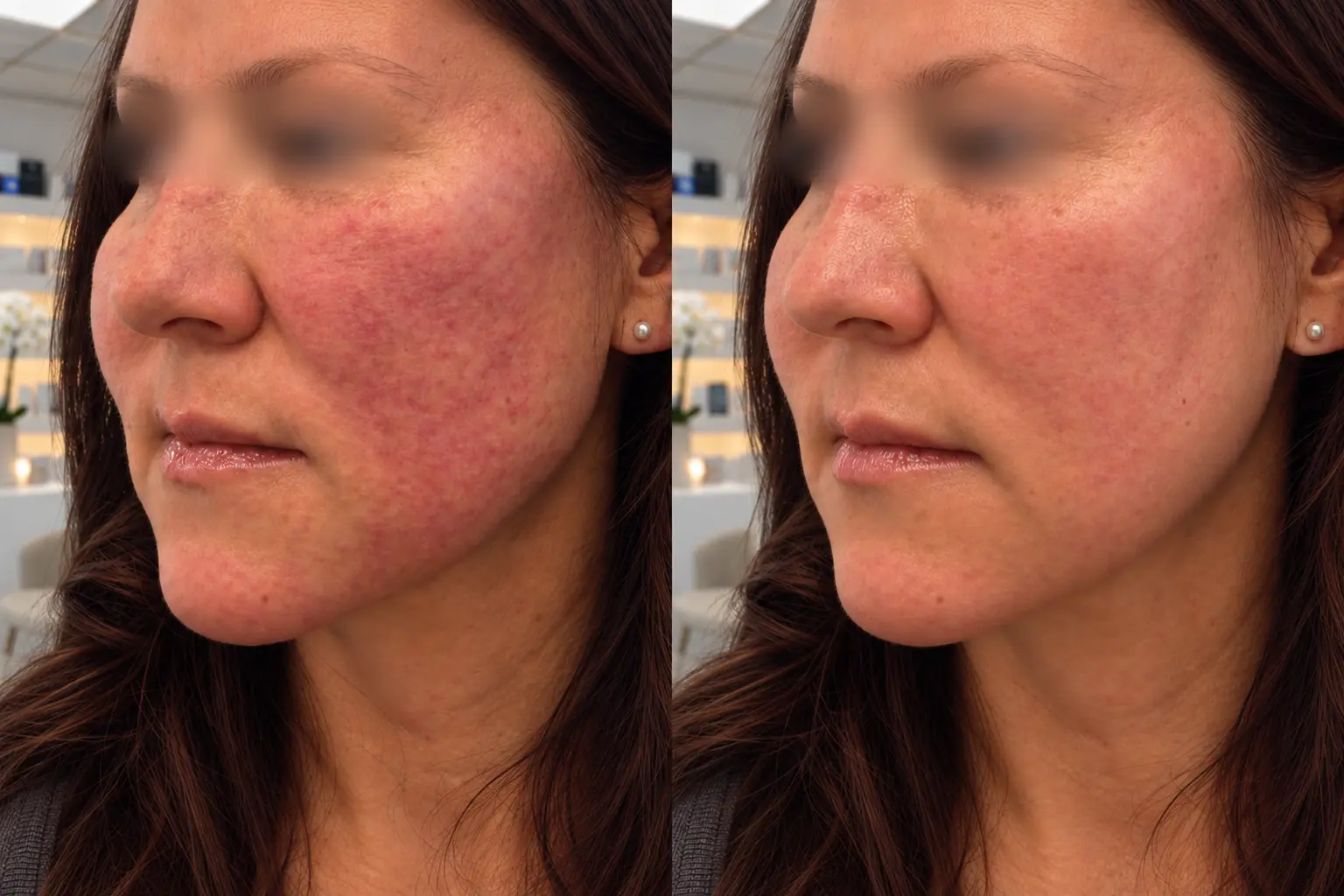
Cheek redness with small papules
Diffuse flushing across the cheek with fine papules on top — the mix people most often try to scrub away. Treated by calming the barrier rather than exfoliating it.
Rosacea is not one condition. Flushing, fixed redness, visible vessels and inflamed bumps behave differently, respond to different things, and some of them are made worse by the products people reach for first. We work out which pattern you have before anything is booked, then treat what is treatable here and tell you plainly what needs a prescription.
Most pages treat rosacea as one thing and sell one treatment against it. The four recognised patterns need different work, and two of them need a prescriber rather than a treatment room. This is the part of the appointment that decides everything else.
| Pattern | What you notice | What actually helps |
|---|---|---|
| Flushing and redness Erythematotelangiectatic. | Face flushes easily and stays red. Burning or stinging. Skin reacts to almost every product. | Barrier repair first, trigger work, and calming professional protocols. Fixed vessels respond better than flushing does — that difference is worth knowing before you spend anything. |
| Visible vessels Telangiectasia. | Fine red threads across the cheeks and around the nose that no longer fade. | Vessel-directed work, assessed at your consultation. These are the most predictable part of rosacea to improve. |
| Bumps and pustules Papulopustular. | Red bumps and small pus-filled spots, with no blackheads anywhere. | Usually prescription treatment. Anti-inflammatory support and barrier work help alongside it, but a device is not the answer to this pattern and we will say so. |
| Thickened skin Phymatous, including the nose. | Skin coarsens and thickens, most often on the nose, sometimes with enlarged pores. | Dermatology territory. Assessed here, referred onward — this pattern is not managed with facials. |
| Eyes involved Ocular rosacea. | Gritty, dry, sore or watering eyes, recurrent styes, red lid margins. | Needs medical care, and it is often missed entirely. We ask about it at every rosacea assessment and send you to your GP or optometrist if it is there. |
Patterns overlap, and they change over years. Being typed once and treated the same way for a decade is one of the commonest reasons rosacea care stops working.
These are our clients, photographed in the same room under the same lighting, with eyes obscured. Rosacea is not cured, so what you are looking at is control — redness settled, papules cleared, skin barrier calmer — held by a protocol and a routine the client keeps.
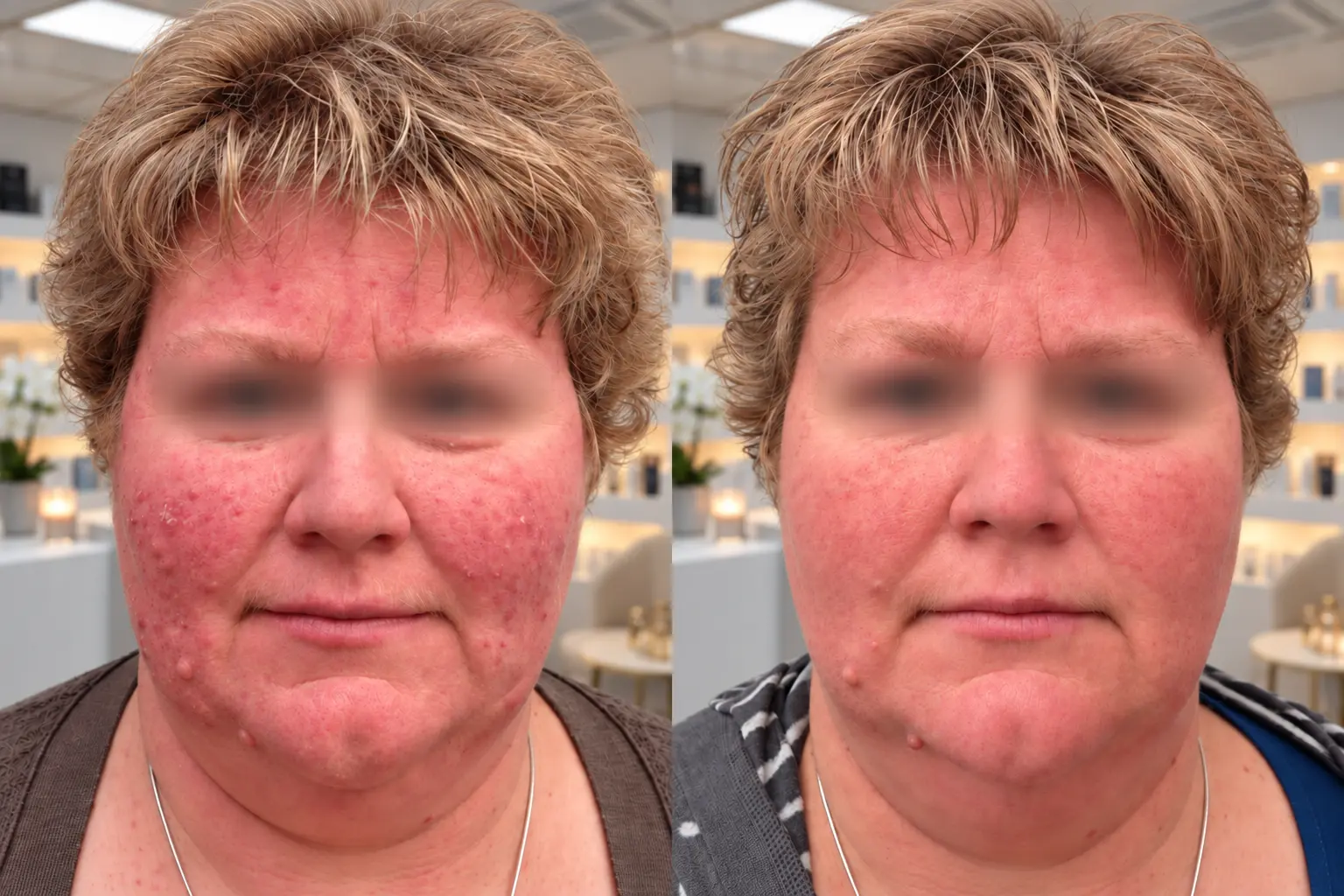
This is the pattern most often mistaken for adult acne, and it is the one that gets worse when it is treated that way. There were papules and pustules across both cheeks, the chin and the nose, sitting on a background of persistent redness — but no blackheads, which is the detail that separates the two.
The plan was built the other way round from an acne plan: calm first, strip nothing. An iS Clinical professional protocol was selected at the assessment and paired with homecare from the same system, so the in-clinic step and the daily routine were not working against each other. Triggers were mapped at the same visit, because a protocol that ignores what sets the skin off buys you weeks rather than months.
Diffuse flushing across the cheek with fine papules on top — the mix people most often try to scrub away. Treated by calming the barrier rather than exfoliating it.
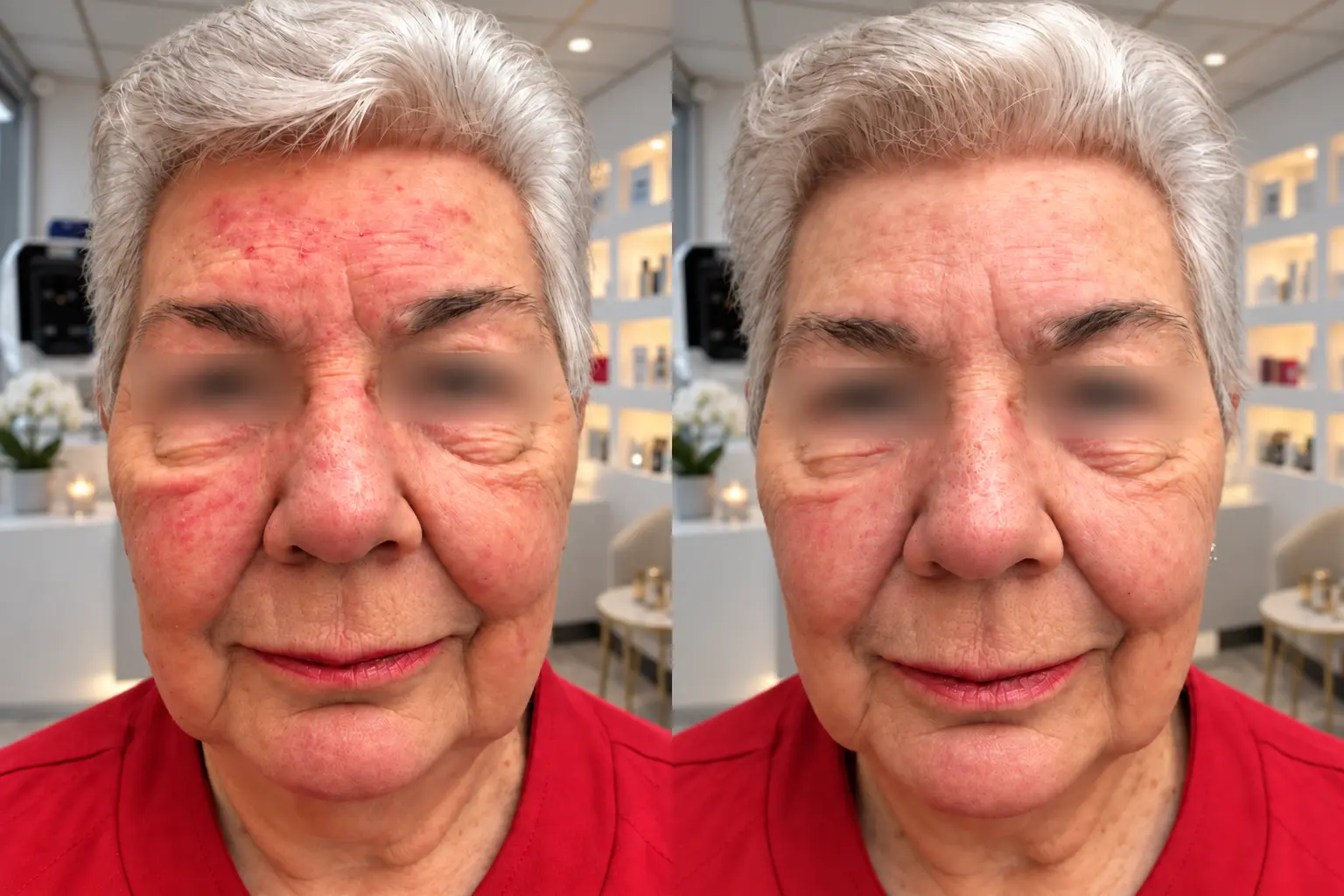
Redness sitting across the nose, cheeks and forehead in the classic central distribution. Mature skin needs the same plan at a gentler pace, not a different one.
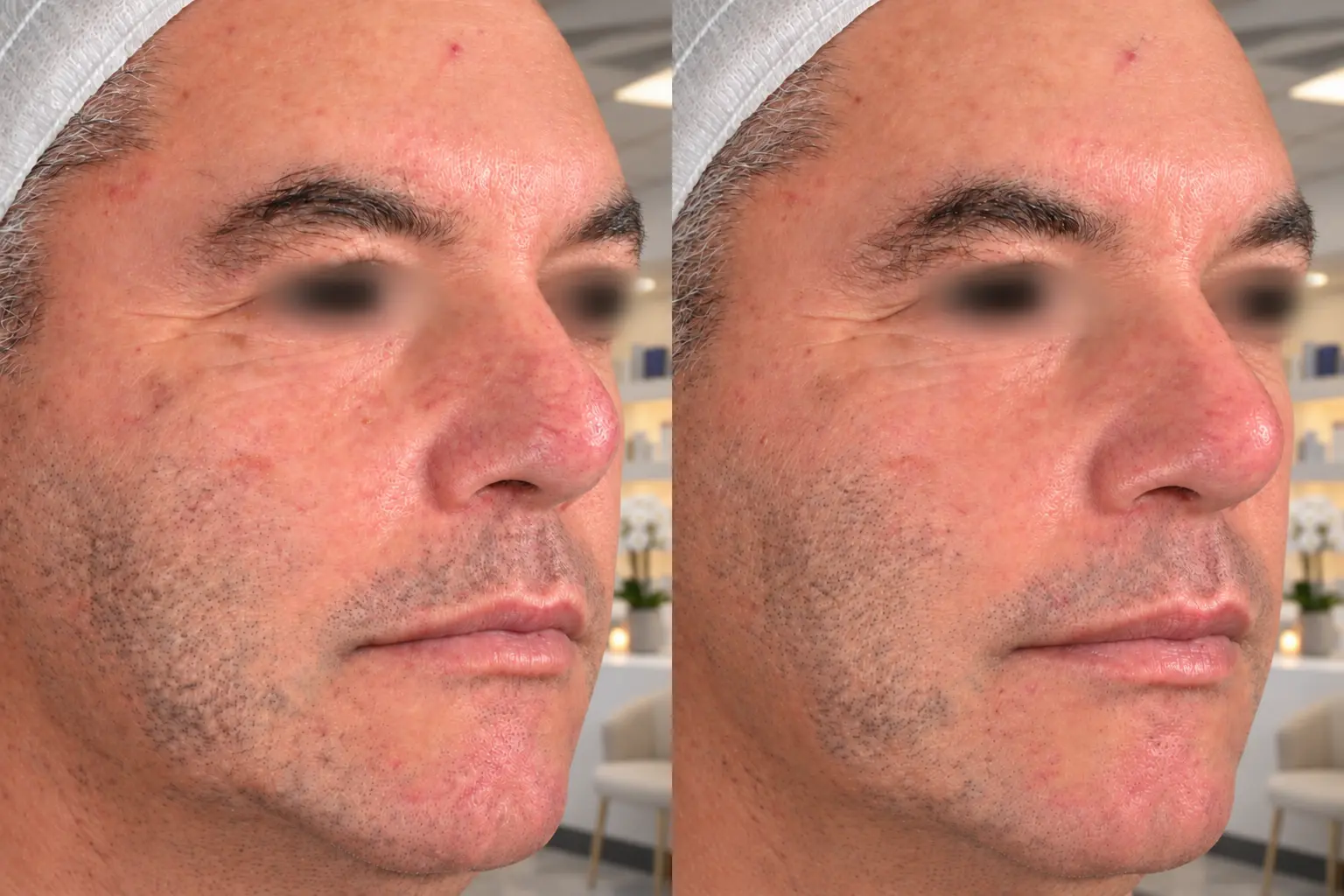
Men are diagnosed later and more often arrive with thickened, ruddy skin around the nose. Background redness responds; established vessels are assessed separately at consultation.
What these photographs are, and are not. They are our own clients, taken at our Armthorpe clinic in the same position and lighting, unretouched, with eyes obscured. Rosacea is a long-term condition: these show it controlled, not cured, and it can flare again if the routine or the triggers change. Results differ from person to person, subtype to subtype, and no outcome shown here is a promise of yours. What we will give you at assessment is a realistic view of which part of your own rosacea is likely to move — and which part is not.
Rosacea is routinely confused with conditions that need entirely different treatment, and two of them get worse if they are treated as rosacea. If the diagnosis is wrong, the plan cannot be right.
Redness with fine greasy scaling, usually in the folds beside the nose, the brows, the hairline and sometimes the ears, often with an itch. Rosacea does not scale like this. The two frequently sit on the same face at once, which is precisely why each needs identifying — treating only the rosacea leaves the scaling untouched and the person convinced nothing works.
The quickest test is blackheads. Acne makes blackheads and whiteheads; rosacea does not. Adult acne and papulopustular rosacea can look almost identical at a glance, and the treatments pull in opposite directions — strong acne actives and aggressive exfoliation typically flare rosacea. See acne treatment if the pattern points that way.
Clustered small bumps around the mouth, nose or eyes, usually leaving a clear rim at the lip border. Very often triggered by a steroid cream or an inhaled steroid. Adding actives makes it worse; the answer is usually stopping the trigger under medical guidance.
Years of sun produce fixed redness and broken vessels that are not rosacea, though they can look like it and often coexist. Separately: topical steroid creams can worsen rosacea, and can cause a rosacea-like eruption of their own. If your redness began or escalated after using a steroid cream on your face, bring that to the appointment — it changes the plan completely and it is the single most useful thing most people do not know.
Trigger lists online run to forty items, which is useless — nobody can avoid forty things. A short, honest list you actually follow beats a long one you abandon in a fortnight.
Rosacea is managed rather than cured, and the aim is fewer flares, less fixed redness and skin that stops reacting to everything. Once the assessment has identified your pattern, your protocol is built on iS Clinical — the range we use for rosacea — with in-clinic treatment and homecare taken from the same system so the two are not pulling against each other.
Rosacea skin has a compromised barrier, which is why it stings and why active products fail on it. The first phase rebuilds tolerance. It is unglamorous and it is the step that decides whether anything else works.
Anti-inflammatory, anti-redness protocols at professional strength, stepped to what your skin will accept rather than to a fixed course length. iS Clinical is built around botanical anti-inflammatories and barrier support rather than high-strength acids, which is why it suits reactive rosacea skin.
Fixed visible vessels are the most predictable part of rosacea to improve. Whether that route is appropriate for your skin type and pattern is assessed at your consultation, with a patch test before anything is booked — never on a first visit.
A short diary, a sun-protection routine that is actually wearable, and a product list cut back to what helps. Most people arrive using six things that irritate them and none that repair.
Rosacea is judged over weeks, against your first images, not by how your face looks on the day. If the plan has not moved it, the plan changes.
Rosacea is one of the treatments we are asked for most, and part of doing it properly is being clear about where our half of it ends.
If you are already using a prescribed rosacea treatment, bring it with you. Nothing we do should collide with it, and the sequencing matters.
“How many sessions” is the first thing people ask and the last thing they get answered. Here is the real shape of it.
The barrier phase. Stinging settles, the skin stops reacting to everything, and redness often calms a little on its own once the irritation stops. Nothing dramatic happens visually, and that is expected.
This is where fixed redness and sensitivity improve measurably. Twelve weeks is the honest point to judge a rosacea plan — sooner than that and you are reading day-to-day fluctuation, not progress.
Visible vessels need more than a single session and respond fairly predictably. The number is set at your assessment once your skin type and pattern are known, and it goes in writing before you commit.
Rosacea is a long-term condition, so the plan steps down rather than stopping. Most of the work becomes homecare and sun protection, with occasional in-clinic top-ups rather than a permanent course.
Flushing improves less predictably than fixed redness and vessels. Anyone quoting you a session count for rosacea before looking at your skin is guessing, and results vary between individuals.
Your plan and its total cost are agreed and written down at your assessment, before anything is booked. That covers the in-clinic work, the homecare and the number of weeks, together.
Starts on the skin analysis machine, which shows redness and vessel patterns that are not yet obvious on the surface. Your pattern is identified, your Fitzpatrick skin type recorded, your history taken — including every product you use, any steroid cream you have used on your face, and any medication. Images are stored so change is measured rather than remembered. The fee comes off your treatment.
What we do in clinic, what you do at home, when to expect change, and the total cost. If part of the answer is a prescriber, that is written down too, along with what to ask for.
Tolerance first. Anything active before this is how rosacea plans fail.
Its own appointment, before treatment. Required, not offered.
Against your first images. The plan either continues, changes, or escalates to a prescriber.
Stepped down to homecare and sun protection, with top-ups as needed rather than an open-ended course.
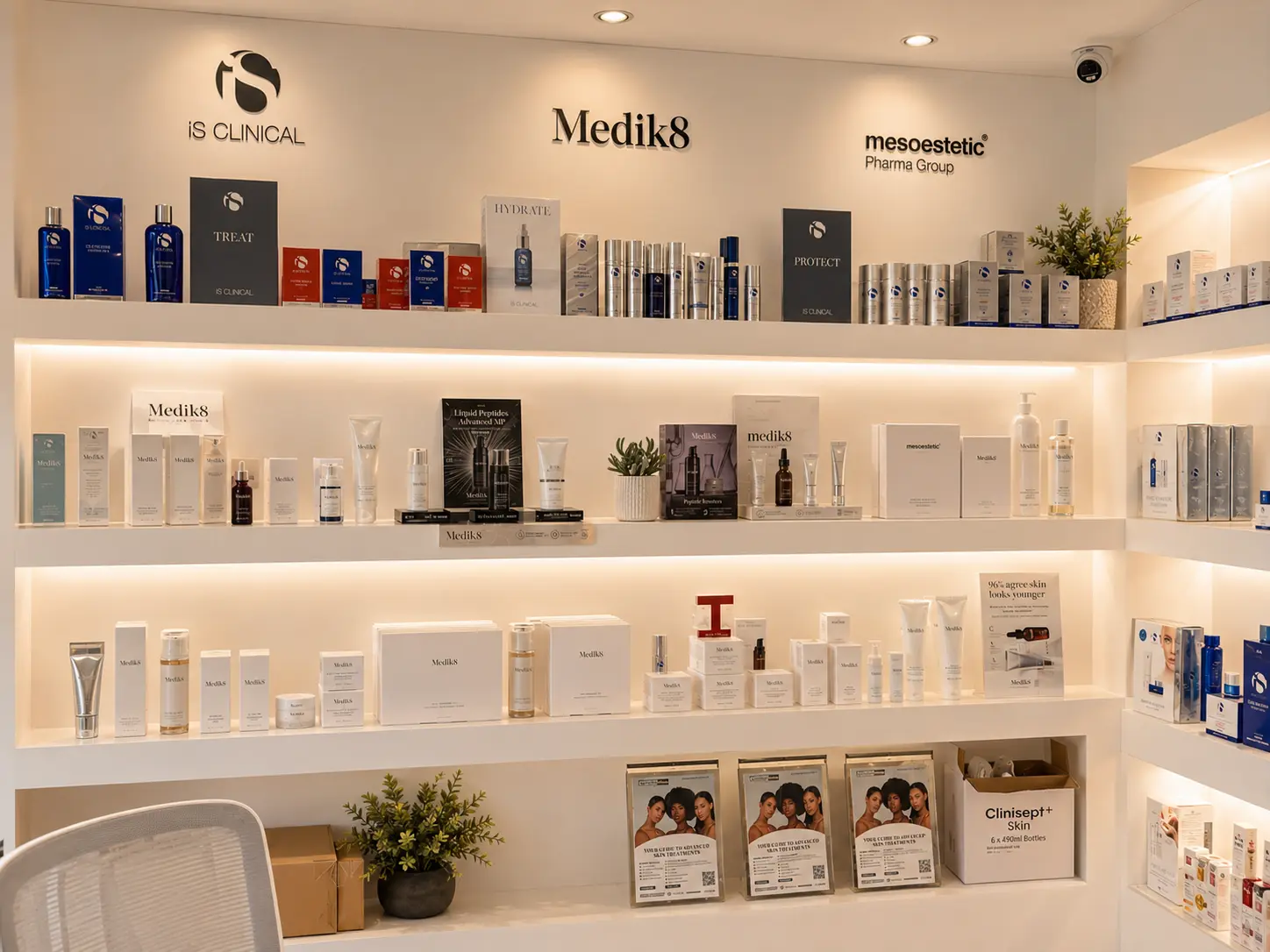
Professional ranges are not the versions sold in shops. They are supplied only to trained clinics, used at strengths that need supervision, and designed so the in-clinic treatment and the homecare belong to one system rather than fighting each other. We work with three, and which one you go on depends on what your skin is doing.
All three are professional cosmetic ranges. None of them contains a prescription-only medicine, and where your skin genuinely needs one we will say so rather than reach for the nearest alternative on the shelf.
Dermacy opened in July 2020 and rosacea has been part of the work from the start — alongside acne and pigmentation, the three conditions most often mistaken for each other. The clinic was built on fifteen years of hospital experience beforehand, across anaesthesia, pain, oncology, plastic surgery and dermatology, and it shows in the order we work in: assess, identify, write it down, refer when referring is right.
Your assessment, skin analysis, treatment plan and reviews are carried out within each practitioner’s current professional scope.
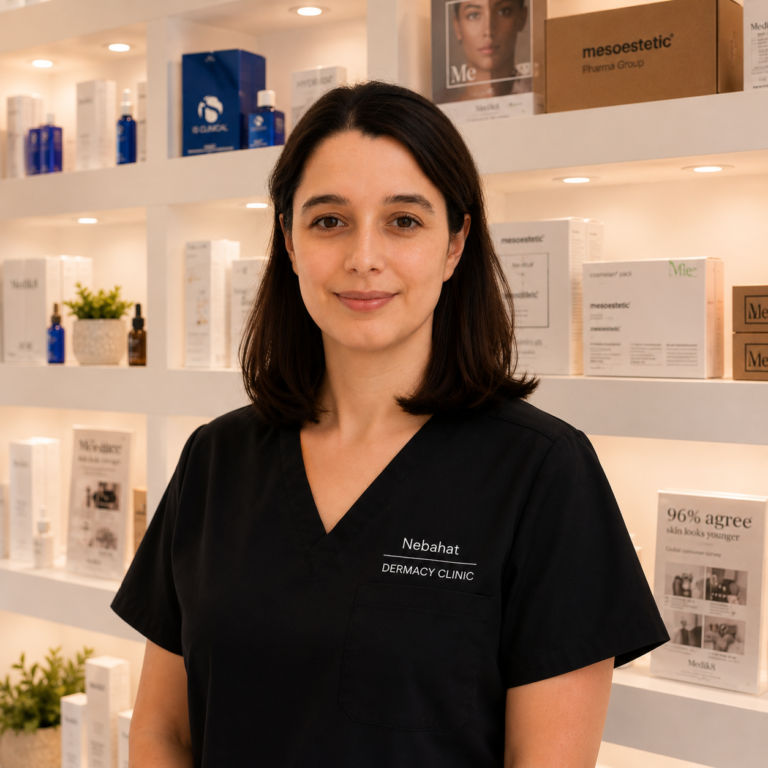
Identifies which pattern of rosacea you have, records skin type and history, sets the barrier and treatment plan and the twelve-week review, and decides when a case needs a prescriber, a dermatologist or an eye assessment rather than treatment in clinic.
Yes. The assessment fee comes off your treatment if you go ahead. It is worth asking every clinic this, because it is commonly not the case — a doctor’s consultation fee and a separate patch-test fee can both be payable before a single treatment, and neither is returned.
The barrier and homecare phase runs about four weeks before anything active, and a rosacea plan is judged at twelve weeks. Visible vessels need a short course rather than one visit. The exact number is set at your assessment once your pattern and skin type are known, and written down before you commit — anyone quoting you a figure without seeing your skin is guessing.
No. It is a long-term condition that is managed, and managed well it stays quiet for long stretches. What a good plan buys you is far fewer flares, less fixed redness, and skin that stops reacting to everything. Results vary between individuals.
Scaling is the clue. Seborrhoeic dermatitis brings fine greasy flaking in the folds beside the nose, the brows and the hairline, and it often itches. Rosacea does not scale like that. The two frequently occur together on the same face, which is why both get identified at the assessment rather than one being assumed.
Blackheads. Acne produces blackheads and whiteheads; rosacea does not. It matters because the treatments go in opposite directions — strong acne actives and scrubs typically flare rosacea. If every acne product you have tried made your skin angrier, that is information, not bad luck.
It can worsen rosacea, and prolonged use on the face can produce a rosacea-like eruption of its own. If your redness started or escalated after a steroid cream, tell us — it changes the plan completely, and stopping it needs to be handled under medical guidance rather than abruptly.
Mainly the redness, the vessels and the sensitivity. The inflamed bumps usually respond best to prescription treatment, so if that is your main complaint the honest plan is a prescriber for the papules and us alongside for the redness, the barrier and the triggers.
Usually yes, and bring them to the appointment. Ivermectin, metronidazole and prescription-strength azelaic acid all sit alongside what we do, but the sequencing and the gaps around in-clinic treatment matter, and some need pausing briefly. We plan around your prescription rather than ignoring it.
Oral doxycycline for rosacea is usually compatible, with care. Isotretinoin is not — it changes how skin heals, so device work and resurfacing wait until you have been off it for a period agreed with your prescriber. Bring your dates and we plan around them.
Yes, with the plan adjusted. Rosacea is routinely missed in Fitzpatrick IV to VI because the redness reads as dusky rather than pink, so it gets found late. Energy-based work carries a real risk of leaving a darker mark on deeper tones, so settings are conservative, the sequence is slower, and sometimes the honest answer is that a non-device route suits you better.
Flushing is the least predictable part of rosacea and it responds less reliably than fixed redness and vessels. Some skin flushes for a day or two after in-clinic treatment. That is why the barrier phase comes first, why patch testing is required, and why we are cautious about promising anything on flushing specifically.
No. That pattern needs a dermatologist, and it is not something facials or peels address. We will identify it and tell you where to go.
It can be. Ocular rosacea affects a large share of people with rosacea and is regularly missed because nobody asks. It is not treated in a skin clinic — see your GP or optometrist. We ask about it at every rosacea assessment for exactly this reason.
Sun is the most consistently reported one. Then heat, sudden temperature change, alcohol, spicy food, stress, and harsh skincare. Beyond that it is individual, which is why two weeks of a simple diary beats a forty-item list you will abandon. Rosacea is not caused by poor hygiene or by drinking too much, and that second assumption causes a lot of unnecessary embarrassment.
Almost certainly, and it is usually a case of removing rather than adding. Most reactive rosacea skin arriving here is using several things that irritate it and nothing that repairs it. You will get a written routine, and if what you already own does the job we will say so.
Yes, and green-toned colour correction genuinely helps in the meantime. On treatment days you will be told when to leave the skin alone, usually the rest of that day.
The professional protocols are designed around reactive skin, so most people return to normal the same day, sometimes a little flushed. Vessel-directed work can leave the area pink for a day or two. You are told what to expect before you book, not afterwards.
Partly. Several standard actives are avoided in pregnancy, and pregnancy itself changes how the skin behaves. We keep the plan short and safe and coordinate with your midwife or GP rather than working around them.
Yes — isolated broken vessels from sun exposure or ageing are assessed the same way, and they are often easier to improve than rosacea vessels because the surrounding skin is not inflamed.
iS Clinical. It is the range we use for rosacea specifically, because it leans on botanical anti-inflammatories and barrier repair rather than the high-strength acids that reactive skin cannot tolerate. The in-clinic protocol and your homecare come from the same system so they work together. It is a professional cosmetic range — it contains no prescription-only medicine, and if your skin needs one of those we will tell you.
Armthorpe, Doncaster, with free customer parking directly outside. Open Monday to Saturday, 10:00 to 18:00, and we see clients from across South Yorkshire — Doncaster, Bawtry, Bessacarr, Rossington, Thorne and Conisbrough among them.
An assessment tells you which pattern you have, whether what you are using is helping or hurting, what is treatable here and what needs a prescription. That is worth knowing either way.