Often, yes, but the honest answer is that it depends on how your skin looks and feels afterwards and on what your practitioner tells you. There is no single universal waiting time. Advice you will find online ranges from “straight away” to “leave it a full day”, and the difference comes down to the products used, your skin type and how reactive your skin is on the day. This guide covers one narrow question: when and how to go back to makeup, why your skin’s response matters more than a number on a clock, and when to contact the clinic.
It is general information, not a diagnosis or a personal instruction. If you have a treatment booked with us at Dermacy Clinic in Armthorpe, Doncaster, the advice you are given at your appointment comes first.
TL;DR
- There is no universal waiting period. Many clinics suggest leaving skin bare for a short while, often anywhere from a few hours to a day, but your skin’s response and your practitioner’s advice decide.
- If your skin looks calm, feels comfortable and you were told makeup is fine, keep it light, clean and gentle.
- Redness, stinging, tightness, swelling or any broken skin is a reason to hold off and ask, not to cover it up.
- Sun protection matters more than foundation: the NHS recommends at least SPF 30 with at least 4-star UVA protection.
- Clean brushes, sponges and fresh products are the quiet detail that makes the biggest difference.
Table of Contents
- Why there is no single answer
- What a clinic means by “let your skin settle”
- A simple way to decide: the three-check test
- If you need to wear makeup the same day
- Sun protection comes before makeup
- Washing your face and removing makeup afterwards
- Choosing makeup that suits freshly treated skin
- When makeup is not the right way to deal with what you see
- Timing around other treatments and products
- A sensible plan for the day of your appointment
- Doing it on your own skin: what we cannot tell you from a web page
- Thinking about a HydraFacial in Doncaster?
- When to contact the clinic
- FAQ
- Sources
Why there is no single answer
A HydraFacial is a multi-step facial: cleansing, exfoliation, extraction, and the application of hydrating or targeted serums. You can read how the treatment works step by step in our guide to what a HydraFacial involves, its results and aftercare. It is generally regarded as a gentle, no-surgery treatment, and many people leave looking fresh and hydrated. But “gentle” is relative, and two people can walk out of the same treatment room with very different skin.
The things that change the answer include:
- Your skin type and sensitivity. Dry, sensitive or reactive skin may stay pink for longer than resilient, oilier skin.
- Which treatment boosters or serums were used. Your practitioner knows what went on your skin and can say whether anything makes it worth waiting.
- How much extraction was needed. If you had congested pores, the skin may look more flushed in the first hours.
- Your usual skincare. If you use strong active ingredients, your skin may respond differently.
- Any skin condition. Acne, rosacea, eczema or recent irritation all change how cautious you should be.
This is why we would rather give you a way of deciding than a number to memorise. A rule such as “wait exactly 24 hours” is reassuring, but it ignores how your skin actually looks.
What a clinic means by “let your skin settle”
After a facial, the outer layer of skin has been cleansed and exfoliated, and often saturated with hydrating ingredients. For a short time it may be slightly more sensitive than normal. Practitioners who suggest a pause before makeup are usually thinking about three things.
- Irritation. Foundation, powders and primers contain fragrance, pigments, preservatives and sometimes alcohol. Freshly treated skin may react to ingredients it tolerates on a normal day.
- Clogged pores. Pores have just been cleared. Heavy, occlusive makeup applied straight after may sit in them, which is the opposite of what you paid for.
- Masking the skin’s response. If your face is red or stinging, makeup hides the information you and your practitioner need.
None of these is a reason to panic. They are reasons to be thoughtful for the first stretch of time after treatment.
A simple way to decide: the three-check test
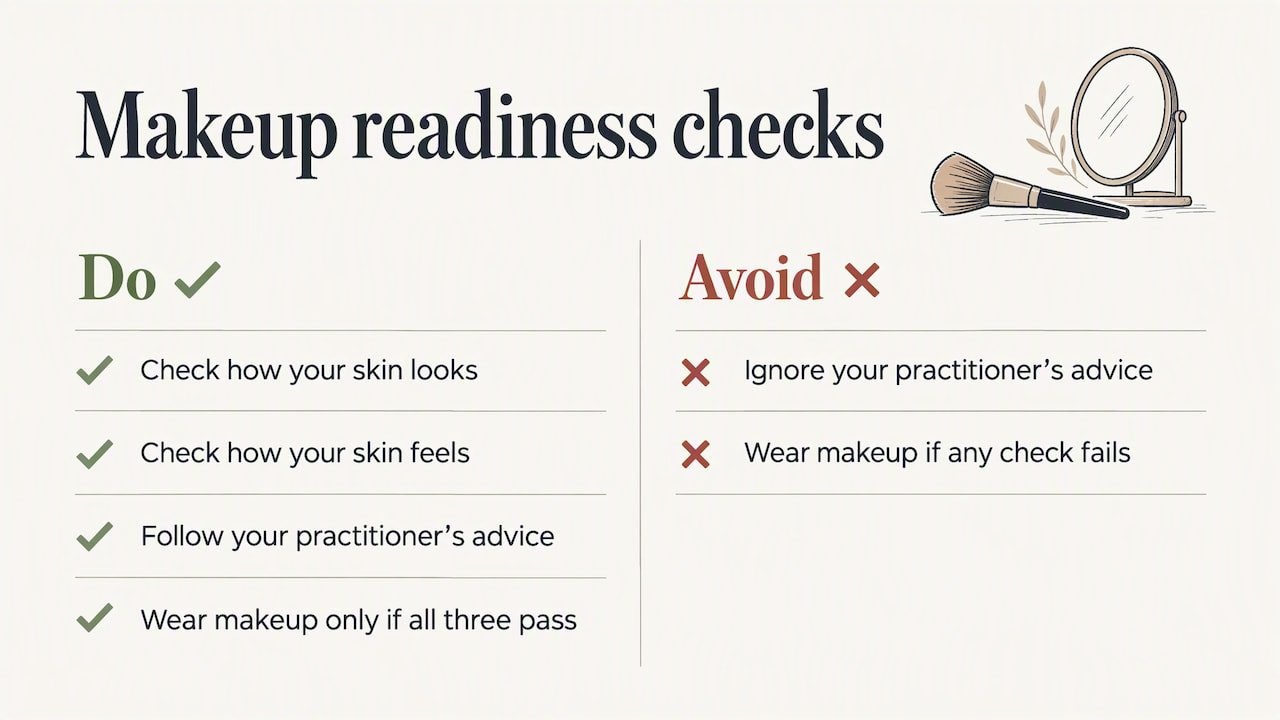
Instead of counting hours, run through these checks in a mirror in good daylight.
1. How does it look?
A little pinkness that is fading is common after facial treatments. Persistent, spreading or deepening redness, visible swelling, raised patches, or any area that looks scratched or broken is different. If you see those, leave makeup off and contact the clinic.
2. How does it feel?
Skin that feels comfortable, hydrated and normal to the touch is a good sign. Stinging, burning, itching or marked tightness when you touch or apply anything suggests it is not ready for cosmetics.
3. What were you told?
Your practitioner saw your skin before and after treatment. If they advised leaving makeup off for a while, follow that even if your skin looks fine. If they said light makeup is fine, you still have the first two checks to pass.
If all three are fine, you can wear makeup. If any one is not, wait and ask.
If you need to wear makeup the same day
Sometimes life does not allow a bare face: a work event, a family occasion, a photograph. If you plan a HydraFacial before a social event, it helps to book with plenty of time in hand rather than the same afternoon, and to tell your practitioner when you booked it. If you do need to apply makeup soon after treatment, a few habits reduce the risk.
- Start with sun protection and moisturiser, applied gently, not rubbed in.
- Choose fewer, lighter products. A tinted moisturiser or a light base is a kinder choice than full coverage foundation, setting powder and contouring.
- Pick products your skin already knows. The day after a facial is the wrong time to try a new foundation. Use things that have never irritated you.
- Avoid heavy fragrance and anything that stings on contact.
- Use clean tools. Wash brushes and sponges beforehand, or use clean fingertips. Old tools carry oil, product residue and bacteria.
- Do not press or rub. Pat or press the product on lightly.
- Skip fresh, strong exfoliating or active products underneath. Ask your practitioner about anything you normally use.
If you notice stinging at any point, take it off with a gentle cleanser and lukewarm water, and stop.

Sun protection comes before makeup
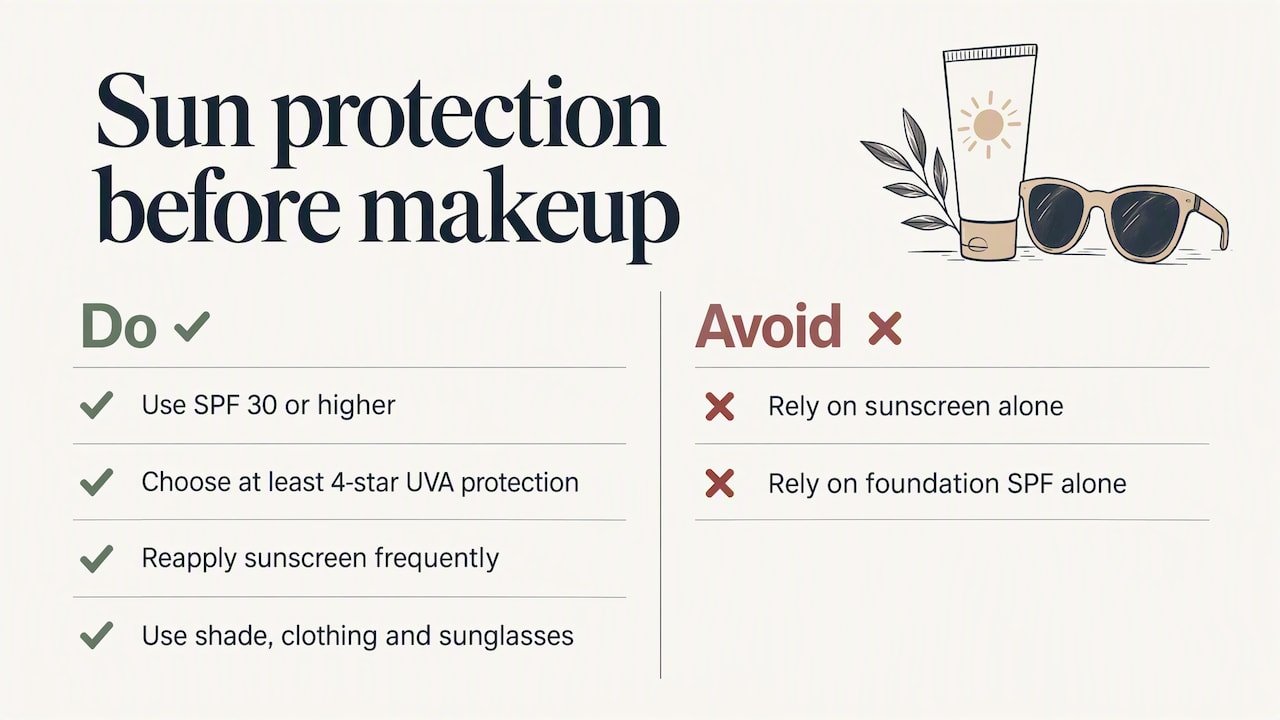
The thing worth thinking harder about than your foundation is your sunscreen. After a facial, many people sensibly want to keep their skin well protected, and in the UK that does not stop in winter, because UVA is present all year round.
The NHS advises using sunscreen with an SPF of at least 30 to protect against UVB and at least 4-star UVA protection, applying enough and reapplying frequently, and it points out that you should not rely on sunscreen alone: shade, clothing and sunglasses count too.
A practical point for makeup wearers: a foundation with SPF is rarely applied thickly enough to give the protection stated on the bottle, so a dedicated sunscreen underneath is a more dependable approach. Choose one with a gentle formula, and if you are unsure which suits skin that has just been treated, ask your practitioner rather than guessing.
Washing your face and removing makeup afterwards
People who search this question often ask about the washing side too. Once makeup is on, you need to take it off properly, and it matters more after a facial than on a normal evening.
- Use a gentle, non-abrasive cleanser and lukewarm rather than hot water.
- Avoid scrubs, cleansing brushes and harsh exfoliating products until your skin feels normal again.
- Pat dry with a clean towel instead of rubbing.
- Do not sleep in makeup. Residue sitting on the skin overnight is more likely to irritate and to block pores.
If you are prone to breakouts, this matters. The British Association of Dermatologists notes that oily skin care products and greasy moisturisers can cause or worsen acne, so heavy, oil-rich makeup and thick layers are worth avoiding if you are acne-prone. The same BAD page advises against picking or squeezing spots, which is worth remembering if your skin looks slightly congested after treatment and you are tempted to deal with it before applying foundation.
Choosing makeup that suits freshly treated skin
You do not need to buy a whole new makeup bag. Think in terms of properties instead.
| What to look for | Why it helps |
|---|---|
| Lightweight, non-greasy textures | Less likely to sit in recently cleared pores |
| Fragrance-free or low-fragrance | Fragrance is a common cause of skin irritation |
| Products you have used before | Removes the risk of a first-time reaction |
| Mineral or tinted formulas | Often lighter in feel and easier to remove |
| Clean, dry application tools | Reduces the chance of transferring bacteria |
Labels such as “hypoallergenic” or “non-comedogenic” are marketing terms and do not guarantee that a product will suit your skin, so treat them as a starting point, not proof. The best test is your own history with the product.
When makeup is not the right way to deal with what you see
It is natural to want to cover redness or a few blemishes before going out. For minor, short-lived pinkness, that is a personal choice once your skin passes the checks above. But some things should not be concealed and left.
- A rash, hives, blistering, crusting or oozing.
- Swelling, especially around the eyes or lips.
- Burning or pain that is getting worse rather than easing.
- A reaction that is spreading.
- Signs of infection such as heat, increasing soreness or pus.
These are reasons to contact the clinic promptly, or an appropriate health professional, rather than a reason to reach for concealer. If you ever feel unwell, have difficulty breathing or notice swelling of the face or throat, seek urgent medical help through NHS 111 or 999 as appropriate. Please do not try to treat a reaction yourself with leftover creams or home remedies.
Separately, if you have a long-standing mark, scar or skin difference that you want to conceal, there is a specialist field for that. The British Association of Dermatologists describes skin camouflage as a specialised technique using highly pigmented products to match your skin colour and conceal marks and scars. It is a different matter from everyday makeup after a facial, but worth knowing about if that is your concern.
Timing around other treatments and products
People often combine questions about makeup with questions about what else they can do. The honest advice here is again to ask, because the right answer depends on what you are using or having done.
- Retinoids and strong active skincare. Many people wonder when to restart these. Your practitioner can advise on timing for your skin and products. If you use a prescribed topical treatment, such as a retinoid-type medicine, follow the prescriber’s instructions and ask them before changing anything. The NHS leaflet on adapalene is an example of how these products are described, including that they are not generally recommended in pregnancy where other topical options exist.
- Other aesthetic treatments. If you plan to have injectable or laser treatment around the same time as a facial, tell each practitioner about the other so they can advise on sequencing. We do not give a fixed schedule here, because it depends on the treatment and the person.
- Medicines that affect your skin. If you take a medicine that changes how your skin behaves, such as isotretinoin, tell the clinic before any facial treatment so they can assess whether it is suitable for you.
- Pregnancy or breastfeeding. Mention it at consultation, as it can affect which products and treatments are appropriate.
These are not blanket rules. They are the conversations to have at your consultation.
A sensible plan for the day of your appointment
If you want a practical routine without a rigid timetable, this works for most people.
- Before you arrive, come with a clean face if you can, or be ready to have makeup removed. Tell your practitioner about any skincare actives, medicines, allergies and skin conditions.
- At the end of treatment, ask directly: “When can I put makeup on, and is there anything I should avoid?” Ask them to be specific for your skin.
- When you leave, apply sun protection if it is daylight and your practitioner is happy with it.
- Later that day, look at your skin using the three checks. If it is calm and comfortable and you were told it is fine, apply light makeup with clean tools. If not, wait.
- In the evening, remove everything gently and keep your routine simple.
- The next morning, reassess. Most people find that things look settled, but if you notice anything unusual, get in touch.
Doing it on your own skin: what we cannot tell you from a web page
We cannot see your skin from here. A general article cannot tell you whether your redness is normal, whether a product will agree with you or how long you should wait. What it can do is help you ask better questions and notice what matters. Results and skin responses vary from person to person, and a suitable plan comes from an individual assessment.
At Dermacy Clinic, treatments and recommendations depend on an individual assessment of suitability. Where a visual skin analysis is used, it is a visual aid that supports the consultation. It is not a diagnostic test, and it does not detect or diagnose disease.
Thinking about a HydraFacial in Doncaster?
If you are considering a HydraFacial and want to know what the treatment involves before you book, our HydraFacial page has the current treatment details, the options we offer and how to book. That is also where you will find up-to-date pricing. You are welcome to raise your makeup questions at your appointment, so you leave with advice that fits your skin and your plans for the rest of the day.
When to contact the clinic
Get in touch if:
- redness, swelling or stinging is not settling as you would expect, or is getting worse;
- your skin blisters, weeps, crusts or looks broken;
- you react to a product you applied afterwards;
- you are unsure whether a makeup product or skincare active is suitable;
- you have an event coming up and want to plan treatment timing around it.
For anything severe or sudden, or if you feel unwell, seek medical help through NHS 111 or, in an emergency, 999.
FAQ
Can I wear makeup straight after a HydraFacial?
Some people can, and some are advised to wait. It depends on how your skin looks and feels and on what your practitioner says after your treatment. If your skin is flushed or sensitive, leaving makeup off for a while is the more cautious choice.
Should I wash my face after a HydraFacial?
Yes, in the sense of cleansing gently at the end of the day, especially if you have worn makeup or sunscreen. Use a mild cleanser and lukewarm water, pat dry, and avoid scrubs or brushes until your skin feels normal. Ask your practitioner if they have specific instructions for your skin.
Can I use retinol after a HydraFacial?
There is no one answer, because it depends on the product, your skin and your treatment. Ask your practitioner when to restart it. If a retinoid was prescribed to you, follow your prescriber’s advice and check with them if you are unsure.
Is it safe to wear SPF foundation instead of sunscreen?
It is better to use a separate sunscreen. The NHS recommends SPF 30 or higher with at least 4-star UVA protection, applied generously, and foundation is rarely applied in the amount needed to match that. You can wear foundation over it if your skin is ready.
Sources
- Sunscreen and sun safety, NHS
- Acne, British Association of Dermatologists
- Skin camouflage, British Association of Dermatologists
- Isotretinoin, British Association of Dermatologists
- Adapalene gels and cream, Dorset County Hospital NHS Foundation Trust
Recommended
This article provides general information and is not a diagnosis or personalised medical advice. Treatment suitability, risks and expected outcomes require an individual consultation. Results vary.