Flat red, pink or brown marks left after a spot are usually not scars. Dents, pits or raised areas in the skin are. The difference matters because microneedling is mainly discussed for texture, not for colour, so the type of mark you have shapes what you can reasonably hope for. This guide explains how the two differ, why active acne changes the picture, and what to ask before an assessment. It cannot tell you which you have: that needs a qualified professional to look at your skin.
TL;DR
- Flat coloured marks (post-inflammatory pigmentation or erythema) are not true scars and often fade over time. Scars change the skin’s surface: dents, pits or raised areas.
- Microneedling is studied mostly for textural scars. Its effect on red or brown marks is less certain and varies from person to person.
- Active, inflamed acne, infection nearby or feeling unwell are reasons to wait or avoid treatment. Treating the acne itself comes first.
- Scar type, skin tone, medical history and medicines all affect suitability. Nobody can promise complete scar removal.
- At Dermacy Clinic in Armthorpe, Doncaster, the next step is a consultation, not a booking made on guesswork.
Table of Contents
- Why the difference between a mark and a scar matters
- What acne marks are
- What acne scars are
- A quick way to look at your own skin
- Can microneedling help marks and scars?
- Why active acne changes suitability
- Other reasons to delay or avoid treatment
- Questions to ask before an assessment
- How many sessions and how long before you notice a change?
- Preparing your skin
- What to expect afterwards
- Options when microneedling is unlikely to be the answer
- Where Dermacy Clinic fits
- FAQ
- Sources
Why the difference between a mark and a scar matters
People search “acne marks” and “acne scars” as if they were one thing. Clinically they are not, and they respond to different approaches.
A mark is a change in colour. A scar is a change in structure. If you run a fingertip over a post-spot mark, it usually feels as smooth as the skin next to it. If you run it over a scar, you may feel a dip, a pit or a firm raised bump. Light also tells you something: a textural scar often looks more obvious when light hits the skin from the side, while a colour mark stays visible in any light.
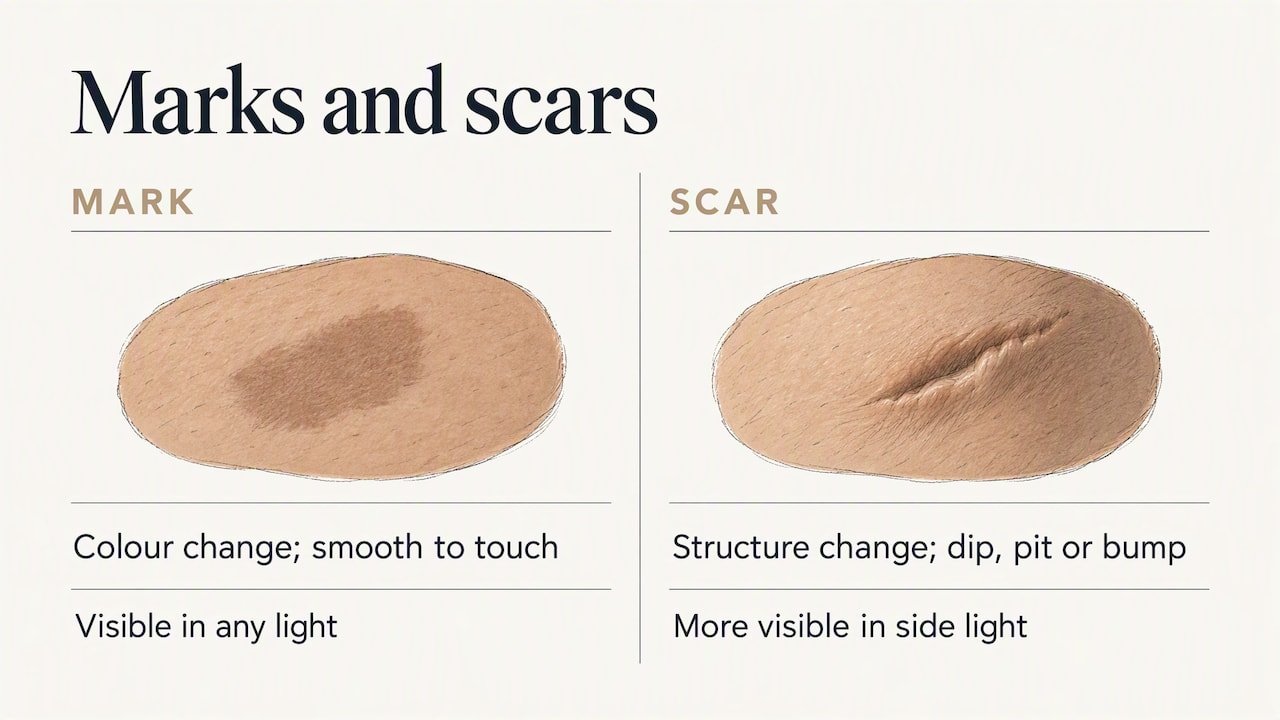
Getting this right before you spend money protects you from two disappointments. One is paying for a treatment aimed at texture when your main worry is flat brown spots. The other is assuming a mark is permanent when it may simply need time, sun protection and the right skincare.
What acne marks are
The American Academy of Dermatology describes post-inflammatory hyperpigmentation as a flat pigmented spot that can appear once acne clears. Its colour varies with skin tone, and it usually fades over time. The same source says these marks are not scars.
In practice that gives two broad groups of marks:
- Brown or dark marks (post-inflammatory pigmentation). These can look tan, brown or grey-brown depending on your skin tone. They are more noticeable and can last longer in some people, particularly if the skin is exposed to the sun.
- Red or pink marks. These follow inflamed spots and can linger for weeks to months. They sit flat on the skin.
Neither group involves a dent or a raised area. That is the key test, and it is why a mark and a scar are managed differently.
What tends to help marks
Because marks usually fade, the first line is often patience, daily sun protection and gentle skincare, and, where acne is still active, treating the acne. The British Association of Dermatologists advises that acne should be treated as soon as it appears to help avoid permanent scarring. The same BAD guidance notes that skin camouflage can disguise lingering pigment changes after acne has been treated.
If colour is your main concern, a consultation about pigmentation is a better starting point than a texture treatment. Our pigmentation treatment page explains how pigment concerns are approached, and that is a different conversation from scar texture.
What acne scars are
The AAD’s overview says acne scars may leave depressions or raised scars, and that discolouration often fades while the scar remains. That last point is worth sitting with: a scar and a mark can be on the same patch of skin, and the colour can settle while the texture stays.
The main groups are:
- Atrophic scars (indented). These form when skin loses tissue as a spot heals. A 2021 academic review lists boxcar, ice-pick and rolling scars as the major atrophic types. Boxcar scars have sharper edges, ice-pick scars are narrow and deep, and rolling scars give the skin a wavy look.
- Raised scars. These sit above the surface of the skin. They are less common on the face than indented scars, and they are not the typical target of microneedling. Anyone with a history of abnormal or raised scarring should say so at the start of a consultation (more on this below).
Many people have a mix. A cheek may carry a few shallow rolling scars, some pink marks from recent spots, and a couple of brown patches. Separating these is the real work of an assessment.
A quick way to look at your own skin
This is a self-observation exercise, not a diagnosis. It helps you describe your skin when you talk to a professional.
- Use daylight from the side. Stand near a window and turn your face so light skims across the cheek. Dents and ridges show up as shadows.
- Stretch the skin gently. Pull the skin to the side with two fingers. Shallow rolling scars often soften when stretched. Deeper boxcar or ice-pick scars tend to stay put.
- Run a fingertip over the spot. Flat and smooth suggests a mark. A dip or bump suggests a scar.
- Note the colour. Red or pink, brown, or the same as your usual skin tone.
- Check for new spots. If you still get breakouts in the area, say so. It changes the advice.
Do not squeeze, pick or scrub to “test” anything. Picking is one of the habits that can make marks last longer and may add to scarring.
Can microneedling help marks and scars?
Microneedling uses fine needles to make tiny punctures in the skin. The 2021 review describes this as triggering a wound-healing response, with collagen production and remodelling. That is why it is discussed mostly for textural change.
Texture: the stronger case
An NHS hospital patient leaflet says microneedling can improve scar texture and even out altered pigment in scars, but that responses vary and scars will not disappear. A study of patients with dark skin reported that microneedling improved acne scars and associated pigmentation, and noted that further treatments might be needed to improve the pigmentation.
That wording is careful for a reason. Improvement is the realistic aim. Smoothing, softening and a more even look are reasonable things to discuss. A flawless result is not.
Colour: a weaker and less certain case
A flat red or brown mark has no dent to remodel. Pigment concerns can respond to other approaches, and marks often fade without any procedure. The same study found pigment might need further treatment after microneedling, which suggests colour is not the strongest reason to choose it. If your main complaint is colour, ask in the consultation whether microneedling is the right tool or whether something else suits better.
Does scar type change the outcome?
The review found that evidence on outcomes by scar type is inconclusive. Some studies found greater improvement for rolling scars and the least for ice-pick scars. Take that as a rough guide, not a rule. Deep, narrow ice-pick scars are often considered harder to improve with this approach, and a professional may talk about other methods for them.
Why active acne changes suitability
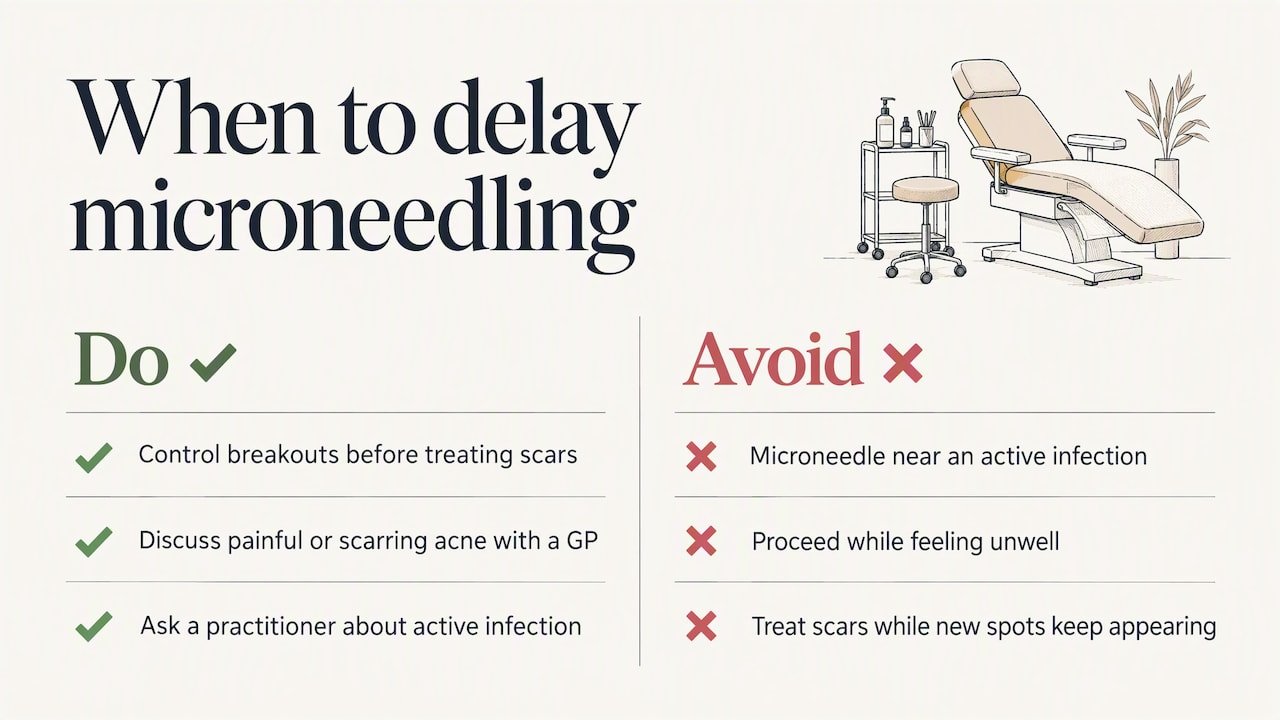
This is the part many articles skip. If you have active, inflamed acne, microneedling may not be appropriate yet.
The British College of Aesthetic Medicine says microneedling is not recommended if you have an active infection near the treatment site or are feeling unwell. Inflamed, pus-filled spots can be a skin infection or at least an irritated area, and making micro-punctures through them is a risk that a practitioner will want to weigh up carefully.
There is a second reason to settle acne first. Scars come from inflammation. If new spots keep appearing, they can keep leaving new marks and new scars, and any improvement from treatment can be undone. BAD guidance is to treat acne early to help avoid permanent scarring, and it is the sensible order of events: control the breakouts, then address what they left behind.
If you are still breaking out, a conversation about acne itself is the better first step. Our guide on what causes adult acne and the options for it covers that ground. For significant, painful or scarring acne, a GP or dermatologist can discuss prescription treatments, which only a prescriber can decide on.
Other reasons to delay or avoid treatment
BCAM lists further situations where microneedling is not recommended:
- a history of abnormal scarring
- a poorly controlled medical condition
- bleeding disorders
- autoimmune disease
- taking steroids or medicines that affect bleeding
These are the reasons a consultation includes questions about your medical history and medicines. Answer them fully, including anything you take over the counter or buy online. A suitable professional will decide whether to go ahead, wait or recommend something else. That decision should not be rushed to fit a booking.
Questions to ask before an assessment
Going in prepared makes the consultation more useful. Consider asking:
- Are my marks flat colour, textural scars or both? Ask the practitioner to point out which is which on your own skin.
- Is my acne settled enough for treatment? If not, ask what should happen first and for how long.
- What type of scars do I have, and does that change what is realistic? Rolling, boxcar and ice-pick scars do not behave identically.
- Is microneedling the right option, or would something else suit my concern better? A good answer may include other approaches or no treatment at all.
- Does my medical history or any medicine I take affect suitability? Mention any tendency to scar badly, any autoimmune condition and any blood-thinning medicine.
- How many sessions might be needed, and how will progress be judged? Ask how change will be recorded, for example with photographs taken in the same lighting.
- What are the risks for my skin tone? The NHS leaflet lists infection and pigment changes among risks, so ask how they apply to you.
- What does the aftercare involve in practice? Know the sun protection and activity restrictions before you book, so you can plan around work and holidays.
Write your answers down. If you cannot get a straight answer to any of these, that is useful information too.
How many sessions and how long before you notice a change?
Treat any number you see online as a rough range. The NHS hospital leaflet says that normally 4 to 6 sessions are required, at least 6 weeks apart, and that improvement may take up to 3 months or more than one treatment to notice. Another provider’s marketing page may quote 3 to 6 sessions, and that is a reminder that the figure depends on your skin and scar type.
Two practical points follow. First, microneedling is not a one-visit fix for scars. Second, collagen remodelling is slow, so judging results after a week is misleading. Photographs taken at the start and at intervals are more reliable than memory.
At Dermacy Clinic, session numbers and spacing are decided after assessment and are not fixed in advance. Results vary.
Preparing your skin
An NHS pre-treatment leaflet advises having your scars assessed and completing the pre-treatment checklist. It also advises avoiding fake tan, sunbathing and unprotected sun for 7 days beforehand, and attending without makeup on the treatment area.
Sun matters here for a plain reason: tanned or sunburnt skin is more reactive, and sun exposure can darken marks. Your own practitioner may give different or additional instructions, and theirs take priority over general advice.
What to expect afterwards
The NHS leaflet describes redness and warmth for 1 to 2 days, pain or tightness for 1 to 3 days, and possible pinpoint bleeding. It lists infection and pigment changes among the risks. Its aftercare advice includes keeping the area clean, avoiding heat, swimming, exercise and makeup for 72 hours, and avoiding the sun for 7 days while using sunblock.
BCAM’s guidance is shorter, advising avoidance of sun exposure, sunbeds and vigorous exercise for 48 hours. The two differ, which shows that protocols vary between providers. Follow the instructions you are given, and contact the clinic that treated you if something looks wrong. If you notice spreading redness, increasing pain, pus or feel unwell, seek medical advice promptly rather than treating it yourself.
Options when microneedling is unlikely to be the answer
Sometimes the honest answer is that another route suits your skin better. BAD lists several options for scarring, including steroid injections, chemical peels and subcision, and notes that laser resurfacing is established but not usually available on the NHS. Which one fits depends on scar type, and some need a doctor or dermatologist.
For lingering colour after acne, BAD says skin camouflage is an inexpensive and effective non-invasive way to disguise pigment changes. For deeper, ice-pick or raised scars, or if scarring is severe, a GP referral to a dermatologist is a sensible route. The American Academy of Dermatology advises seeing a medical doctor with expertise in skin and cosmetic procedures, such as a board-certified dermatologist, for microneedling. That is American wording, and in the UK the equivalent step is asking about your practitioner’s training and registration, and being clear about who is responsible for your care.
Where Dermacy Clinic fits
If you are in Armthorpe, Doncaster or nearby and want to know which of your marks are colour and which are texture, the practical start is an assessment. Dermacy Clinic offers a visual skin analysis, which is listed at £30. It is a visual assessment that supports the consultation and progress photographs. It is not a diagnostic test, and it does not detect or diagnose disease.
If microneedling looks suitable after that conversation, the microneedling page has the current service details and the route to book. If your concern turns out to be mostly colour, the pigmentation page linked above is a better fit. You can see how the clinic describes its other services on the Dermacy Clinic site.
Recommendations depend on individual suitability, and results vary.
FAQ
Can microneedling remove acne scars completely?
No. An NHS hospital leaflet says responses vary and scars will not disappear. Microneedling is generally discussed as a way to improve the look and feel of textured scars, and the degree of change depends on scar type, skin and the number of sessions.
Does microneedling help red or brown acne marks?
It is not the strongest option for flat colour. Studies on scars report some improvement in associated pigmentation, but a study in darker skin noted that further treatment may be needed for pigment. Many marks also fade by themselves, so a consultation about pigmentation may serve you better.
Can I have microneedling if I still get spots?
It depends on how active and inflamed your skin is. Professional guidance advises against microneedling near an active infection or when you are unwell, so a practitioner may ask you to settle the acne first. Ask about this at your assessment.
How do I know if I have a mark or a scar?
A mark is flat and smooth to the touch and is just a change in colour. A scar leaves a dip or a raised area. Looking at your skin in side light can help, but only a qualified professional can assess your skin and say which you have.
How long should I wait between sessions?
The NHS hospital leaflet describes at least 6 weeks between sessions, with improvement sometimes taking 3 months or more. Your practitioner will advise on timing for your skin.
Sources
- AAD: Acne scars, signs and symptoms
- AAD: Acne scars, overview
- AAD: Microneedling can fade scars, uneven skin tone, and more
- BAD: Acne patient information leaflet
- BCAM: Microneedling
- Chelsea and Westminster NHS: Microneedling post-treatment information
- Chelsea and Westminster NHS: Microneedling pre-treatment information
- PubMed: Skin microneedling for acne scars associated with pigmentation in patients with dark skin
- PMC: Microneedling in the treatment of atrophic scars
Recommended
- Microneedling Doncaster
- Acne Scar Treatment Doncaster
- What Causes Adult Acne | Treatment Options Explained
This article provides general information and is not a diagnosis or personalised medical advice. Treatment suitability, risks and expected outcomes require an individual consultation. Results vary.