Sun damage on the face is not one problem. It can mean brown marks and uneven tone, rough or fine-lined skin, or dry, scaly patches that need medical attention. Which treatment helps depends on which of these you have, so the first step is working out what you are looking at. Cosmetic treatments can improve some sun-related pigmentation and texture. They cannot repair every sign of sun damage, they cannot reverse it completely, and they are not a way to check a mark that worries you.
This guide is for adults in Armthorpe, Doncaster and across South Yorkshire who have noticed lasting marks or roughness on their face and want to know where to start.
TL;DR
- “Sun damage” covers flat brown marks, uneven tone, texture changes and scaly patches. Only some of these are cosmetic.
- Rough, scaly, crusty, bleeding, fast-growing or non-healing patches should be seen by a GP before any beauty treatment.
- Persistent brown pigmentation may suit a cosmetic programme such as Cosmelan, but only after an in-person assessment. It is not right for all sun damage.
- Treatments can soften and fade marks. Results vary, and none of them undoes years of UV exposure.
- Daily broad-spectrum sunscreen, applied generously, matters more than any single treatment.
Table of Contents
- What “sun damage” actually means on a face
- Sun spots, melasma or something else?
- When to see your GP before anything else
- The medical route for scaly sun-damaged patches
- Cosmetic options for brown marks and uneven tone
- Where Cosmelan fits, and where it does not
- What happens at a pigmentation consultation
- Realistic expectations
- A sensible order of steps
- Book a pigmentation assessment at Dermacy Clinic
- FAQ
- Sources
What “sun damage” actually means on a face
Ultraviolet (UV) light harms skin cumulatively. The British Association of Dermatologists describes daily photoprotection as a long-term strategy rather than something only for hot holidays, and that is as true in Yorkshire as on a beach. Years of ordinary daylight, outdoor work, sunbeds and the odd burn all add up.
On the face this tends to show in three ways:
- Pigment changes. Flat brown spots, patchy darkening and uneven colour, often over the cheeks, forehead and upper lip. After sun exposure, pigment cells make more melanin to absorb UV, as an NHS patient information sheet explains. Over time that response can leave marks that stay.
- Texture and ageing changes. Fine lines, a rougher feel, loss of firmness. Photoageing is linked to structural collagen loss, according to the same BAD guidance.
- Precancerous patches. Dry, scaly or crusty areas called actinic (solar) keratoses. These are the ones that need a medical route rather than a cosmetic one.
Many faces show a mixture. That is why a mark that looks like a “sun spot” should be judged, not assumed.
Sun spots, melasma or something else?
These are the usual patterns, described in plain terms. They are a guide for conversation, not a diagnosis, and you cannot reliably sort your own skin from a mirror.
| What you notice | Common explanation | Usual route |
|---|---|---|
| Small, flat, evenly brown marks on cheeks, temples or forehead, which have been there a long time | Sun-related pigmentation (often called sun spots or age spots) | Cosmetic assessment is reasonable, once any doubtful mark has been ruled out |
| Larger, blotchy, symmetrical patches, often worse after sun | Possibly melasma, which hormones and UV can both influence | Individual assessment, then a plan that includes strict sun protection |
| Rough, dry, scaly or crusty patch, sometimes easier to feel than see | Possible actinic keratosis | GP first |
| A mark that has changed in size, shape or colour, bleeds, itches, or does not heal | Needs medical assessment | GP promptly |
| Brown marks that appear after spots or inflammation | Post-inflammatory pigmentation | Assessment; treatment depends on the cause |
The NHS explains that actinic keratoses are dry, scaly patches of sun-damaged skin. They are not usually serious, but there is a small chance of them becoming skin cancer. They can be rough enough to feel like sandpaper, and they are common on the face, ears, bald scalp, neck and backs of the hands.
When to see your GP before anything else
This is the part that should come before any facial, peel or laser appointment. Book a GP appointment if a patch on your face:
- is painful, itchy or tender,
- is growing quickly,
- bleeds, crusts or forms a sore that does not heal,
- has changed in size, shape or colour.
The NHS advice on actinic keratoses lists these as reasons to be checked, and Cancer Research UK explains what to expect when you see your GP about a skin change. Most squamous cell skin cancers appear on skin that is often exposed to the sun, such as the head, neck, forearms and backs of the hands, according to Cancer Research UK.
A cosmetic treatment should never stand in for that check. Peeling, lasering or needling over a lesion that has not been assessed could hide a change you needed to have looked at. At Dermacy Clinic the visual skin analysis is an aid to consultation and photographic records. It is not a diagnostic test and it does not detect skin cancer or any disease. If something looks as though it needs medical review, we will say so and suggest you speak to your GP.
The medical route for scaly sun-damaged patches
If your GP or a dermatologist confirms actinic keratoses, treatment sits in healthcare, not in a beauty clinic. The BNF treatment summary on photodamage and the NHS describe several approaches, chosen by the number and position of the patches:
- Cryotherapy, which freezes individual lesions.
- Prescription creams such as fluorouracil, imiquimod or diclofenac, for wider areas.
- Photodynamic therapy (PDT), where a cream is applied and activated by light. Some NHS trusts offer daylight PDT for mild to moderate lesions on the face and scalp.
- Surgical removal, for lesions that need it.
These treatments can be demanding. The BAD leaflet on 5-fluorouracil cream says the skin becomes inflamed during treatment, with redness, soreness and crusts, because the cream targets damaged cells. That reaction is part of the process, and it is why this is supervised by a prescriber, not something to try from an article.
We do not provide or recommend prescription treatments for these patches, and nothing here is a substitute for advice from the clinician who has examined your skin.
Cosmetic options for brown marks and uneven tone
Once a doctor is comfortable that a mark is a benign sun-related one, or you have only general uneven tone, there are cosmetic routes. None of them is a cure and results vary from person to person.
Daily protection and topical care
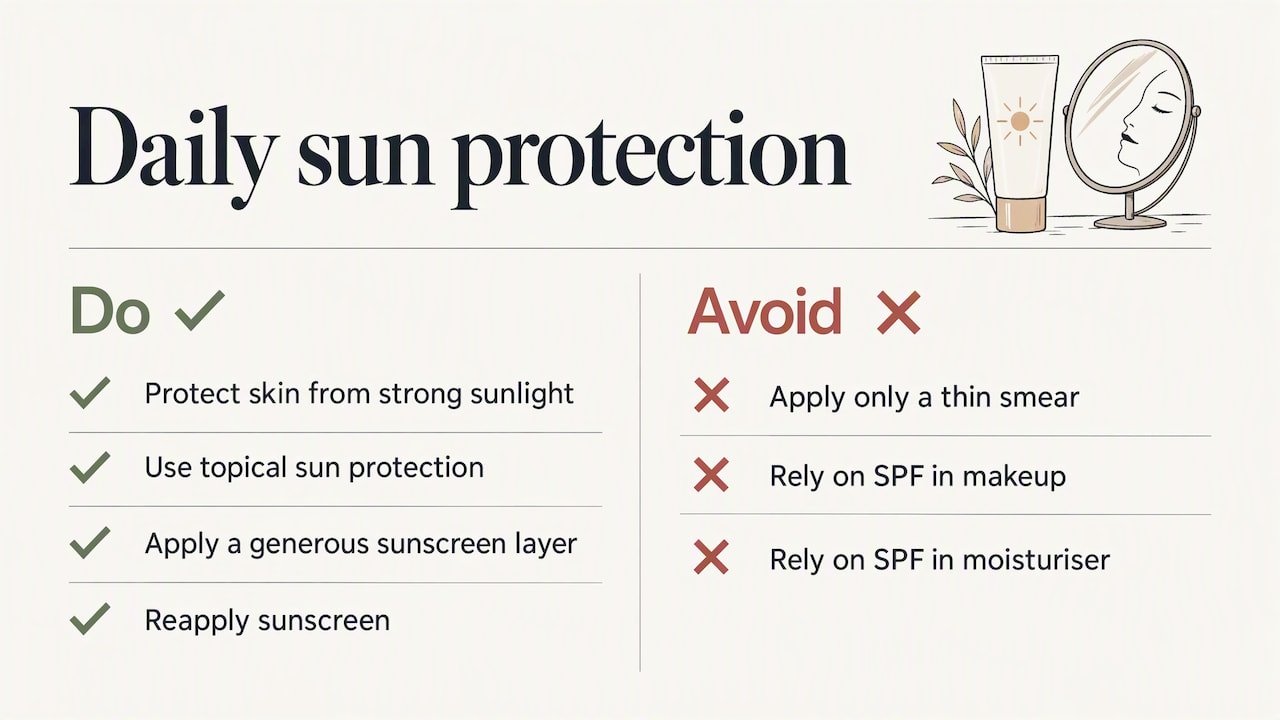
Every plan starts here, because pigment tends to return or darken when the skin is unprotected. The BNF advises that people should be advised on protecting their skin from strong sunlight, including topical sun protection. Other topical ingredients such as vitamin C, retinoids or exfoliating acids are widely used in skincare. Which of these suits you depends on your skin type, sensitivity and what else you use, so it is a question for an assessment rather than a shopping list.
How much sunscreen you use matters. The Frimley Health fact sheet says an average adult needs about 35 mL for full-body coverage to reach the stated SPF, and most people use far less. For the face alone that means a generous layer, reapplied, not a thin smear. Relying on the SPF in make-up or a moisturiser is rarely enough.
Chemical peels
Superficial peels remove the outer layer of skin and can improve tone and texture. People often ask whether a peel will remove sun damage. The honest answer is that it can refresh the surface and lighten some surface pigmentation, but the BNF-based research we checked says results for specific actinic keratosis lesions vary, so a peel is not a treatment for scaly patches. Deeper sun-related change often needs more than one approach.
Microneedling
Microneedling is used to improve texture and, alongside topical products, some types of pigmentation. A systematic review of microneedling for melasma found it improved melasma severity when combined with topical agents, with the best results seen over about 12 to 16 weeks. That is a finding about melasma, not a promise for every sun mark. If you want to know more about the technique, our microneedling page explains what we offer.
Light-based treatments
Intense pulsed light and lasers are often discussed for sun spots and broken capillaries, and several clinics publish pages on them. We do not offer a sun-spot laser or IPL service, so we will not suggest that one of our treatments does that. What we do offer for pigmentation is described below.
Where Cosmelan fits, and where it does not
Cosmelan is a professional depigmenting programme that combines an in-clinic mask with a home regime. At Dermacy Clinic it is one of our pigmentation programmes, and it is considered only after an assessment of your skin. It is not a treatment for all sun damage.
It can be a reasonable thing to discuss if:
- you have persistent brown pigmentation, such as melasma or long-standing sun-related marks, that has not responded to over-the-counter products,
- any scaly, changing or bleeding lesion has already been looked at by a doctor,
- you are prepared to follow a strict daily sun-protection routine.
It is not the answer if:
- the patch is rough, crusty or scaly (see your GP),
- a mark is new or changing,
- your skin is currently inflamed or broken,
- the concern is fine lines or lost firmness, which are different problems.
Suitability is individual, and some people will be told it is not right for them or that another approach comes first. We do not publish an outcome for any one person because results vary. For what the programme involves and current details, see our Cosmelan page. For the wider picture of how we approach melasma and dark spots, our pigmentation treatment page is the place to start.
What happens at a pigmentation consultation
The aim of a consultation is to decide what you are dealing with and what is sensible, not to sell a course on the spot. In general you can expect:
- A conversation about your history. How long the marks have been there, whether they have changed, your sun habits, sunbed use, medicines, pregnancy or breastfeeding, and what you have already tried.
- A look at your skin. We examine the area in person and may use the visual skin analysis to support the discussion and to record progress photographs. It is a visual aid and not a diagnostic test, and we do not claim every plan uses it.
- A decision about the next step. That might be a pigmentation programme, a simpler skincare plan, treatment to prepare the skin, or advice to see your GP first.
- A realistic conversation about limits. Which marks may fade, which may not, how long improvement can take and how likely they are to return without sun protection.
The skin analysis is listed on our site at £30 as a one-off. Check the page for the current price before you book.
Realistic expectations
A few truths are worth hearing before you spend money on any treatment for sun-damaged skin:
- Reverse is a strong word. Treatments can fade marks and improve texture. They do not remove the cumulative UV exposure your skin has had, and new damage can add to the old.
- Time matters. Studies on microneedling and melasma looked at results across several months, not days.
- Some treatments are not pretty in the middle. Medical field treatments can mean redness, soreness and crusting for weeks, and cosmetic programmes can involve peeling and dryness. Plan around that.
- Recurrence is common. Without daily protection, pigment can come back.
- Not everyone is suitable. Your skin type, health, medicines and what you are hoping for all shape the advice.
A sensible order of steps
- Look honestly at what you have. If any patch is scaly, crusty, bleeding, painful, growing or changing, book your GP first.
- Start daily broad-spectrum sunscreen on the face, applied generously, and keep it up through the year.
- Avoid sunbeds and avoid picking at or scrubbing marks.
- Once any doubtful lesion has been seen by a doctor, arrange an assessment for persistent pigmentation or texture concerns.
- Agree a plan you can sustain, with realistic timescales.
Book a pigmentation assessment at Dermacy Clinic
If your concern is long-standing brown pigmentation and you would like an individual view on what could help, Dermacy Clinic in Armthorpe, Doncaster offers consultations with visual skin analysis and progress photographs. Read the Cosmelan page for the current service details and booking route, or browse the Dermacy Clinic blog for other supporting guides. Our recommendations depend on assessment, and results vary.
FAQ
Can sun-damaged skin on the face be reversed?
Not fully. Treatments can fade some pigmentation and improve texture, and daily sun protection stops things getting worse. But the underlying cumulative UV exposure cannot be undone, and some changes, including precancerous patches, need medical management. Results vary from person to person.
Will a chemical peel remove sun damage?
A peel can refresh the surface and lighten some superficial pigmentation, but it is not a treatment for scaly sun-damaged patches. Evidence for specific actinic keratosis lesions varies, so any rough or crusty patch should be seen by a GP first. A peel is a cosmetic option for tone and texture once that is ruled out.
What is a scaly sun spot?
A dry, rough or scaly patch on sun-exposed skin may be an actinic keratosis, which the NHS describes as sun-damaged skin with a small chance of becoming skin cancer. It is often easier to feel than see. Have it assessed by your GP, particularly if it bleeds, grows, hurts or does not heal.
Is Cosmelan suitable for all sun damage?
No. It is a pigmentation programme considered only after assessment, and it is not for scaly patches, changing marks or skin that is inflamed or broken. Suitability, expected improvement and aftercare are all discussed individually, and some people will be advised against it.
How do I protect my face from further sun damage?
Use a broad-spectrum sunscreen every day, applied generously and reapplied, and add shade and a hat in strong sun. NHS information notes that most people apply too little, so a thin layer gives less protection than the number on the bottle. Avoid sunbeds altogether.
Sources
- NHS: Actinic keratoses
- BNF: Photodamage treatment summary
- British Association of Dermatologists: How to reduce the risk of getting skin cancer
- British Association of Dermatologists: 5-fluorouracil cream
- Cancer Research UK: Seeing your GP
- Cancer Research UK: New study on skin cancer prevention
- Cambridge University Hospitals: Daylight photodynamic therapy
- Frimley Health NHS Foundation Trust: Sunscreen fact sheet
- PubMed: Microneedling for melasma, systematic review
Recommended
- Pigmentation Treatment Doncaster | Melasma & Dark Spots
- HydraFacial Explained | Steps, Results and Aftercare
This article provides general information and is not a diagnosis or personalised medical advice. Treatment suitability, risks and expected outcomes require an individual consultation. Results vary.