Peeling after Cosmelan is a reaction of the skin to the treatment, not a score for how well it is working, and the homecare phase is where most of the avoidable problems start. Homecare is personalised: your practitioner decides what you apply, where, how often and for how long, based on your skin and how it responds. This article does not give you a schedule. It explains what to expect, what tends to go wrong, and which questions to put to the person treating you.
It is written for adults in Armthorpe, Doncaster and the surrounding area who are considering Cosmelan or are partway through a programme. It does not replace the instructions you are given, and it is not a diagnosis of any skin condition. If you want the programme itself explained, our Cosmelan service page covers it, including current details and booking.
TL;DR
- Peeling and redness are common reactions to a strong depigmenting programme, but a bigger peel does not mean a better result.
- Homecare is set by your practitioner and adjusted to your skin. Do not copy someone else’s routine or a schedule from a forum.
- Rubbing, scrubbing or picking at flaking skin can irritate it and may trigger more pigment, not less.
- Daily sun protection is the foundation of long-term pigment control. The British Association of Dermatologists recommends broad-spectrum SPF 30 or higher with high UVA protection.
- Contact your practitioner early about anything that worries you: persistent redness, pain, blistering, or darker patches appearing.
Table of Contents
- What Cosmelan homecare is actually for
- Why homecare is not one size fits all
- Peeling: what is normal and what is not
- Sun protection: the part that decides long-term results
- The consultation should happen before treatment day
- Questions to ask your practitioner
- Common homecare mistakes
- Realistic expectations and the long view
- Starting with Dermacy Clinic
- FAQ
- Sources
What Cosmelan homecare is actually for
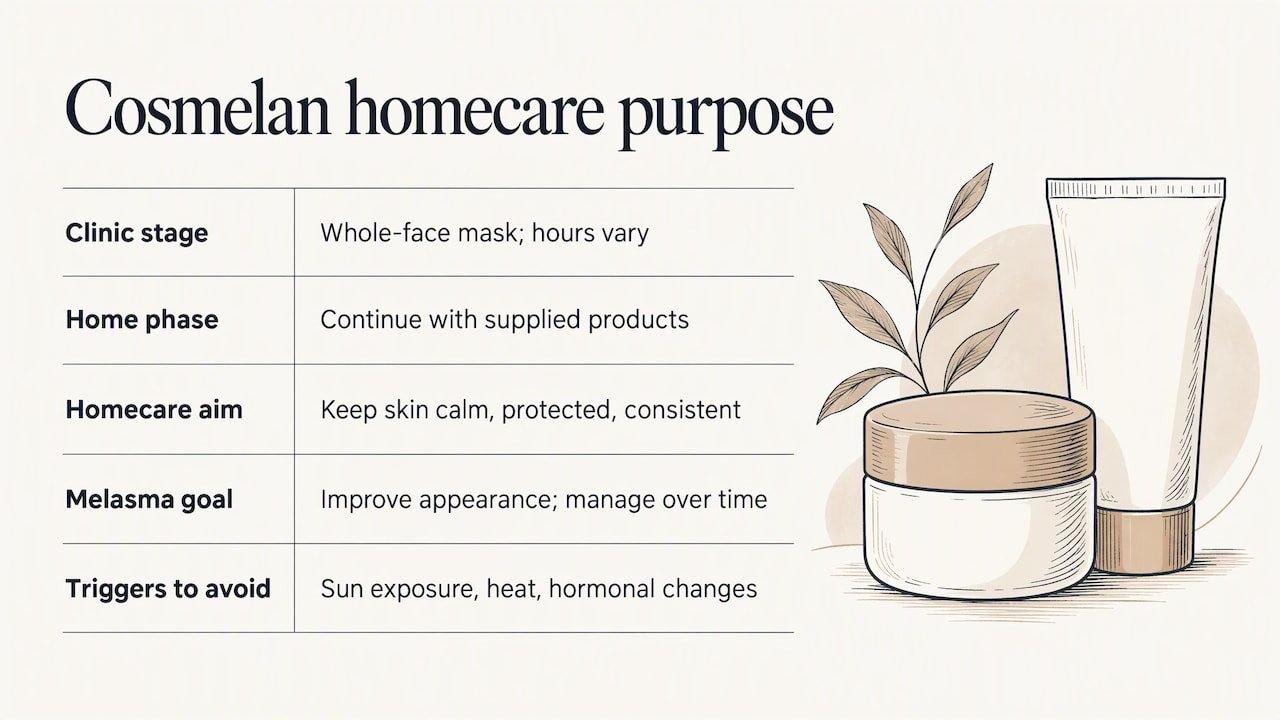
Cosmelan is a two-part approach. A professional application is made in clinic, and then you continue at home with products you have been given. The in-clinic stage is only the start. The manufacturer’s own method document describes a mask applied to the entire face, not just the pigmented areas, and left on for several hours depending on the severity of the pigmentation and the skin’s characteristics. That tells you something useful: even the professional stage is individualised, and the home phase is designed to carry on the work.
The aim of homecare is to keep the skin calm, protected and consistent while the treatment does its job and while the skin recovers. It is not to speed things up. When people run into trouble, it is usually because they treated homecare as a race.
It also helps to be realistic about what pigmentation is. For melasma in particular, the British Association of Dermatologists (BAD) states there is no cure. Treatment aims to improve appearance and manage the condition over time, and success depends heavily on avoiding triggers such as sun exposure, heat and hormonal changes. Results vary from person to person, and a programme should be seen as a commitment, not a quick fix.
Why homecare is not one size fits all
Two people can walk out of the same clinic with the same product box and need quite different instructions. Your practitioner may adjust how often you use a home product, or advise a pause, depending on how your skin looks and feels. The things that influence that decision include:
- how reactive or dry your skin is at baseline
- your skin tone and how easily it darkens after irritation
- the type and depth of your pigmentation
- other products or medicines you use
- your sun exposure, work and lifestyle
- how your skin responded in the first days after the clinic application
This is why we will not print a timetable here. Any universal schedule, whether it says to apply every second night or stop after a fixed number of days, ignores the very factors your practitioner is assessing. A routine that suits one person can over-treat another, and over-treated skin can respond with inflammation and rebound pigmentation, particularly in skin that tans easily or is prone to post-inflammatory hyperpigmentation. That is the opposite of what you are paying for.
If something in your written instructions is unclear, ask. A short message to the clinic is better than guessing.
Peeling: what is normal and what is not
Most people expect some peeling. Redness, tightness, dryness, flaking and a sensitive feel are widely described after strong depigmenting peels. How long this lasts and how visible it is differs between people. Clinics describe everything from a few days to several weeks, so any single figure you read online should be treated as one person’s or one clinic’s experience rather than a rule.
The most important thing to understand is that peeling is a side effect of the process. It is not proof the treatment is working, and a lack of visible flaking is not proof that it is failing. Some people peel heavily and see modest change. Others peel lightly and are pleased. Chasing a dramatic peel is a mistake.
What to leave alone while your skin flakes
The temptation is strong, but these habits are the ones practitioners most often ask people to avoid:
- Picking or pulling flakes. Skin that is not ready to come away can be torn, leaving raw patches that are open to infection and more likely to darken as they heal.
- Rubbing or scrubbing. Pressure when applying a home cream increases how deeply it exfoliates and can cause unexpected irritation. Apply exactly as shown to you, without massaging it in harder.
- Adding your own exfoliation. Scrubs, brushes, cleansing devices and extra acids on top of a programme can push the skin beyond what it was meant to tolerate.
- Using old products out of habit. Retinoids, exfoliating acids and strongly active products were probably paused for a reason. Do not restart anything without checking when your practitioner wants it back.
- Hot environments. Heat is a recognised melasma trigger according to BAD, so saunas, hot yoga and very hot showers on your face are worth raising with your practitioner.
Gentle care is the theme. Your practitioner will tell you which cleanser and moisturiser suit the stage you are in. Ask for them by name rather than choosing your own.
Peeling versus a skin problem
There is a difference between expected reactions and signs that something is wrong. Contact your practitioner, or seek urgent medical help if you feel unwell, if you notice:
- pain that is increasing rather than settling
- blistering, weeping, crusting or yellow discharge
- swelling of the face or around the eyes
- redness that is spreading or not improving as you were told to expect
- new dark patches, or patches that are noticeably lighter than the surrounding skin
- any reaction you were not warned about
We are not going to tell you how to treat these yourself. Chemical peels and depigmenting treatments carry recognised risks, including darker or lighter patches, scarring and infection, and UK local authority guidance on aesthetic procedures stresses that a proper consultation should cover how complications would be handled. If a reaction feels wrong, the person who treated you needs to see it, ideally with a photograph of how it looked when it started. If you cannot reach them and are worried, speak to your GP, a pharmacist or NHS 111.
Sun protection: the part that decides long-term results
If there is one thing to take from this article, it is that sun and light protection is not an optional extra. Pigment-producing cells are easily stimulated, and fresh, recovering skin is more vulnerable.
BAD recommends broad-spectrum sunscreen of SPF 30 or above with a high UVA rating, applied daily and reapplied about every two hours, and more often after swimming or sweating. It also points out that sunscreens containing iron oxides give better protection against visible light, which is relevant for melasma. Cloud cover does not remove the need, and neither does staying mostly indoors near a bright window.
Some practical points to raise with your practitioner:
- Which sunscreen should I use at each stage? Skin that is peeling may not tolerate every formula, and a tinted, iron oxide product can be a good fit, but ask rather than assume.
- How do I combine it with my other homecare? Order of application matters, and your practitioner can tell you where sunscreen sits in your routine.
- What about hats and shade? Physical protection works alongside sunscreen, and they matter more in summer and on holiday.
- What about my commute or screen time? Ask whether your daily habits change the advice.
- What should I do if I get caught in strong sun? Ask what they want to hear about, and when.
Timings matter too. If you have a holiday, wedding or event coming up, say so at your consultation. Planning around the sun is far easier before treatment than during recovery. Our article on sun damage on the face explains how sun exposure relates to pigmentation more broadly.

The consultation should happen before treatment day
Homecare adherence starts with understanding. You cannot follow instructions you have only half taken in while sitting in the treatment chair. The UK council guidance on aesthetic procedures warns against same-day treatment and says a proper consultation should leave time to review your history, assess your skin and discuss how complications would be managed. The same guidance says that where a prescription product is involved, it must be prescribed specifically for you, which takes time.
That is why a Cosmelan journey begins with a consultation. At Dermacy Clinic, a visual skin analysis can be part of that conversation. It is a visual assessment that supports the consultation and provides progress photographs for comparison. It is not a diagnostic test, it does not detect disease, and not every treatment plan uses it. Your practitioner will decide what is appropriate for you.
Questions to ask your practitioner
Take this list to your consultation, or message the clinic if you are already on a programme. Write the answers down, or ask for them in writing.
Before treatment
- Is my pigmentation the type this programme is suited to, and what are the realistic limits?
- Do my medicines, contraception, hormone treatment, pregnancy plans or breastfeeding affect whether this is suitable? (Never stop prescribed medicines on your own account. Ask your prescriber.)
- Which of my current products must I stop, and when can I restart each of them?
- How should I prepare my skin, and for how long?
- What will I need to buy or be given for homecare, and what does the written plan look like?
- Are there dates in my diary, such as holidays, weddings or sports, that make this a poor time?
During the peeling phase
- What should my skin look and feel like at this stage, with photographs if possible?
- How exactly should I apply the home product, including where to avoid, such as around the eyes, corners of the nose and mouth?
- What should I use to cleanse and moisturise, and how often?
- What reactions mean I should pause and call you?
- How do I reach you out of hours or at weekends?
- Can I wear make-up, and if so which?
After the peeling settles
- When and how do I move to maintenance, and who decides?
- What do I do to protect results over the next year?
- What is the chance that pigmentation returns, and what would trigger it?
- When should I have a review, and will you compare it with earlier photographs?
- If I want another treatment later, how long should I wait, and is a repeat suitable for me?
Common homecare mistakes
These come up repeatedly in conversations about strong pigment programmes, and they are all avoidable.
Stopping too early because the peel looks bad. Skin can look at its worst before it looks better. Stopping a product without advice can leave you with the discomfort and without the benefit. Call first.
Carrying on too hard because the peel looks good. Doing more than instructed will not improve results and can inflame the skin.
Comparing yourself with someone online. Photos shared online are selected, often filtered and rarely come with the person’s skin type, history or instructions. Your timeline will not match theirs.
Buying a home kit separately. Home protocols are designed to follow a professional treatment and a consultation. A product used without assessment and supervision is not the same thing, and UK guidance is clear that prescription products must be prescribed for the individual.
Letting the sun back in during recovery. One long sunny afternoon without protection can undo weeks of careful care.
Treating a flare-up as failure. Melasma tends to fluctuate. Because BAD describes it as a condition to be managed rather than cured, a change in your skin later does not necessarily mean the treatment was wasted. It does mean you should talk to your practitioner.
Realistic expectations and the long view
A strong programme can improve the appearance of pigmentation for many people, but outcomes vary and nobody can promise a particular result or how long it will last. Pigment can come back, especially if triggers return. That is true of any pigment treatment, not just Cosmelan.
Thinking in terms of years rather than weeks helps. Daily sun protection, gentle skincare and regular reviews do more for you than any single product. Many people also find that photographing their face in the same light every few weeks gives a calmer, more accurate picture of progress than looking in the mirror each morning.
If you are not sure Cosmelan is the right approach, our pigmentation treatment page outlines the wider options we offer, and a consultation is the way to find out what suits your skin.
Starting with Dermacy Clinic
If you live in Armthorpe, Doncaster or nearby and want to talk through pigmentation, the Cosmelan page at Dermacy Clinic explains how the programme works, who may be suitable, current pricing and how to book. A consultation comes first, and your practitioner will decide whether Cosmelan, another approach or no treatment at all is right for you. Recommendations depend on individual assessment, and results vary.
FAQ
How long will I peel after Cosmelan?
It varies between people, and clinics describe anything from a few days to several weeks. Your skin type, how you apply homecare and how reactive your skin is all play a part. Your practitioner can tell you what to expect for you and when to be concerned.
Does more peeling mean Cosmelan is working better?
No. Peeling is a side effect of the treatment process, not a measure of success. Trying to force a heavier peel can damage the skin barrier and may lead to irritation and rebound pigmentation.
Can I use my usual skincare during the homecare phase?
Not without checking. Retinoids, exfoliating acids and other strong actives are usually paused around a programme, but exactly which ones, and when to restart them, is for your practitioner to decide. Ask for the answer in writing.
What sunscreen should I wear while recovering?
BAD advises a broad-spectrum sunscreen of SPF 30 or higher with a high UVA rating, and notes that iron oxide formulations protect better against visible light. Ask your practitioner which specific product suits your skin while it is sensitive, as not all formulas are comfortable on peeling skin.
What should I do if my skin looks worse or darker?
Contact the clinic that treated you promptly and send a photograph if they ask for one. Do not try to fix it with extra products or exfoliation. If you have severe pain, blistering, signs of infection or feel unwell, seek medical help through your GP, a pharmacist or NHS 111.
Sources
- British Association of Dermatologists: Melasma patient information
- Telford & Wrekin Council: Aesthetic procedures
- Cosmelan Evolution full method document, 2024
Recommended
- Cosmelan Doncaster | Melasma & Pigmentation | Dermacy
- Pigmentation Treatment Doncaster | Melasma & Dark Spots | Dermacy
This article provides general information and is not a diagnosis or personalised medical advice. Treatment suitability, risks and expected outcomes require an individual consultation. Results vary.