
Crow’s feet are the fine lines that fan out from the outer corners of your eyes. The right treatment depends on what is causing your lines: repeated muscle movement, sun damage, thinning skin or loosening tissue. Each of those responds to different approaches, and no single option suits everyone. This guide explains how to tell the types apart, what everyday habits can do, which professional treatments are used and what to ask at a consultation.
It is general education, not a diagnosis. At Dermacy Clinic in Armthorpe, Doncaster, suitability is always decided at an individual consultation, and results vary from person to person.
TL;DR
- Crow’s feet usually start as movement lines that show when you smile or squint, and over time they can become lines that stay visible at rest.
- Daily broad-spectrum sunscreen, sunglasses, not smoking and a sensible moisturiser routine can slow the lines down but will not erase established ones.
- Muscle-relaxing injections suit lines caused by muscle movement, while peels and microneedling are used for light surface lines and skin texture. Lines from sun damage or sagging need a different approach.
- Every treatment has limits and risks, so choose a practitioner whose training, qualifications and insurance you have checked.
- A consultation is the right place to find out which kind of lines you have and what is realistic for you.
Table of Contents
- What crow’s feet actually are
- Why they form where they do
- Can you prevent crow’s feet?
- Treatment options for established lines
- Risks and who should be cautious
- What happens at a consultation
- Choosing who treats you
- Talk to us about the skin around your eyes
- FAQ
- Sources
What crow’s feet actually are
Crow’s feet are expression lines around the outer corners of the eyes. Clinicians sometimes call this area the lateral canthus, and the lines “lateral canthal lines”. They are not a disease or a sign that something is wrong. They are part of how skin ages and how faces move.
The key distinction is between two types of line. According to DermNet, dynamic lines appear with facial movement, while static lines stay put regardless of muscle movement. Over time, dynamic lines tend to become static.
You can get a rough idea of which you have with a mirror and good daylight:
- Lines that only appear when you smile, laugh or squint and vanish when your face is relaxed are mostly dynamic.
- Lines you can still see with a completely relaxed face are static, at least in part.
- Many people have a mixture, with faint resting lines that deepen sharply when they smile.
This is a self-check for orientation only. It cannot tell you why your lines look the way they do, and it is not a substitute for assessment by a trained professional.
Why they form where they do
The skin around your eyes is among the thinnest on your face, and the muscle that circles the eye (the orbicularis oculi) contracts every time you smile, blink or squint. Thousands of repetitions a day crease the skin in the same direction.
Several other factors add to the movement:
- Sun exposure. Ultraviolet light breaks down collagen and elastin, the fibres that let skin spring back. Sun-related lines tend to be fine, crinkled and more widespread than movement lines.
- Squinting. Bright light makes you tighten the muscles around your eyes, which deepens the same creases.
- Smoking. Harvard Health lists avoiding smoking among the habits that help slow skin ageing.
- Natural ageing. Collagen production falls, skin becomes thinner and drier, and tissue loosens with gravity.
- Facial expressiveness. If you smile a lot, you will tend to see lines earlier. That is a sign of a lived-in face rather than a fault.
It matters because different causes call for different tools. The British Association of Aesthetic Plastic Surgeons (BAAPS) explains that muscle-relaxing injections can improve lines caused by muscle contraction but do not reduce fine lines caused by sun damage or lines due to sagging.
Can you prevent crow’s feet?
You cannot stop them completely, because smiling and ageing are not optional. You can, however, slow their development and keep the skin around your eyes in better condition. Harvard Health’s guidance on ageing skin points to daily broad-spectrum sunscreen, sunglasses to reduce squinting and avoiding smoking as the foundations.
Habits worth building
- Wear sunscreen every morning. Choose a broad-spectrum product, and apply it around the eye area too, being careful not to get it into your eyes. In the UK, UV levels are lower in winter but not zero, and daylight reaches you through cloud.
- Wear sunglasses. Good wraparound or large-lens pairs reduce both UV exposure and the reflex squint.
- Keep skin hydrated. Moisturisers help maintain hydration, and well-hydrated skin makes fine lines look softer.
- Consider a retinoid and an antioxidant. The same Harvard source notes that retinoids can boost collagen and improve skin thickness, while antioxidants such as vitamin C help protect skin from environmental damage. Retinoids can irritate delicate eye-area skin and are not suitable in pregnancy, so ask a qualified professional before adding one.
- Do not smoke. It is one of the few lifestyle changes with clear benefits for skin as well as general health.
Prevention is about the long game. If lines are already visible, these habits protect what you have and support any professional treatment, but they will not remove established creases on their own.

Treatment options for established lines
There is no single best treatment. The British Association of Dermatologists’ patient hub describes the main categories: botulinum toxin, chemical peels, microneedling, fillers and laser or light treatments. Here is how they compare in purpose.
| Approach | What it is used for | Main limits |
|---|---|---|
| Muscle-relaxing injections | Lines caused by muscle contraction | Temporary; does not treat sun-damage lines or sagging |
| Chemical peels | Light surface wrinkles and skin texture | Superficial; depth and results depend on the peel and your skin |
| Microneedling | Light wrinkles and overall skin appearance | Gradual; usually needs more than one session |
| Dermal fillers | Plumping wrinkles or adding volume to hollows | Not a treatment for movement lines in itself |
| Laser and light treatments | Wrinkles and surface texture | Can cause significant problems, including burns, if not administered correctly |
| Surgery | Sagging and gravity-related changes | Surgical risks and recovery; not aimed at the eye-corner lines alone |
The table is a summary of the categories in the BAD and BAAPS pages cited in this article, not a ranking.
Muscle-relaxing injections
This is the option most readers have heard of. Botulinum toxin works by blocking nerve signals to a muscle, so the muscle contracts less and the skin above it creases less. BAAPS says it usually starts working within 24 to 72 hours, peaks at around one to two weeks and lasts approximately three to four months, while the BAD describes a typical duration of three to six months for moderate to severe crow’s feet.
Botulinum toxin is a prescription-only medicine in the UK. That means it can only be prescribed after an individual assessment by a suitably qualified prescriber, and it cannot be advertised to the public as a product. For that reason this article does not recommend it, but you should know what it is and what its limits are, so that you can have an informed conversation if you choose to explore it.
Some points are worth understanding:
- It addresses lines caused by muscle contraction, not those from sun damage or sagging.
- Very heavy lines may need repeated treatment, according to BAAPS.
- It is temporary, so any effect fades as the muscle activity returns.
- It is not a technique to attempt or source yourself. Questions about suitability belong with a qualified prescriber.
Chemical peels
Peels remove the surface layers of skin and are used to improve texture and light, fine lines. The BAD notes that chemical peels aim to treat light wrinkles and improve skin appearance. BAAPS adds that peels and laser resurfacing may improve skin texture, though they are not the same thing as treating muscle movement.
Peels are chosen by strength and skin type. Someone with pigmentation concerns, sensitive skin or a recent tan needs a different approach from someone with dry, sun-weathered skin. That is a consultation decision.
Microneedling
Microneedling uses very fine needles to create tiny controlled channels in the skin, prompting the skin’s own repair response. The BAD groups it with peels as an option for light wrinkles and skin appearance. For eye-corner lines, it is best thought of as a skin-quality treatment: it may help with fine, crinkly texture, not deeper creases driven by strong muscle movement.
Most people need a course rather than a single session, and results build gradually and vary. If you want to see how we approach it, our microneedling treatment page explains what the treatment involves and how to book once you have read it.
Comfort is a fair question. Some people ask about numbing creams, and a general overview of microneedling numbing options can help you understand what is used and why. Do not apply anything around your eyes before an appointment without checking with the practitioner who will treat you.
Dermal fillers
Fillers can plump wrinkles or restore volume to hollow or sagging areas, as the BAD describes. They are not a primary answer for dynamic crow’s feet, which are caused by muscle movement rather than lost volume. The BAD advises that fillers should be given by someone with suitable training and that you should check their registration and qualifications.
If what bothers you is a hollow under the eye rather than the lines at the corner, that is a different concern and a different conversation. Our tear trough filler page covers that area specifically.
Laser and light treatments
Lasers are used for wrinkles, but the BAD warns they can cause significant skin problems, including burns, if not administered correctly. This is exactly why the choice of practitioner and device matters so much around the eyes. Laser hair removal, which Dermacy Clinic offers, is a different treatment for a different purpose and is not a treatment for wrinkles.
Surgery
Some lines come from gravity and tissue sagging, and BAAPS notes that these are generally only improved by surgical tightening procedures. Facelifts and necklifts do not get rid of wrinkles around the eyes, although modifications can reduce crow’s feet. This is surgical territory and belongs with a surgeon, not a skin clinic.
Risks and who should be cautious
Every treatment that changes the skin or the muscle beneath it carries risk, and being honest about that is part of choosing well.
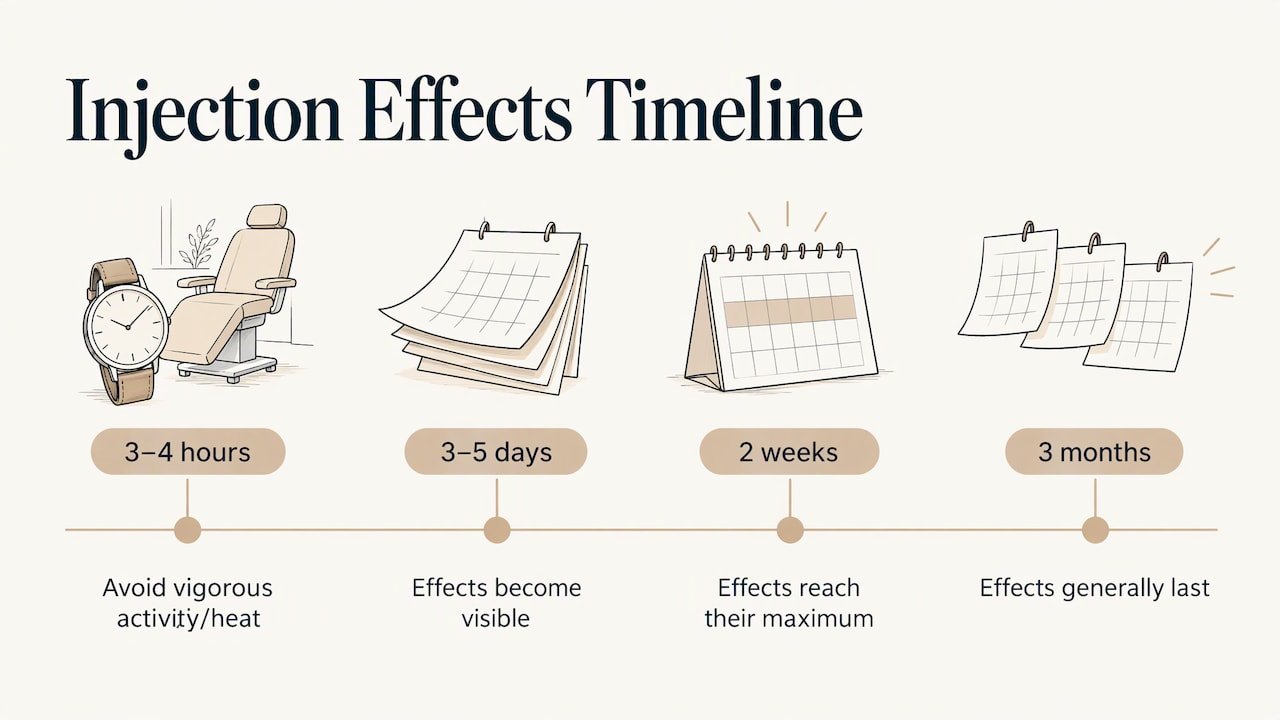
For muscle-relaxing injections, an NHS hospital patient leaflet lists headache, a drooping eyelid, localised muscle weakness, facial pain, bruising, redness or swelling at the injection site among the possible effects. The same leaflet says effects are visible after about three to five days on average, reach their maximum in around two weeks and generally last about three months. It advises avoiding vigorous activity or hot environments for at least three to four hours afterwards.
It also says these injections are not appropriate if you are pregnant or breastfeeding, have an infection at the injection site, or have myasthenia gravis or Lambert-Eaton syndrome. Rarely, toxin products can spread beyond the injection site. An NHS medicines assessment notes this can cause muscle weakness, swallowing or speech problems and breathing symptoms, and that you should seek immediate medical care if swallowing, speech or breathing problems occur.
For peels, microneedling and lasers, the usual concerns are redness, irritation, temporary sensitivity to sun and, with poor technique or unsuitable skin, longer-lasting marks. If you have a skin condition, are prone to pigmentation, take medicines that affect the skin, or are pregnant, say so at your consultation. Any concern after treatment should go back to the practitioner who treated you, or to your GP or NHS 111 if it feels urgent.
What happens at a consultation
A good consultation is mostly questions. Expect to talk about:
- which lines bother you, and whether they show only in movement or also at rest;
- your medical history, medicines, allergies and skin type;
- your sun exposure, skincare and smoking habits;
- what you want your face to look like, and what is realistic;
- the options that suit you, their limits and what aftercare involves.
At Dermacy Clinic, visual skin analysis and progress photographs can support the discussion. The scan is a visual assessment that helps document how your skin looks over time. It is not a diagnostic test, it does not detect disease, and it is not used in every treatment plan. Lines you are concerned about that look unusual, such as a patch that is changing, bleeding or not healing, are a matter for your GP or a dermatologist, not a cosmetic clinic.
Choosing who treats you
The NHS advises that you book a consultation with the person who will carry out the procedure before making your final decision. Its guidance is to check their training, qualifications and insurance, and to ask about complications, aftercare and how long results are likely to last.
A few practical questions to take with you:
- What training and qualifications do you hold for this treatment?
- Are you insured for it?
- What could go wrong, and what is the plan if it does?
- How long will results last, and what happens when they fade?
- What would you advise against for my skin, and why?
Be wary of pressure to decide on the spot, and of anyone who promises a guaranteed result. Outcomes vary, and an honest practitioner will say so.
Talk to us about the skin around your eyes
If you are in Armthorpe, Doncaster or nearby and want to understand which type of lines you have, Dermacy Clinic offers individual consultations, with visual skin analysis available to support the conversation where it is appropriate. For current service details and to book, visit our consultation and contact page. If skin texture is your main concern, you can also read about microneedling at Dermacy Clinic first, so you arrive with questions ready.
FAQ
Can crow’s feet go away on their own?
Movement lines that only appear when you smile will not vanish, because they come from the way your face works. Faint lines may look softer with good sun protection and hydration, but established lines tend to deepen with time. A practitioner can tell you which approach suits your type of line.
What is the difference between crow’s feet and other eye wrinkles?
Crow’s feet fan out from the outer corners and are usually linked to smiling and squinting. Lines under the eye or fine crinkling across the lower lid can have other causes, such as sun damage, thin skin or loss of volume. A consultation helps separate them, and the answer affects which treatment makes sense.
Can I prevent crow’s feet?
You cannot stop them completely, but you can slow them. Daily broad-spectrum sunscreen, sunglasses, a moisturiser and avoiding smoking are the habits most often recommended. These protect your skin, though they will not remove lines that are already established.
Do peels or microneedling work on crow’s feet?
They are used for light, fine lines and for skin texture, according to the British Association of Dermatologists. They are less suited to deeper creases caused by strong muscle movement. Results vary and often build over a course of treatments, so ask at consultation what is realistic for you.
Is it safe to treat the skin near the eyes?
The area is delicate, so it needs a trained, insured practitioner who knows the risks and can manage them. Always have an assessment first, tell them about your health and medicines, and follow aftercare advice. If you notice anything alarming afterwards, contact the person who treated you or seek medical help.
Sources
- Facial lines and wrinkles, DermNet
- Skin care for aging skin, Harvard Health
- Cosmetic dermatology, British Association of Dermatologists patient hub
- Botulinum toxin injections, BAAPS
- Facelift and necklift, BAAPS
- Treatment with botulinum toxin type A, Queen Victoria Hospital NHS
- Botulinum toxin new medicine assessment, NHS formulary
- Choosing who will do your cosmetic procedure, NHS
- Microneedling numbing options
Recommended
- Broken Capillaries on the Face: Treatment Options Explained
- Rosacea Triggers & Symptoms | What Actually Helps
This article provides general information and is not a diagnosis or personalised medical advice. Treatment suitability, risks and expected outcomes require an individual consultation. Results vary.