Dark patches on your face during or after pregnancy are common, and for many women they fade on their own in the months after birth. The pattern most people notice is called melasma (also chloasma, or the “pregnancy mask”). It is triggered by hormonal change plus light exposure, and the first steps are the same for almost everyone: protect your skin from UV and visible light every day, and get anything that looks unusual checked. Stronger treatments depend on whether you are still pregnant or breastfeeding, so that is where timing matters most.
This guide answers the narrow question: what is happening to your skin, how long it can take to settle, what is considered suitable while pregnant or breastfeeding, and when a clinic consultation makes sense. It is general information, not a diagnosis. At Dermacy Clinic in Armthorpe, Doncaster, recommendations depend on an individual assessment, and results vary.
TL;DR
- Darker skin in pregnancy is normal, and melasma on the face affects a large share of women, mostly in the second half of pregnancy.
- Pigmentation that appears in pregnancy may fade a few months after delivery, but for some women it lasts, and it can return in a later pregnancy.
- Daily sun protection is the most important step. Several prescription options cannot be used in pregnancy or breastfeeding, so ask your GP, midwife or pharmacist before using anything.
- A mole or mark that grows, bleeds or changes needs a GP, not a skin-tone treatment.
- Medical-grade pigmentation programmes are a conversation for after pregnancy and breastfeeding, once suitability has been assessed.
Table of Contents
- Is it normal for skin to darken after pregnancy?
- What the pregnancy mask looks like on the face
- Why pregnancy can bring on melasma
- How long does post-pregnancy pigmentation take to fade?
- Start with sun and light protection
- What is and is not suitable while pregnant or breastfeeding
- Do I need treatment at all?
- When to see your GP about a dark mark
- Planning a pigmentation consultation after pregnancy
- Pigmentation consultations at Dermacy Clinic
- FAQ
- Sources
Is it normal for skin to darken after pregnancy?
Yes. The Primary Care Dermatology Society (PCDS) describes increased skin pigmentation in the second half of pregnancy, including darkening of the areola, nipple and genital skin, and melasma in approximately 70% of women, especially those with a darker complexion. DermNet NZ gives the same 70% figure for melasma in the second half of pregnancy and notes it usually fades completely afterwards.
The British Association of Dermatologists (BAD) gives a more cautious figure: it says that up to 50% of women may be affected by melasma during pregnancy. Different sources use different populations and definitions, so the honest summary is that it is very common, affecting somewhere between a half and a majority of pregnancies, and that it is not a sign that something is wrong.
Other pigment changes you might notice alongside facial patches include:
- Moles and freckles that look darker.
- Darker skin on the nipples and areolae, neck, underarms or inner thighs.
- A darker line down the middle of the tummy.
These often ease after birth as hormones settle. If one particular mole looks different from the others, that is a separate matter, covered in the GP section below.
What the pregnancy mask looks like on the face
Melasma is a skin condition in which brown or greyish patches develop, usually on the face. DermNet NZ describes it as irregular, sharply edged areas of pigment in a symmetrical pattern on the forehead and temples or the central face. Common places are the cheeks, forehead, upper lip and around the eyes.
A few features help tell melasma from other dark marks:
- It is symmetrical. Patches usually appear on both sides of the face in a similar pattern.
- It is flat. Melasma does not raise the skin or feel different to the touch.
- It deepens with light. Patches often look darker after sun exposure and may look fainter in winter.
- It is patchy rather than speckled. Individual freckles or sun spots are small and separate, while melasma tends to form larger, blotchy areas.
Because pigment can look similar to other conditions, a visual impression from a photo or a mirror is not a diagnosis. At a consultation, a practitioner looks at the pattern, your history and your skin type. Dermacy Clinic may use visual skin analysis and progress photographs to support that conversation. The scan is a visual assessment, not a diagnostic test, and not every plan uses it.
Why pregnancy can bring on melasma
The BAD states that the exact cause is not known, but pregnancy and hormonal drugs can contribute to its development. The British Skin Foundation also lists avoiding known triggers such as the contraceptive pill and hormone therapy as a key part of managing melasma.
In practical terms, three things tend to combine:
- Hormonal change. Pregnancy changes hormone levels, and pigment-producing cells in the skin respond.
- Light. Ultraviolet light and visible light both stimulate pigment. This is why patches can darken in summer, on holiday or after time outdoors with the pram.
- Your own skin. Melasma is more common in women and in people with darker complexions, according to the sources above.
None of this is something you did wrong. It also explains why the pigment can return: if the triggers come back, so can the patches.
How long does post-pregnancy pigmentation take to fade?
There is no fixed timetable, and anyone promising one is guessing. What the clinical sources say is:
- The BAD says melasma that occurs during pregnancy may go away a few months after delivery.
- The British Skin Foundation says treatment may not be necessary in that case, but that it may come back in another pregnancy, and that even when treated, melasma often returns after treatment stops.
- The PCDS patient leaflet says pregnancy-associated melasma generally resolves in time, but for some women the pigmentation lasts permanently to varying degrees.
- The same leaflet says most melasma fades with age, and in most women after the menopause, although melasma outside the face tends to persist longer.
So a sensible expectation is: give it a few months while protecting your skin well, and expect that some of it may linger. If it is still there after that, or it is bothering you now, it is reasonable to ask for advice rather than wait indefinitely.
Breastfeeding changes the picture too. The patches may still be present while you feed, and several treatments are off the table during that time (see below). Many mothers find it helps to think in two stages: protect and wait while pregnant or breastfeeding, then review options once that stage is over.
Start with sun and light protection
Every UK source in the research puts protection first. The PCDS clinical guidance calls year-round UV protection the most important aspect of treatment. It recommends a mineral sunscreen that protects against UVA, UVB and visible light, with an SPF of 30 or more and a 4 or 5 star UVA rating, applied in a teaspoon amount to the head and neck several times a day.
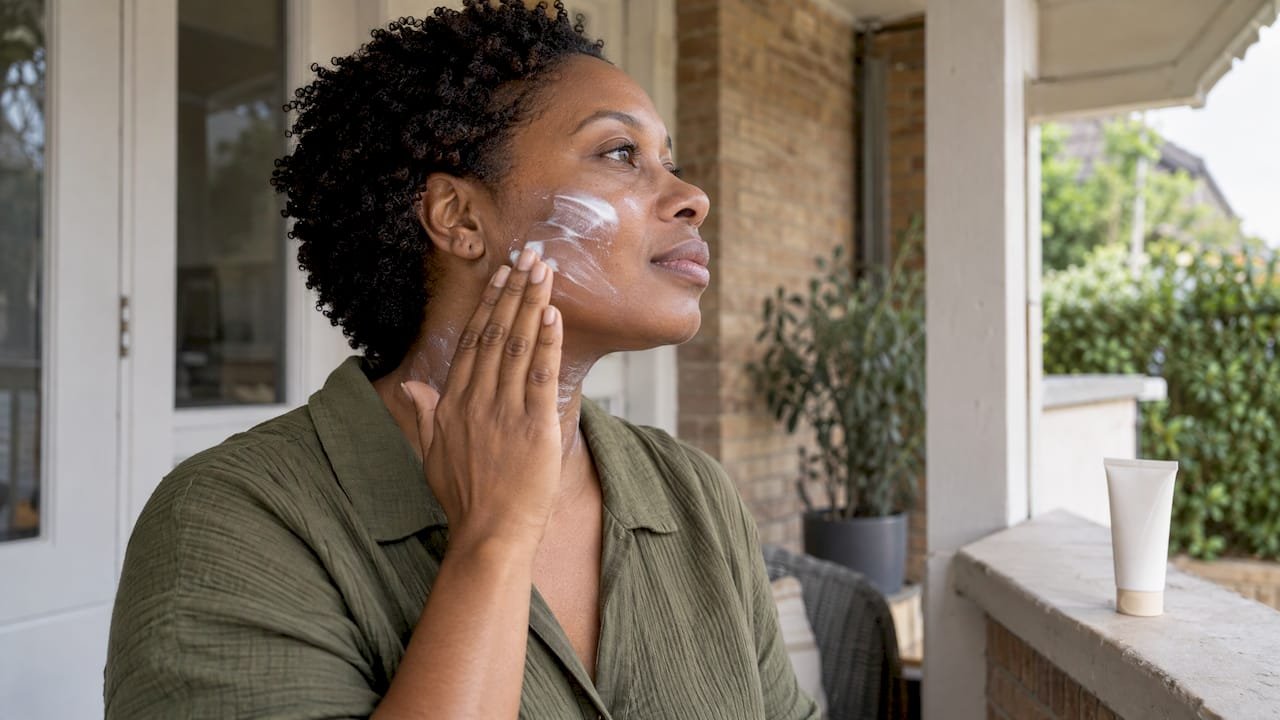
The BAD adds practical points: avoid the sun, wear a wide-brimmed hat, use broad-spectrum SPF 30 or above with a high UVA rating, consider a sunscreen containing iron oxides for extra protection against visible light, and avoid sun-tanning beds.
What that means on a normal day with a newborn:
- Apply sunscreen to your face and neck every morning, including cloudy days and winter.
- Reapply if you are outdoors for long stretches, for example on a long walk or a park trip.
- Keep a hat in the pushchair basket so it is there when you need it.
- Remember windows: visible light also reaches you indoors by a bright window or in the car.
Day-to-day routines are easier when the rest of life is not chaotic. A postpartum self-care checklist can help you build small habits like this into the first months.
If you want to read about light damage in general, our guide to sun damage on the face covers that separately. Here, the point is narrower: with melasma, protection is not an add-on, it is the foundation.

What is and is not suitable while pregnant or breastfeeding
This is the part where most people search for a quick fix, and where caution matters most. Do not assume that a cream, peel or programme is safe in pregnancy or breastfeeding because it is sold for pigmentation.
What the UK sources say:
- The BAD states that hydroquinone and retinoid creams should be avoided in pregnancy as they could harm the baby in the womb. It also says skin lightening creams must only be used when prescribed and under medical supervision, to reduce the risk of side effects.
- The PCDS leaflet says that triple combination cream and oral tranexamic acid cannot be used in pregnancy or breastfeeding. The triple cream combines tretinoin, hydrocortisone and hydroquinone.
- The same leaflet says azelaic acid 20% cream can be used safely in pregnancy and breastfeeding, and needs at least 8 to 12 weeks of use before results can be judged.
- The PCDS clinical guidance notes that oral tranexamic acid should be avoided where there is an increased risk of thrombosis, and that it can occasionally take up to six months to show improvement.
These are prescription matters. Whether azelaic acid or anything else is right for you is a decision for your GP, pharmacist, midwife or health visitor, who know your health and whether you are pregnant or feeding. Do not use leftover creams, products bought online, or something a friend was prescribed. We do not provide doses or self-treatment instructions, and no cosmetic clinic should ask you to guess.
A simple way to check any product: take the name to your pharmacist and say you are pregnant or breastfeeding. Ask whether it is suitable for you now.
What this means for clinic treatments
Clinic procedures such as peels, microneedling or pigmentation programmes are assessed individually, and being pregnant or breastfeeding is something we need to know about before recommending anything. At Dermacy Clinic, we do not assume that any programme or ingredient is suitable during pregnancy or breastfeeding. For most people with new pigmentation after birth, the practical route is to protect the skin, give it time, and plan any in-clinic treatment for after pregnancy and breastfeeding, once suitability can be assessed.
Do I need treatment at all?
Not necessarily. If your patches appeared in pregnancy and are gradually fading, the British Skin Foundation’s position is that treatment may not be necessary. Reasonable reasons to ask for advice include:
- The patches have not improved a good while after delivery.
- They are getting darker or spreading despite daily sun protection.
- They affect your confidence enough that you want to explore options.
- You are not sure whether it is melasma or something else.
The PCDS leaflet says that if melasma persists despite sun protection and azelaic acid, a referral to a specialist may be appropriate, depending on local NHS provision. Your GP is the first stop if you want to go down that route.
Whatever route you take, expect honesty about limits. Melasma is a long-term, relapsing condition for many people. Treatment aims to lighten and manage it, not to promise a cure, and results vary between people.
When to see your GP about a dark mark
Not every dark mark is melasma. Melasma is flat, symmetrical and spread across the face. A single spot that behaves differently is a different question.
The BAD advises seeing your GP if you have marks that grow, bleed, change in any way or never heal completely. The same page advises seeing your GP about existing moles that change in size, shape, colour or texture, or that look completely different from your other moles.
Pregnancy can darken moles, so it is easy to put changes down to hormones. If you are in any doubt, get it looked at. Do not wait for a cosmetic appointment, and do not treat a changing mole as pigmentation. A cosmetic clinic skin scan is not a diagnostic test and does not detect skin cancer, so a changing lesion needs a medical assessment.
Planning a pigmentation consultation after pregnancy
When you are no longer pregnant or breastfeeding and your patches are still bothering you, a consultation is a sensible next step. It helps to prepare:
- Know your dates. Tell the practitioner when you gave birth, whether you are breastfeeding, and whether you are planning another pregnancy.
- List your medicines and skincare. Include contraception or hormone treatments, prescription creams and anything you have been using on your face.
- Describe the history. When did the patches start, have they changed, and do they worsen with sun?
- Mention your skin history. Past reactions, sensitivity, cold sores, eczema or scarring all matter when judging suitability.
- Ask about limits. A good practitioner will tell you what is realistic, what might come back, and what daily protection you will need afterwards.
Sun protection remains part of the plan whichever treatment you choose, because light is one of the main triggers. Treatment without protection is unlikely to hold.
Pigmentation consultations at Dermacy Clinic
Dermacy Clinic is a skin, laser and aesthetic clinic in Armthorpe, Doncaster, South Yorkshire. If your pigmentation persists once pregnancy and breastfeeding are behind you, our Cosmelan pigmentation service page explains how medical-grade pigmentation programmes work, what a consultation involves, how to book and the current prices. Suitability is decided individually after an assessment, results vary, and a programme is not guaranteed to clear pigmentation or keep it away.
If you would like a broader look at your skin first, you can start with a consultation and visual skin analysis, which supports the conversation but does not diagnose disease. If your question is general rather than about a specific programme, our pigmentation treatment page gives an overview of the types of pigmentation we see.
If you are still pregnant or breastfeeding, you are welcome to ask questions, and we will tell you honestly what is better left until later.
FAQ
Is it normal for skin to darken after pregnancy?
Yes. Increased pigmentation is a normal part of pregnancy for many women, and melasma on the face affects roughly half or more of them depending on the source. It often fades in the months after delivery, though for some women it lasts longer. A new or changing mole is different and should be checked by your GP.
What is chloasma?
Chloasma is another name for melasma, sometimes called the pregnancy mask. It shows as brown or greyish patches, usually on the face, often on both sides in a similar pattern. It is not harmful, but it can come back with sun exposure, hormonal changes or another pregnancy.
Can I use skin lightening creams while breastfeeding?
Not without medical advice. UK guidance says hydroquinone and retinoid creams should be avoided in pregnancy, and that triple combination cream and oral tranexamic acid cannot be used in pregnancy or breastfeeding. Ask your GP, pharmacist or health visitor what is suitable for you before using any product.
Will post-pregnancy pigmentation go away on its own?
Often it improves within a few months of delivery, and treatment may not be needed. Some women find the pigment persists, and it may return after treatment or in another pregnancy. Daily sun and light protection gives your skin the best chance of settling.
When can I have a pigmentation treatment after pregnancy?
That depends on your health, whether you are breastfeeding and the treatment itself, so there is no single date. We assess suitability individually at consultation and do not assume any programme is suitable during pregnancy or breastfeeding. Book a consultation once you are ready and bring your dates and medicines list.
Sources
- PCDS: Pregnancy related skin conditions, an overview
- DermNet NZ: Skin problems in pregnancy
- British Association of Dermatologists: Melasma
- British Skin Foundation: Melasma
- PCDS patient information leaflet: Melasma
- PCDS clinical guidance: Melasma (chloasma)
- British Association of Dermatologists: Skin cancer, how to reduce the risk
Recommended
- Pigmentation Treatment Doncaster | Melasma & Dark Spots
- Sun Damage on the Face: What Can Be Treated and What to Check First
- Cosmelan Homecare and Peeling: What to Ask Your Practitioner
- Cosmelan Doncaster | Melasma & Pigmentation
This article provides general information and is not a diagnosis or personalised medical advice. Treatment suitability, risks and expected outcomes require an individual consultation. Results vary.