Avoid natural sun, sunbeds and fake tan for 4–6 weeks before and after every laser hair removal session, and stop sunbeds and fake tan today. If you cannot avoid daylight, cover the area and wear SPF. Sun-darkened skin raises the risk of burns and lasting pigment changes, so timing matters as much as the treatment itself.
TL;DR:
If a holiday is two weeks away, wait until you return; with eight weeks to go, schedule treatment at least 4–6 weeks before departure.
Stop plucking, waxing, and threading at least four weeks beforehand, shave 12–24 hours before treatment, and follow instructions about facial retinoids.
After treatment, avoid swimming, saunas, and hot environments until your skin heals, a period that may range from several days to two weeks.
Use fragrance free SPF 50 on healed skin, cover treated areas outdoors, and continue daily sun protection for up to six months.
Tell your clinician about recent outdoor exposure and photosensitizing medicines; wavelength and skin tone can change timing, and darker skin may need a patch test.
Table of Contents
How long should you avoid the sun before and after each session?
Why does your clinician’s advice differ from the general rule?
How long should you avoid the sun before and after each session?
Clinic leaflets commonly tell patients to avoid sun or sunbed exposure for at least 4–6 weeks before, during and after treatment. Some wavelengths and situations carry slightly different windows, and 1064 nm guidance can differ, so your clinician’s instructions come first.
The sun-avoidance window applies around each session in your course, not just the first. If you have several appointments spaced a few weeks apart, you are effectively managing sun exposure for months.
Holiday in 8 weeks: book your session at least 4–6 weeks before you fly, and plan your next one for after you return and your skin has settled.
Holiday in 2 weeks: wait until you are back, then book, because treating tanned skin is the risky combination.
Wedding or event soon: leave a gap of 4–6 weeks afterwards before any sunbathing or outdoor day trips.
Already tanned: tell your clinician honestly, because they may postpone treatment until the tan fades.
Why does sun exposure make laser hair removal riskier?
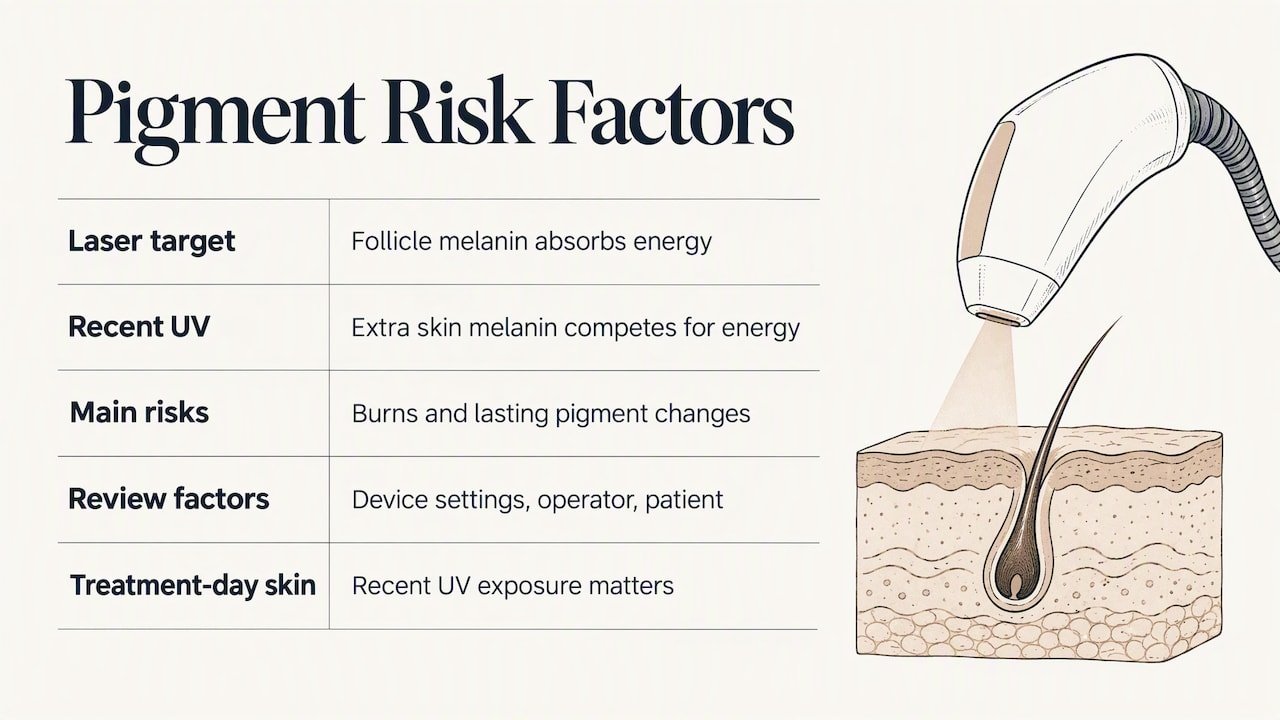
Laser targets pigment. Melanin in the hair follicle absorbs the energy and heats the follicle. Tanned or recently sun-exposed skin has extra melanin, so it competes with the follicle for laser energy. That competition raises the chance of burns and post-inflammatory hyperpigmentation, where skin darkens after irritation.
Pigment changes are the most common lasting problem. Practitioner commentary notes that hyperpigmentation and hypopigmentation can persist for months, which is why strict UV avoidance either side of treatment is essential.
Exposure does not need to produce an obvious tan to matter. Clinicians warn that sub-clinical UV exposure can still activate melanocytes and raise pigment risk, so mention any recent outdoor time.
A 2023 review of adverse events reported complications associated with device settings, operator factors and patient characteristics, and emphasised the importance of operator training and safety precautions. Skin condition on the day, including recent UV exposure, is part of that picture.
What should you do before your appointment?
Follow these steps in order:
Stop sunbeds and fake tan at least 4–6 weeks before treatment.
Stop plucking, waxing and threading for at least 4 weeks, because these remove the hair root and leave the laser nothing to target.
Shave the treatment area 12–24 hours before your session.
Stop topical retinoids on the face when instructed. Hospital leaflets often advise two weeks before for face treatments.
Tell your clinician about holidays, recent outdoor days and any medicines that increase photosensitivity.
Pro Tip: Keep a simple note of where you have been outdoors recently. It takes a minute and helps your clinician judge your skin accurately.
How should you look after treated skin?
Cool the area if it feels warm, and follow your clinic’s instructions about hot baths, saunas and strenuous exercise. Post-treatment guidance advises avoiding swimming, saunas and hot environments until the skin has healed, which takes several days to 2 weeks.
Use cooling measures such as aloe vera gel if the skin feels hot or irritated.
Keep treated skin out of direct sun for 4–6 weeks, and cover it with clothing when outdoors.
Do not pick at flaking or crusting skin.
Apply broad-spectrum SPF 30 or preferably SPF 50 whenever the area is exposed.
NHS trust guidance often recommends daily SPF 30 or 50+ for up to 6 months after treatment to protect skin and reduce pigment risk. That is far longer than the avoidance window, so treat sun protection as a habit, not a fortnight’s task.
Contact your clinic if you notice blistering, spreading redness, signs of infection or an unexpected change in skin colour. If sun exposure happens by accident, cool and protect the area, then tell your clinic before your next session. Mild redness usually settles within days, and persistent darkening or lightening deserves a prompt review.
Which sunscreen works best, and how do you use it?
Choose a fragrance-free SPF 50 with high UVA protection. Clinical practice notes also stress that clothing, shade and avoiding peak UV hours matter as much as sunscreen, because it can be applied unevenly or wiped off.
Apply a generous layer to clean, healed skin only, and never to broken or blistered areas.
Reapply after sweating, towelling or swimming once your clinic says swimming is fine.
Pat it on gently rather than rubbing, so you do not irritate treated skin.
Wear loose, tightly woven clothing over treated areas and seek shade between late morning and mid-afternoon.
Pro Tip: Keep a small SPF in your bag and one at home, so reapplying is never an excuse to skip.
Why does your clinician’s advice differ from the general rule?
Timing varies with wavelength, device and skin phototype. Some 1064 nm protocols use different windows, and darker skin often calls for longer avoidance and a patch test first. Ask your clinician whether a patch test is appropriate for your treatment and skin.
Treat the numbers in this article as a sensible default. If your clinician gives you different instructions, follow theirs.
Ready to book your laser hair removal?
We offer laser hair removal with assessment-led scheduling, and you can see our laser hair removal page for course details. Popular areas include Bikini Extended, Full Back and Under Arm. Book a consultation, tell us about any recent sun exposure, and ask us to plan around your events.

This article is general information, not a substitute for advice from a qualified doctor. Consult a qualified healthcare professional about your own circumstances before acting on anything here.
FAQ
How long should I avoid the sun before laser hair removal?
Most clinics ask for at least 4–6 weeks of avoiding sun, sunbeds and fake tan before each session. Your clinician may adjust this for your device and skin type, so confirm it at your consultation.
Can I use sunscreen instead of avoiding the sun?
No, sunscreen is a back-up rather than a replacement. Clothing, shade and avoiding peak UV hours matter alongside it, because sunscreen can be applied unevenly or wiped off.
When can I swim after laser hair removal?
Wait until the skin has healed, which guidance puts at several days to 2 weeks. Your clinic will tell you when it is safe for your skin.
How long before laser should I shave?
Shave the treatment area 12–24 hours beforehand. Avoid plucking, waxing or threading for at least 4 weeks, because they remove the hair root.