Laser is the practical first choice for reducing hair across larger areas or darker hair, while electrolysis is the established permanent option, working on any hair colour. Laser is classed as permanent hair reduction, not guaranteed removal. That is why these methods can be combined: laser first to cut the bulk, then electrolysis for the stubborn remnants.
TL;DR:
Laser can reduce hair growth by up to two thirds, but maintenance may be needed, and white, gray, blonde, or fine hairs respond poorly.
For dense dark hair over larger areas, start with a laser course, then use electrolysis for light or resistant hairs left behind.
Avoid waxing, plucking, threading, and epilators between laser sessions because treatment needs the hair root; shaving, trimming, and depilatory creams are acceptable.
Laser choice should match skin tone: alexandrite suits lighter skin, while Nd:YAG is often chosen for deeper tones, and a patch test should come first.
Electrolysis treats one follicle at a time, so reserve it for small areas or finishing work, and disclose pacemakers or other implanted devices beforehand.
Table of Contents
What do the two treatments feel like, and how long do sessions take?
What side effects should you expect, and how do you look after your skin?
How do laser and electrolysis compare at a glance?
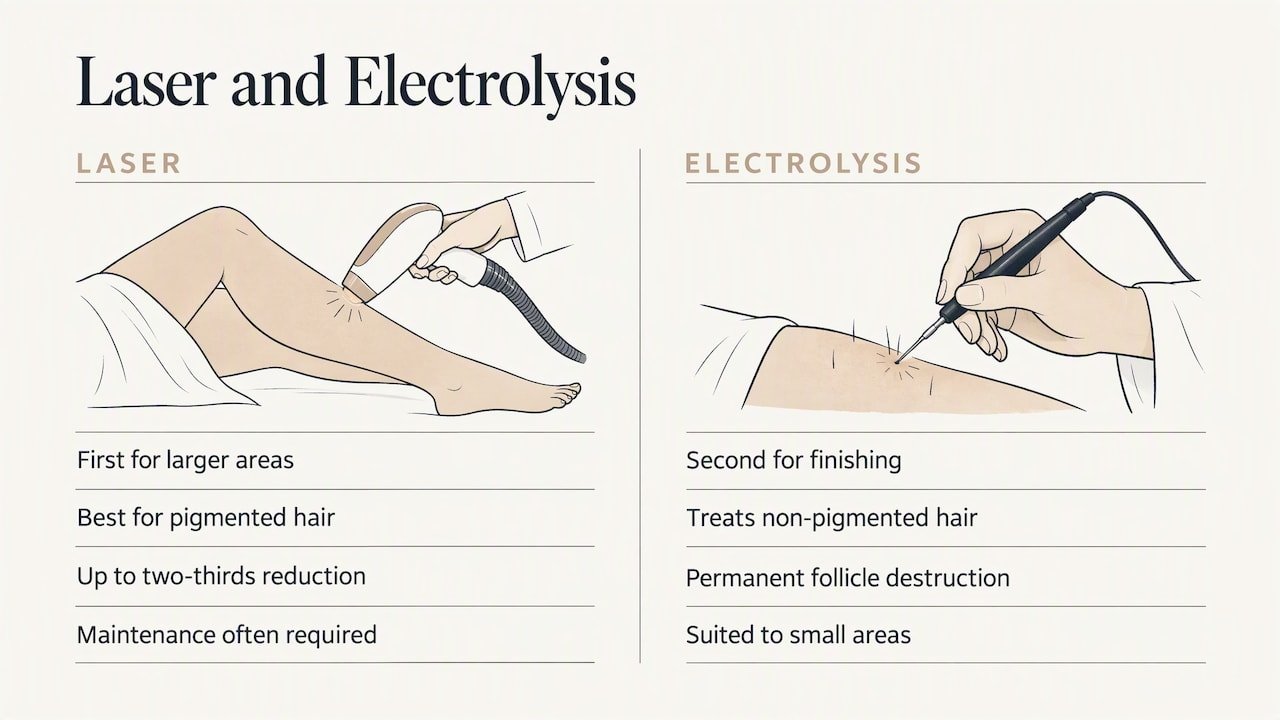
Laser uses light energy that is absorbed by the pigment in the hair, which damages the follicle enough to slow or stop growth. It suits larger areas and dark hair. Electrolysis treats one follicle at a time with a fine probe and an electrical current, so it is slower but works regardless of hair colour.
Permanence: electrolysis is classed as permanent removal, while laser is classed as permanent reduction.
Speed: laser covers an area quickly, whereas electrolysis is worked hair by hair.
Sensation: laser feels like a brief snap or sting per pulse, while electrolysis is a sharper prick at each follicle.
Cost over a course: laser is usually more economical for big areas, and electrolysis for small, targeted ones.
Best areas: a full face or under arm often suits laser, while a few stray chin hairs may suit electrolysis.
A simple rule of thumb: choose laser for bulk and dark hair, and electrolysis for permanent single-hair work or for hair without pigment.
How does laser hair removal work?
Laser targets melanin, the pigment in the hair shaft. Patient leaflets explain that lasers work best on hair in the growth (anagen) phase, which is why a course of several sessions is needed to catch every hair as it enters that phase. The contrast between dark hair and lighter skin is what makes the treatment efficient.
Different laser types may be used depending on your skin and hair:
Alexandrite: well suited to lighter skin with dark hair.
Diode: a versatile option for a broad range of skin tones.
Nd:YAG: a longer wavelength that bypasses more surface pigment, so it is often chosen for deeper skin tones.
A typical visit starts with a patch test, then cooling measures during treatment. Small areas such as the chin or under arm take minutes, and sessions are spaced weeks apart. Between sessions, waxing, plucking, threading and epilators must be avoided because the laser needs the hair root present. Shaving, trimming or depilatory creams are fine.
The limits are worth knowing: white, grey and very fine hairs respond poorly because there is little pigment to absorb the light.
How does electrolysis work, and what does a course involve?
Electrolysis inserts a fine probe into each hair follicle and delivers a small current to destroy the cells that produce the hair. Because it acts on the follicle itself, pigment does not matter, so it can treat any hair colour.
Practitioners use one of three modalities, as local-authority practice guidance describes:
Galvanic: direct current, which chemically breaks down the follicle.
Thermolysis: high-frequency alternating current, which heats the follicle.
Blend: a combination of the two.
Local-authority guidance defines electrolysis as a permanent hair removal method, yet you still need multiple visits, because follicles cycle through growth phases and not every hair is visible at once.
Working hair by hair makes electrolysis slow on large areas. Contraindications include pacemakers, so always tell your practitioner about implanted devices and medical conditions. Comfort measures such as numbing cream and pacing sessions help considerably.
What does the evidence say about permanence?
The honest picture is that laser reduces hair substantially but does not reliably remove it for good. A systematic evidence review found that lasers and light sources give partial short-term reduction, repeated treatments improve results, and alexandrite and diode lasers showed better long-term reduction, yet no laser system had unequivocal evidence of complete persistent removal.
Clinical data suggests an average of up to two-thirds reduction in hair growth with laser, with maintenance often required. Even after strong results, fine or downy hairs can reappear over time.
Electrolysis is described in guidance as permanent because each follicle is destroyed. The trade-off is time, so it suits small areas or finishing work. That is why commissioning policy guidance treats laser as more practical for larger areas and electrolysis as the route for non-pigmented hair. Laser first, electrolysis second, balances efficacy with efficiency.
What do the two treatments feel like, and how long do sessions take?
Both treatments are tolerable for most people, but they feel different.
Laser: a brief stinging or snapping sensation with each pulse, softened by cooling. Small and medium areas are quick.
Electrolysis: a prick or sharp sting at every follicle, and because it is slower, the discomfort lasts longer per area.
Full Face: laser is generally quicker for the area, whereas electrolysis would take longer.
Chin: a small area where either method is practical, and a common place to finish with electrolysis.
Under Arm: laser is brisk here, and downtime is usually limited to temporary redness.
Pro Tip: Ask about numbing cream or cooling before you start, and book shorter, regular sessions rather than long ones. Pacing the treatment makes it far more comfortable.
How much do they cost, and when will you see results?
Budget depends on the area, the device and how many sessions you need. Laser typically takes several sessions, and you usually see visible thinning as treatment progresses. Maintenance may be needed later.
Laser: you pay per session or for a course, and it is generally the more economical route for larger areas.
Electrolysis: often priced by time, so the total depends on how many hours your area needs.
Small areas: electrolysis becomes sensible when permanence on a limited patch matters most.
Timeline: laser results build across months, while electrolysis clears areas gradually as follicles are treated.
For our laser pricing, our laser hair removal course prices show what to expect, with laser hair removal available from £25 as a one-off.
Which skin tones and hair colours suit each method?
Laser performs best where there is clear pigment contrast between hair and skin. Modern diode and Nd:YAG devices widen the options for deeper skin tones, but white, grey and blonde hairs remain poor responders.
Dark hair, lighter skin: an excellent laser candidate.
Dark hair, deeper skin: suitable with the right wavelength chosen at assessment.
White, grey, blonde or very fine hair: electrolysis is the standard option.
Mixed hair colours: a combined pathway usually works best.
Hormone-driven growth: conditions such as PCOS can affect response, and policy guidance notes that hormonal causes complicate expected outcomes, so medical management may sit alongside hair removal.
When do we combine laser and electrolysis?
Clinical protocols typically complete a full laser course first to reduce the bulk of dark hairs, then use electrolysis to remove remaining light, grey or resistant ones. This shortens total electrolysis time on a dense area and improves overall cost-effectiveness.
An illustrative timetable for a chin or face:
Laser course: sessions spaced weeks apart.
Reassessment: we review what remains and which hairs have resisted.
Following months: targeted electrolysis sessions for the residual hairs.
What side effects should you expect, and how do you look after your skin?
Both treatments can cause short-term redness and swelling. Pigment changes are a recognised risk, particularly without sun protection.
Patients are advised to protect treated skin with high-factor sunscreen for several months after laser to reduce the risk of pigment change.
After laser: avoid hot baths and saunas for 24 hours, and do not wax or pluck between sessions.
After electrolysis: keep treated sites clean and follow the wound-care advice you are given.
Sun: apply high-factor sunscreen daily on treated areas.
Seek review: contact the clinic or a doctor if you notice infection signs or pigment change that persists.
What should you ask when choosing a clinic or practitioner?
A good consultation should leave you clear on the plan and confident in the person delivering it. Our guide on how to choose a laser hair removal clinic goes further, but here is a checklist to take with you:
Which device will be used, and why is it suited to my skin and hair?
What qualifications and experience does the practitioner have?
Do you carry out a patch test before treatment?
How many sessions should I expect?
What safety and aftercare processes do you follow?
Will you keep photo records to track progress?
How is pricing structured?
Look for written consent, clear aftercare advice and experience with your skin and hair type.
Pro Tip: Bring photos of your hair growth cycle and note any medication, so the assessment starts from accurate information.
How can we help you remove hair for the long term?
We offer laser hair removal, including area-specific treatment for Full Face, Chin and Under Arm, and every journey begins with an assessment. Book an initial consultation or a 3D skin analysis and you leave with a personalised plan and clear pricing.

Our laser hair removal page covers courses and what to expect.
Our skin analysis is a good first step if you are unsure where to begin.
FAQ
Which is better for hair removal, electrolysis or laser?
It depends on your hair and the area. Laser is better for larger areas and dark hair, while electrolysis is better for permanence and for light or grey hair. Many people benefit from both, starting with laser.
Is electrolysis really permanent?
Guidance classes electrolysis as a permanent method because it destroys each follicle. You still need several sessions, since hairs grow in cycles and not all are active at once.
Is there a downside to electrolysis?
The main downside is time. It treats one hair at a time, so large areas take many sessions, and each prick can be more uncomfortable per area than laser. This is why it is best for small areas or finishing work.
Is laser hair removal permanent?
Laser is classed as permanent reduction rather than guaranteed removal. Clinical sources report up to around two-thirds reduction after a full course, and occasional maintenance sessions may be needed.