Blackheads come back after extraction because extraction empties the pore but does nothing about what fills it. Your skin keeps producing oil (sebum) and shedding dead skin cells, so the same pore can clog again. A clear nose after a facial is a fresh start, not a permanent result. How long it lasts depends on your skin, your routine and whether anything is controlling the underlying blockage.
This guide explains why recurrence happens, how quickly it can show up, what a realistic maintenance plan looks like, and when it is worth speaking to a GP or a qualified skin professional. It is general information, not a diagnosis, and results vary from person to person.
TL;DR
- Extraction removes the plug that is there today. It does not change how much oil your skin makes or how your pores shed cells, so recurrence is normal.
- Refilling can start within weeks. Research on comedones suggests that complete refilling can take roughly 50 to 105 days when cells remain on the follicle wall.
- Steady, gentle habits and, where suitable, topical treatments such as benzoyl peroxide or retinoids do more for recurrence than repeated extraction.
- Squeezing at home can irritate skin and risk scarring, so it is the wrong response to a returning blackhead.
- Persistent, painful, scarring or mood-affecting acne should be seen by a GP rather than managed by repeated extractions.
Table of Contents
- What extraction actually does
- Why they keep coming back
- How quickly can blackheads return?
- What helps keep blackheads from returning
- Why squeezing at home is not the answer
- Where professional treatment fits
- What realistic maintenance looks like
- When to see a GP
- FAQ
- Sources
What extraction actually does
A blackhead is an open comedone: a pore blocked by a mix of sebum and shed skin cells. The surface of the plug looks dark because it is exposed to air, not because it is dirt. This is why scrubbing harder rarely helps, and why blackheads have nothing to do with poor hygiene.
Extraction, whether done in a professional treatment or by a suction or cleansing step, removes the visible plug. The pore is then empty. What it does not do is:
- reduce how much sebum your oil glands produce;
- change how the lining of the pore sheds cells;
- permanently change the size or shape of the pore opening;
- treat the early, invisible blockages (microcomedones) sitting beside the one you removed.
That last point matters most. Blackheads start as microscopic blockages long before you can see them. Clearing the ones that have surfaced leaves the next wave already forming underneath.
If you are wondering whether what you have is actually a blackhead or a sebaceous filament, which look similar on the nose and behave differently, we cover that in a separate Dermacy Clinic article. Here we stay with the question of recurrence.
Why they keep coming back
Your skin keeps making sebum
Oil production is driven largely by hormones, genetics and age, not by how often you cleanse. After extraction the gland carries on exactly as before. Within days the pore starts collecting oil and cells again.
Dead cells still build up inside the pore
In blackhead-prone skin, the cells lining the pore do not always shed cleanly. They clump with sebum and form a plug. A single extraction does not alter that tendency. Exfoliating ingredients and prescription-strength topical treatments are the tools designed to influence it, which is why they feature in acne guidance.
Part of the lining can be left behind
In laboratory work on comedones, complete refilling took between 50 and 105 days when keratinised cells remained on the follicle wall after extraction. That is a research finding about how the pore behaves, not a promise about your own timeline, but it explains why an “empty” pore is not a reset to a brand-new one. A peer-reviewed clinical report that describes professional extraction for stubborn comedones also notes that incomplete extraction and recurrence are recognised risks, even when extraction is used alongside medical treatment.
Pore size is largely set by your skin
Pores do not shrink permanently after being emptied. A stretched, visibly open pore can fill again more easily, and that is why the same spots on the nose and chin tend to be the ones that return. Anything that claims to “close” pores for good is overpromising.
Skincare that is not matched to your skin
Heavy, pore-clogging make-up or skincare can add to the blockage. The NHS advises using non-comedogenic skincare and make-up products and removing make-up at the end of the day. On the other side, over-cleansing and harsh scrubs irritate the skin and can leave it producing more oil or becoming inflamed, not less.
Picking and squeezing between appointments
Repeated pressure on a pore can damage it and make it more likely to clog again. NHS advice is not to pick or squeeze spots, and not to scrub, because this can cause scarring or irritation and make acne worse. Local NHS self-care guidance in Nottinghamshire goes further and says not to try to clean out blackheads yourself, because this can worsen them and cause permanent scarring.
How quickly can blackheads return?
There is no single answer. Some people notice darkening in the same pores within a couple of weeks. Others get a clearer stretch of several weeks or months. The timing depends on how oily your skin is, how many pores were affected, whether you use any active treatment between sessions and whether the extraction was complete.
From the research above, a full refill of a removed comedone can take around 50 to 105 days in experimental conditions, though visible darkening of a blocked pore may show sooner. A reasonable expectation is that extraction gives you a clean surface for a period, not an end to blackheads.
Here is what tends to shorten or lengthen that window, in general terms:
| Factor | Tends to bring blackheads back sooner | Tends to help the clear period last |
|---|---|---|
| Skin type | Very oily skin, acne-prone skin | Normal or drier skin |
| Between-session care | Nothing active, or harsh scrubbing | A gentle, consistent routine with suitable actives |
| Products | Heavy or pore-clogging make-up and moisturisers | Non-comedogenic products, make-up fully removed at night |
| Handling | Picking, squeezing, pore strips used repeatedly | Leaving the skin alone |
| Extraction quality | Partial removal | Thorough removal by a trained professional |
Treat this as a guide for thinking, not a forecast. Two people can have the same treatment and very different results.
What helps keep blackheads from returning
The pattern in acne guidance is consistent: control the cause with a steady routine and, if needed, topical treatment, rather than relying on repeated physical removal.
A gentle daily routine
The NHS advises washing twice a day with a gentle cleanser, using non-comedogenic products and removing make-up at night. NICE guidance for acne also supports twice-daily syndet (soap-free) cleansing, avoiding comedogenic products and avoiding persistent picking or scratching.
In practice that means:
- Use a mild, fragrance-light cleanser morning and evening.
- Choose moisturiser and sun protection labelled non-comedogenic.
- Remove make-up fully every night.
- Do not scrub. Friction does not remove a blackhead and can inflame the skin.
- Keep your hands off the area.
Topical treatments that target the blockage
NHS treatment guidance says topical retinoids, including prescription ones, are among the treatments used for acne, and that benzoyl peroxide can reduce whiteheads and blackheads. A pharmacist can talk you through over-the-counter options. Prescription retinoids need a prescriber, and we do not recommend self-selecting them or copying someone else’s regimen.
Patience matters. The NHS notes that many acne treatments can take two to three months to start working. If you stop after three weeks because the nose looks the same, you have not given the approach a fair trial.
Maintenance for people who relapse often
NICE recommends a 12-week first-line course of treatment for acne and says maintenance treatment should be considered for people with frequent relapse. The guidance also says people should be told about relapse, including when and how to get further advice if it happens. Seen that way, blackheads returning is not a sign that something has failed. It is an expected feature of a condition that needs ongoing management.
If your blackheads are on your back or shoulders as well as your face, a pharmacy resource on acne on the back can give you an idea of the product types commonly used for body acne. Your own pharmacist or GP is the right person to confirm what suits you.
Why squeezing at home is not the answer
It is tempting to deal with a returning blackhead yourself, especially one on the nose that you can see every time you look in a mirror. The trouble is that fingernails and improvised tools push pressure unevenly, break the skin and can push material deeper. That can lead to inflammation, red or dark marks and, in some cases, scarring.
We will not give a step-by-step for DIY extraction, because it is not a safe thing to coach. If a spot is bothering you, a better move is to leave it, keep to the routine above and let a trained professional assess it. If marks are what you are left with, our guide to acne marks versus acne scars explains how they differ and what to ask before any microneedling.
Where professional treatment fits
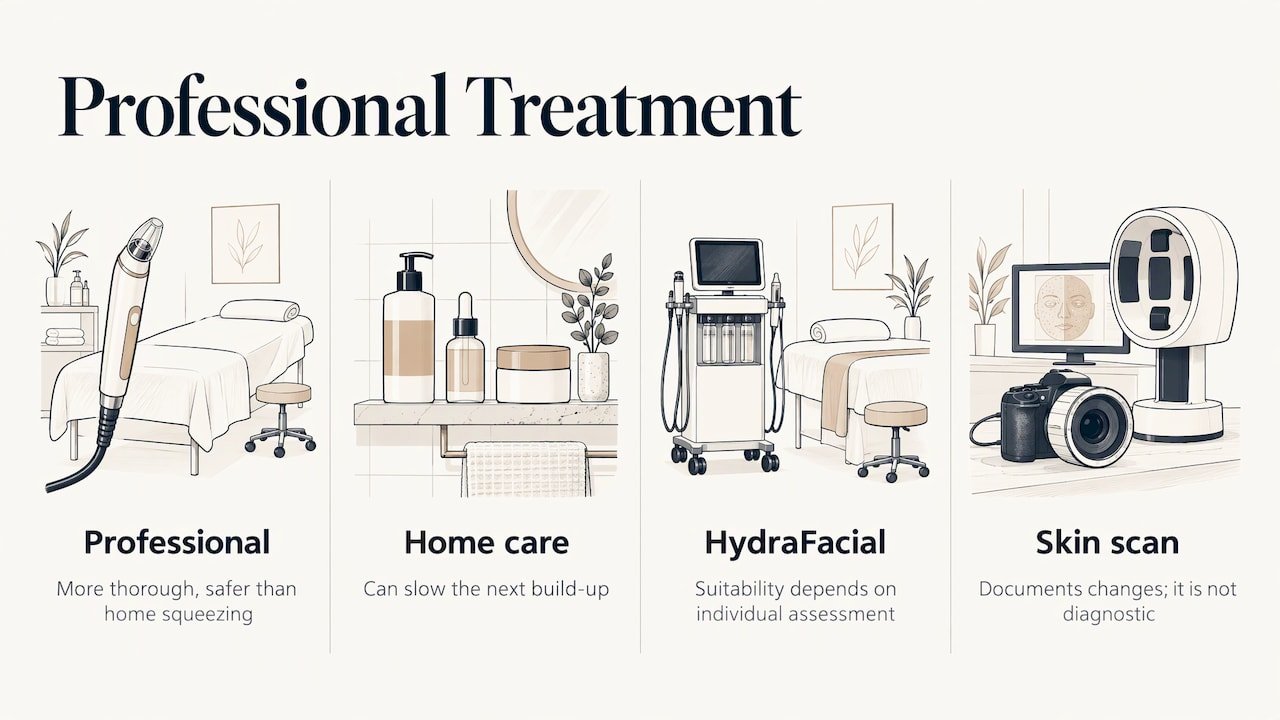
A professional treatment can help in two ways. It can remove existing congestion more thoroughly and more safely than home squeezing, and it can be part of a wider plan that includes home care to slow the next build-up. It cannot stop your skin from producing oil or promise that pores stay clear.
At Dermacy Clinic in Armthorpe, Doncaster, a HydraFacial is one option clients ask about for congested skin. Whether it suits you depends on an individual assessment, and results vary. If you want to know what the treatment involves, current prices and how to book, the HydraFacial page is the place to start. Booking comes after you have read it and decided it fits what you want.
We can also look at your skin during a consultation. Our visual skin analysis and progress photographs support the conversation and help us document how your skin changes over time. The scan is a visual assessment, not a diagnostic test, and it does not detect disease. For acne that goes beyond occasional blackheads, you may find our page on acne treatment in Doncaster and our article on what causes adult acne more relevant.
What realistic maintenance looks like
If blackheads keep returning, the aim is fewer, smaller and slower-to-return blockages, not none at all. A realistic plan has three layers:
- Daily basics. A gentle cleanse, non-comedogenic products, full make-up removal and no picking.
- An active that targets the blockage. Chosen with a pharmacist, GP or qualified skin professional, and used consistently for the two to three months it can take to show an effect.
- Occasional professional care, if you want it. Spacing and frequency are individual. We do not offer a fixed schedule because skin needs differ, and a clinician should decide it after assessing you.
People with oily skin, or whose skin has always clogged around the nose and chin, may find they need all three on an ongoing basis. That is a normal pattern. Think of it as you would think of dental hygiene: regular and unglamorous rather than a one-off fix.
One more point on expectations. Some people see the same few pores darken again and again. This is common, because those pores are often the larger or more active ones. It does not mean the treatment was done wrongly.
When to see a GP
Blackheads alone are usually a cosmetic concern. But recurrence can be one part of acne, and acne has a medical side. The NHS advises seeing a GP if self-treatment has not helped, you have lots of spots, spots are deep or painful, scarring is developing, there are signs of infection, or acne is affecting your mental health.
For more complex cases, NICE says referral to a dermatologist-led team should be considered when mild to moderate acne has not responded to two completed treatment courses, when moderate to severe acne has not responded to treatment that includes an oral antibiotic, or when acne is causing scarring. It also recommends referral where there is diagnostic uncertainty or nodulocystic acne, and urgent same-day referral for acne fulminans, with assessment within 24 hours.
If you have a spot that looks unusual, bleeds, does not heal or is changing, see your GP. We do not use our skin analysis to diagnose conditions or check for skin cancer.
FAQ
Do blackheads return after extraction?
Often, yes. Extraction removes the current plug, but your skin continues to make oil and shed cells, so the pore can fill again. Research on comedones points to complete refilling in roughly 50 to 105 days when cells remain on the follicle wall, and some people notice darkening sooner. How quickly it happens varies from person to person.
How do I stop a blackhead that keeps coming back?
No approach stops it for certain, but consistent habits make the biggest difference. Cleanse gently twice a day, use non-comedogenic products, remove make-up at night and avoid picking. A pharmacist or GP can advise on actives such as benzoyl peroxide or retinoids, which can take two to three months to show an effect.
Why do blackheads on my nose return so quickly?
The nose tends to have more active oil glands and larger pores, so it clogs more readily than other areas. Pores do not shrink permanently after being emptied. For that reason the nose often needs the steadiest routine and the most patience.
Is repeated extraction bad for my skin?
Gentle extraction by a trained professional is different from squeezing at home, which NHS advice says can irritate the skin and cause scarring. Extraction on its own also does not address why blackheads form. If you are having it repeatedly and still struggling, ask a clinician to look at the underlying acne and your home routine as well.
Can a HydraFacial stop blackheads coming back?
We cannot promise that. A HydraFacial can be part of a skin plan and may help with congestion, but oil production and pore behaviour continue afterwards, and results vary. Suitability is decided at consultation, and the HydraFacial page has current details and booking.
Sources
- Acne – NHS
- Acne vulgaris: management, recommendations – NICE NG198
- Acne self-care information – Nottinghamshire APC
- Mechanical stress and the development of pseudo-comedones – Experimental Dermatology
- Clinical Pearl: Comedone extraction for persistent macrocomedones – JCAD
- Akne na hrbtu – Moja lekarna
Recommended
- Acne Treatment Doncaster | Acne & Scar Clinic | Dermacy
- What Causes Adult Acne | Treatment Options Explained
This article provides general information and is not a diagnosis or personalised medical advice. Treatment suitability, risks and expected outcomes require an individual consultation. Results vary.