Laser and IPL (intense pulsed light) both use light to heat the pigment in a hair and slow its regrowth. The main difference is the light itself. A laser delivers one focused wavelength. IPL delivers a broad band of filtered wavelengths. For most people, that makes laser the more selective and often more effective option, while IPL is a gentler-sounding, broader tool that can suit some situations. Neither one gives guaranteed permanent removal, and neither works on every hair colour.
This guide explains how each works, where diode laser fits, who each suits, and what to ask before you book anything. It is general information, not a diagnosis. Whether a treatment is suitable for you depends on an assessment of your skin and hair by a qualified practitioner.
TL;DR
- Laser uses a single, concentrated wavelength. IPL uses a broad spectrum of light, so it is less selective. Diode is a type of laser, not a third technology.
- Evidence suggests professional laser and IPL can give similar results, with a trend towards laser doing better. Neither is proven to remove hair permanently.
- Both rely on dark pigment in the hair. White, grey, blonde and ginger hair, and fine downy hair, generally respond poorly or not at all.
- Darker skin carries a higher risk of pigment changes, so the device, settings and practitioner matter more than the label.
- Dermacy Clinic offers laser hair removal in Armthorpe, Doncaster. We do not offer IPL or electrolysis, so this comparison is here to help you decide, not to sell you a device.
Table of Contents
- What laser and IPL have in common
- How laser and IPL differ
- Where diode laser fits
- Side by side
- Who each option may suit
- Risks and side effects
- Safety, regulation and who should treat you
- What about home IPL and laser devices?
- So, which should you choose?
- Laser hair removal at Dermacy Clinic
- FAQ
- Sources
What laser and IPL have in common
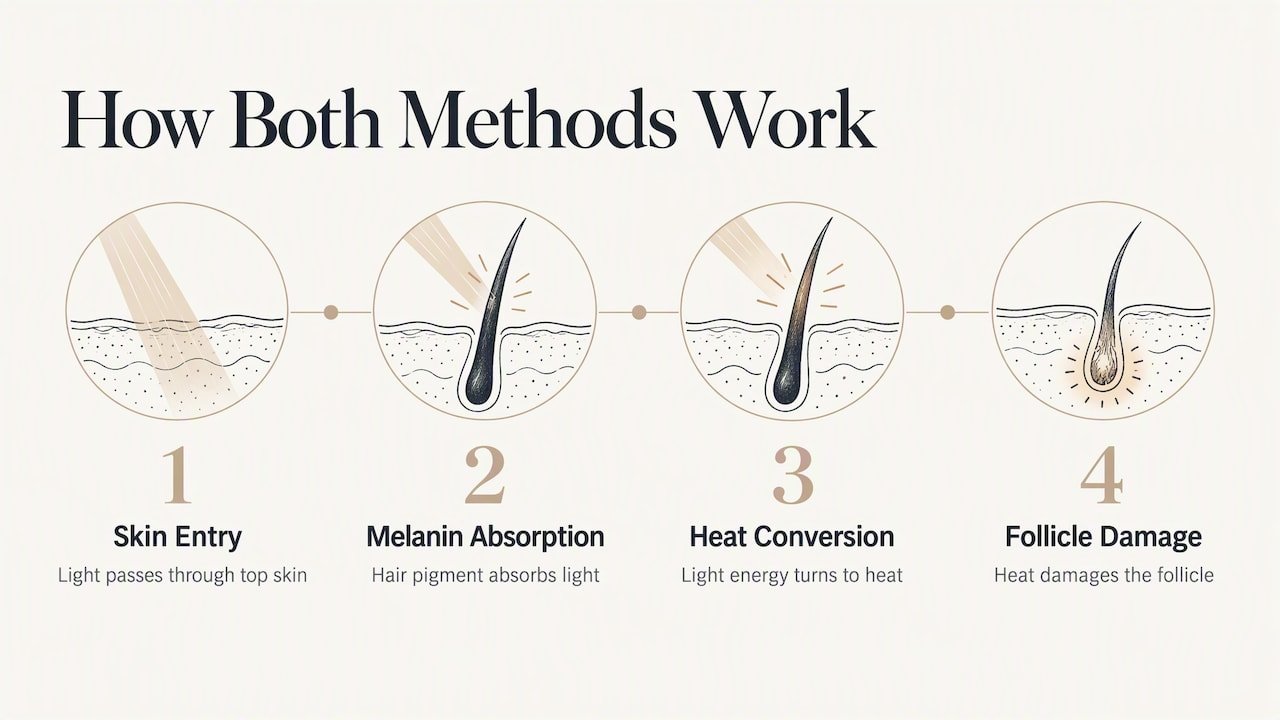
Both methods work on the same principle, sometimes called selective photothermolysis. Light passes through the top layer of skin and is absorbed by melanin, the dark pigment in the hair. The light energy turns to heat, and that heat damages the follicle. North Bristol NHS Trust explains that this is why the treatment depends on pigment: hair without melanin cannot absorb the energy.
Two more shared limits are worth knowing from the start.
Hair growth runs in cycles. Only hairs in the active growth phase (anagen) are connected to the root in a way that makes them vulnerable. At any one time, many hairs are resting. That is why a single session never clears an area and why you need a series of sessions, as Sandwell and West Birmingham NHS Trust sets out in its patient information.
Results are reduction, not a promise of permanence. The NHS describes laser and IPL as longer-lasting than home methods, but not usually permanent. They are also not usually available on the NHS and can be expensive. Leeds Teaching Hospitals NHS Trust says in its patient information on laser hair reduction that complete removal cannot be achieved and that people may expect up to a two-thirds reduction in hair growth on average. Individual results vary.
How laser and IPL differ
The light source
The GOV.UK guidance on lasers, intense light source systems and LEDs treats lasers and IPL as separate categories of equipment, because they behave differently. A laser produces a narrow beam of a single wavelength. An IPL device flashes a broad spectrum and uses filters to cut out the wavelengths it does not want.
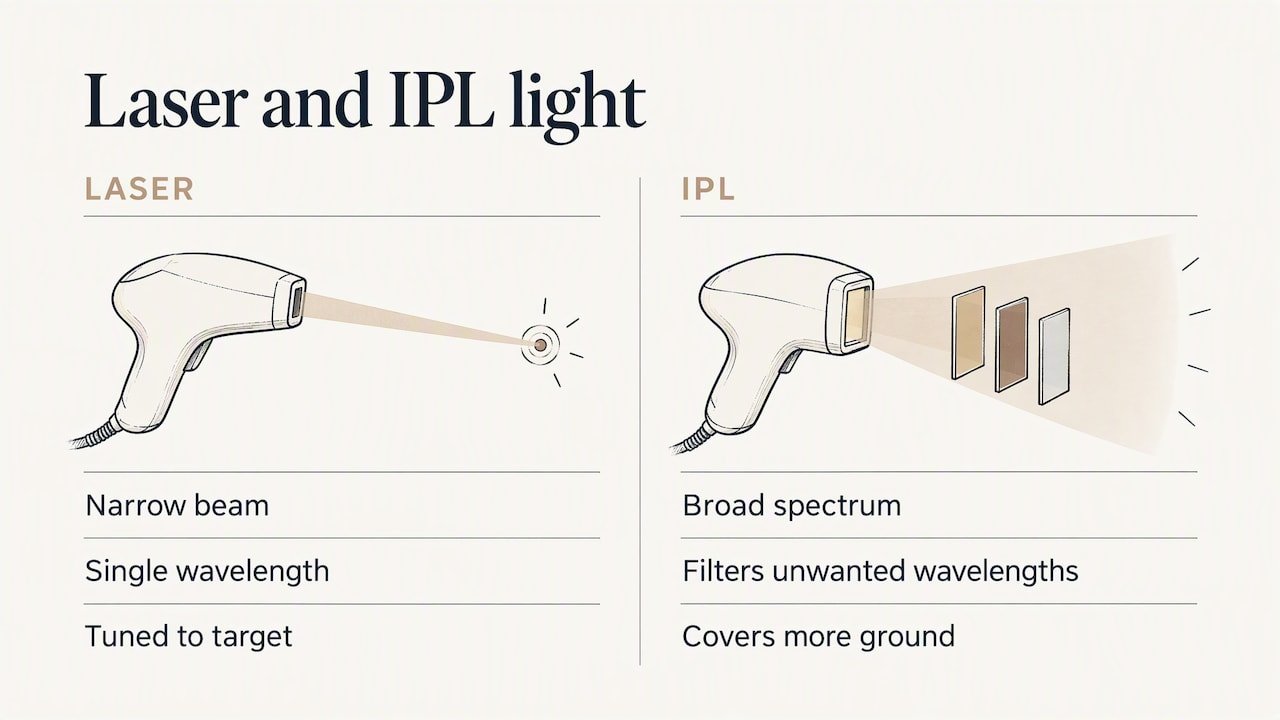
Think of it as a spotlight versus a floodlight. The spotlight can be tuned to the target. The floodlight covers more ground but sends some energy that the target does not absorb well, and some that the surrounding skin does.
Selectivity and depth
Because a laser is tuned to one wavelength, the practitioner can choose a wavelength that suits a given depth of follicle and a given skin tone. IPL’s broad band is generally less selective, which is why IPL may need more sessions and why outcomes can be less consistent. That is a general pattern across sources, not a rule for every device or every person.
What the research says
A 2019 meta-analysis in the Journal of the European Academy of Dermatology and Venereology compared the technologies. Its broad message is that professional laser and IPL outcomes can be similar, with a trend towards better efficacy for certain lasers, such as alexandrite and diode, than for IPL. It also found no modality proven to guarantee complete, permanent removal. So the honest answer to “which is better” is: laser tends to come out ahead, but the gap is not dramatic, and operator skill and the right match to your skin and hair count for a lot.
Where diode laser fits
People often search for “diode vs IPL” as though diode were a separate third option. It is not. Diode is one type of laser, defined by the way the light is generated. Alexandrite and Nd:YAG are other lasers used for hair reduction. Each has its own wavelength, which is part of why practitioners choose between them according to skin tone and hair type.
So a diode-versus-IPL question is really the same laser-versus-IPL question with a specific laser named. The same points apply: a single wavelength, more selectivity, and a research trend favouring laser. Which laser is right for you is a question for the practitioner who assesses you. Leeds Teaching Hospitals NHS Trust explains that its choice of laser depends on the treatment being carried out, which is a useful reminder that no one device is best for everybody.
Side by side
| Question | Laser (including diode) | IPL |
|---|---|---|
| Light | One focused wavelength | Broad, filtered spectrum |
| Selectivity | Higher, can be matched to skin and hair | Lower, broader energy |
| Research trend | Tends towards greater efficacy | Often comparable, sometimes less effective |
| Number of sessions | A course is needed | A course is needed, sometimes more sessions |
| Hair colour | Needs dark, pigmented hair | Needs dark, pigmented hair |
| Permanence | Long-lasting reduction, not guaranteed permanent | Long-lasting reduction, not guaranteed permanent |
| Regulation | Professional systems fall under UK safety guidance | Same guidance covers IPL equipment |
Who each option may suit
Hair colour and thickness
This matters more than the choice of device. North Bristol NHS Trust states that white, grey, blonde and ginger hair lack the melanin needed to absorb the light, and fine downy hair is generally unsuitable. If your hair is light, neither laser nor IPL is likely to help, and no clinic should tell you otherwise. For hair that is light and stubborn, the route to look at is electrolysis, which we cover in our piece on laser vs electrolysis in UK clinics.
Skin tone
Hair reduction works best when there is strong contrast between the hair and the skin: dark hair on lighter skin gives the most predictable result. The same NHS page notes that darker skin tones carry a higher risk of pigment change, so a careful skin assessment is essential. The British Association of Dermatologists also stresses that light-based treatment should be done by a qualified practitioner who can manage the risks, particularly in darker skin.
In practice this is where the laser-versus-IPL choice becomes real. A broad-spectrum device sends more energy that skin pigment can absorb, so for deeper skin tones, a practitioner will usually look for a device and settings that treat the hair while sparing the skin. That decision should come from an in-person assessment, including a patch test where appropriate, not from a table in an article.
Tanned skin
Recent sun, sunbeds and fake tan all raise the amount of pigment in the skin, which narrows the contrast the light relies on. If you have a holiday coming up or have tanned recently, read our guides on laser hair removal and sun exposure and laser hair removal on tanned skin.
Larger areas versus small ones
IPL handpieces often have a wide window, which is one reason the technology is associated with larger areas. That is a convenience, not proof of better results. Lasers can also treat large areas, and the number of sessions you need depends on your hair, skin and the area treated.
Risks and side effects
Both technologies are heat-based, so the risks overlap. The NHS patient leaflet from Sandwell and West Birmingham describes redness, swelling and blistering as possible, with pigment changes and scarring in rarer cases. It reports hyperpigmentation (darkening) in around 17% of patients, hypopigmentation (lightening) in around 1% and scarring in roughly 1 in 800. Those are figures from one document, not a prediction for you, and the risk depends on your skin tone, your sun exposure and how well the device is matched to you.
A few practical points follow from this:
- Tell the practitioner about medicines, recent sun, tanning products, a history of cold sores in the area, and any skin condition in the area to be treated.
- Follow the pre-treatment instructions. These usually include shaving the area beforehand and avoiding waxing and plucking between sessions, because those disrupt the hair cycle. Westminster City Council’s laser hair removal checklist is one local-authority example of this standard guidance.
- If you notice blistering, severe pain or a colour change after a session, contact the clinic that treated you, and see your GP or NHS 111 if you are worried. Our laser hair removal aftercare guide covers what is normal and when to call.
Safety, regulation and who should treat you
Professional lasers and IPL equipment are covered by the same GOV.UK guidance on the safe use of lasers and intense light sources. That guidance expects safety rules, eye protection and risk assessment around treatment. The Westminster checklist above lists practical measures such as covering reflective surfaces and displaying safety notices on the treatment room door.
When you compare providers, whichever technology they use, ask:
- Which device or wavelength will you use on my skin and hair, and why?
- Will you assess my skin and hair in person before the first treatment, and do a patch test?
- Who will carry out the treatment, and what is their training?
- What are the realistic outcomes and limits for someone with my hair colour?
- What aftercare do I need, and who do I contact if something goes wrong?
Our guide on how to choose a laser hair removal clinic goes through these and more.
What about home IPL and laser devices?
Home devices are a separate category. A review in PubMed on light-based home-use devices explains that they evolved from high-fluence professional machines into low-fluence appliances, and that they also need repeated use to work. Lower energy is partly a safety design for use without supervision, so you should expect a slower and often more modest effect than a professional course. The same limits on hair colour apply. If you have darker skin, a skin condition, or are unsure, speak to a pharmacist, your GP or a qualified practitioner before using one.
So, which should you choose?
Start with your hair and skin, not the device name.
- Dark hair, lighter or medium skin: both technologies may be suitable. Laser’s selectivity and the research trend make it a strong first choice to discuss.
- Dark hair, deeper skin tone: device choice and settings are critical. Look for a practitioner who explains how they will protect your skin and who offers a patch test.
- Light, grey, blonde or ginger hair: neither will work reliably. Ask about alternatives such as electrolysis.
- Fine, downy hair: generally unsuitable for light-based treatment.
- Recently tanned: wait. Tanned skin raises the risk of side effects and lowers the contrast the treatment needs.
If you mainly want fewer ingrown hairs and razor bumps, the British Association of Dermatologists notes that shaving and waxing can cause pseudofolliculitis, and that light-based treatment is sometimes sought to reduce it. That is a reason to ask a professional, not a guarantee.
Laser hair removal at Dermacy Clinic
At Dermacy Clinic in Armthorpe, Doncaster, we offer laser hair removal, not IPL or electrolysis. Recommendations depend on an individual assessment, and results vary. If you want to see how a course works, which areas we treat and the current prices, our laser hair removal page has the details and the route to book. We also treat men, which is covered on our laser hair removal for men page.
If you are preparing for a sensitive area, our guide to your first bikini laser appointment walks through what to expect.
FAQ
Is laser or IPL better for hair removal?
Laser is generally considered more selective, and research shows a trend towards greater efficacy for lasers such as diode and alexandrite. Professional IPL can still give comparable results in some people. Neither is proven to be permanent, and your hair colour and skin tone matter more than the label.
Is diode laser better than IPL?
Diode is a type of laser, so it shares the single-wavelength precision that separates laser from IPL. The 2019 meta-analysis suggests a trend favouring diode and alexandrite over IPL. Which laser suits you depends on your skin and hair, and a practitioner should assess that in person.
Does laser or IPL work on dark skin?
Both can cause pigment changes in darker skin, so careful assessment and device selection are essential. Hyperpigmentation has been reported more often in darker skin tones. Ask a qualified practitioner about the device they will use and whether a patch test is advised before you commit to a course.
Is laser or IPL hair removal permanent?
No method of light-based hair reduction is proven to be permanent. The NHS describes the results as longer-lasting than home methods but not usually permanent. You may need top-up sessions in future, and results vary between people.
Who is not a good candidate for IPL or laser?
People with white, grey, blonde or ginger hair, or fine downy hair, are unlikely to respond. Recent tanning, certain medicines and some skin conditions also affect suitability. A qualified practitioner should assess you before treatment.
Sources
- NHS: Excessive hair growth (hirsutism)
- British Association of Dermatologists: Hirsutism
- North Bristol NHS Trust: Hair removal
- Sandwell and West Birmingham NHS Trust: Hair removal
- Leeds Teaching Hospitals NHS Trust: Laser hair reduction
- Leeds Teaching Hospitals NHS Trust: Which laser will be used for my treatment?
- 2019 meta-analysis, Journal of the European Academy of Dermatology and Venereology (PubMed)
- Light-based home-use devices for hair removal (PubMed)
- GOV.UK: Lasers, intense light source systems and LEDs
- Westminster City Council: Laser hair removal checklist
Recommended
- Laser vs Electrolysis in UK Clinics: Laser First, Then Strays
- Why You Need Laser Hair Removal Treatment
- How to Choose a Laser Hair Removal Clinic | 7 Questions
- Laser Hair Removal Aftercare: What to Do and When to Call
This article provides general information and is not a diagnosis or personalised medical advice. Treatment suitability, risks and expected outcomes require an individual consultation. Results vary.