Most people see redness and feel warmth straight after microneedling, and the redness usually eases within one to two days. Peeling, tightness and mild swelling can follow, and how long each lasts depends on the device, the needle depth, your skin and the concern being treated. This guide covers the questions people ask once the appointment is over: what is normal, what to put on your skin, what to avoid, and when to pick up the phone.
One point first. Your own practitioner’s written aftercare overrides any general guide, including this one. Needle depth, the device and the products used in your session all change the advice.
TL;DR
- Warmth and redness straight after treatment are expected. An NHS hospital leaflet says redness should improve after one to two days, and tightness or discomfort can last one to three days.
- Keep skin clean, moisturise gently, do not pick at flakes or scabs, and protect the skin from the sun.
- The same leaflet advises avoiding hot water, saunas, swimming, sweaty exercise and makeup for 72 hours, and sun exposure for seven days. Your practitioner may set different limits.
- Worsening pain, spreading redness, discharge or an open wound is not normal healing. Contact your practitioner, your GP or NHS 111.
- Results build over weeks and usually need a course, so do not judge the treatment by the first few days.
Table of Contents
- Why aftercare matters more than it does after a facial
- The first hours after treatment
- Microneedling recovery day by day
- How to look after your skin in the first week
- What to avoid after microneedling, and for how long
- Makeup, exercise, swimming and your usual routine
- Normal healing or something to ask about?
- Why recovery differs between people
- When will you see results, and how long between sessions?
- Booking microneedling with Dermacy Clinic
- FAQ
- Sources
Why aftercare matters more than it does after a facial
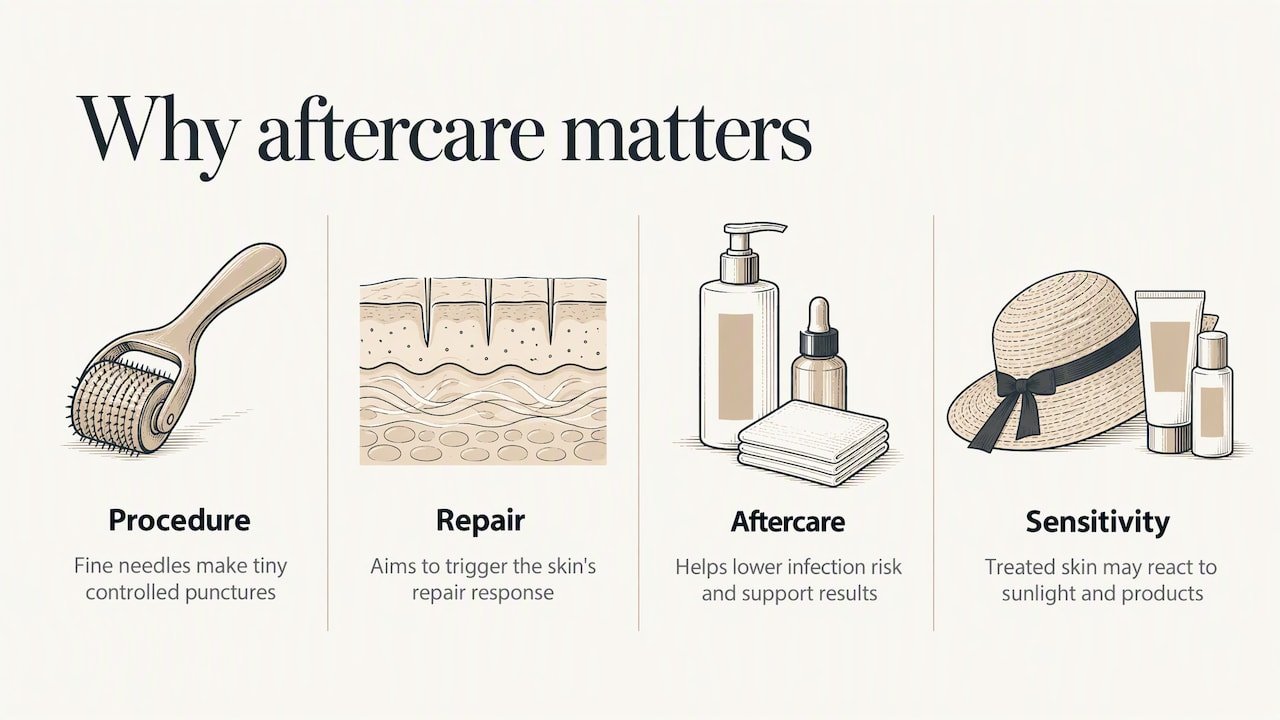
Microneedling uses fine needles to make tiny controlled punctures in the skin. The aim is to trigger the skin’s repair response. That makes it a procedure rather than a surface treatment, and the American Academy of Dermatology describes microneedling as a medical procedure that comes with an aftercare plan. Good aftercare helps lower the risk of infection and supports the result.
The FDA makes a related point in its consumer guidance: treated skin can be more sensitive to sunlight and to products such as sunscreen, makeup, moisturisers, retinol, glycolic acid, menthol, capsaicin or alcohol, so you should discuss aftercare with your provider. That page is American, but the reasoning applies anywhere: for a short while, the skin barrier is not working at full strength.
The first hours after treatment
Expect the skin to feel warm and look red, much like mild sunburn. The Chelsea and Westminster NHS leaflet lists warmth, redness, pain or tightness and possible pinpoint bleeding during the session as normal reactions.
What happens next depends on what you were given. The leaflet in question supplies a cooling gel to use straight after treatment and for the first 24 hours, with nothing else applied in that window unless the clinician says so. Your clinic may use a different product or protocol, so follow the instructions you were handed rather than a generic list.
Practical points for the first evening:
- Keep your hands clean before you touch your face, and avoid touching it more than you need to.
- Sleep on a clean pillowcase if you can.
- If a spot bleeds lightly, press sterile gauze on it rather than rubbing with a tissue or flannel.
- If the skin feels hot and tight, a clean ice pack or gel pack held near the area (not pressed hard on it) can ease discomfort and swelling, as the NHS leaflet suggests.
Microneedling recovery day by day
No two recoveries match exactly, so treat this as a typical pattern rather than a schedule. It draws on the NHS leaflet and the AAD, which says reactions such as redness, darker-looking treated skin, sunburn-like discomfort, burning and swelling usually disappear within a few days to a week.
| Stage | What you may notice | What helps |
|---|---|---|
| Straight after | Warmth, redness, tightness, sometimes pinpoint bleeding | Cooling gel or the product your practitioner gave you, clean hands, no other products unless advised |
| Day 1 to 2 | Redness easing, skin may feel tight or sensitive | Keep the skin clean, then a simple moisturiser once your practitioner says you can |
| Around day 2 to 3 | Dryness, flaking or light peeling can begin | Moisturise, do not pick, avoid scrubbing |
| Up to about a week | Most visible reactions settle | Daily sun protection, gentle routine |
| Weeks to months | Gradual change in texture or tone | Patience, and a course if one was planned |
Two cautions about that table. First, the NHS leaflet says peeling may start after a couple of days and tightness can last one to three days, but a deeper treatment can take longer to calm down than a light one. Second, a small study of acne scars noted transient redness in nine patients and swelling in six, which shows that even in a research setting, reactions differ from person to person.
How to look after your skin in the first week
Keep it clean and simple
The NHS leaflet advice comes down to this: keep the area clean, then use a simple moisturiser three to four times a day once the initial 24 hours have passed. Simple here means a plain, fragrance-free product without active ingredients. It does not mean a favourite serum from the bathroom shelf.
If your practitioner recommended or supplied a specific cleanser and moisturiser, use those. They were chosen with your session in mind.
Do not pick
Peeling is common. The leaflet’s advice is to moisturise rather than pick, and to avoid creating scabs. Picking at flakes can pull away skin that is not ready to come off, which raises the risk of marks and gives bacteria an easier way in. If a flake is catching on your clothes or makeup brush, let it come away on its own during gentle washing.
Manage discomfort sensibly
Tightness and a sunburn-like feeling are expected. A cool gel pack or ice pack wrapped in a clean cloth is the leaflet’s suggestion for discomfort and swelling. If you would normally take over-the-counter pain relief, check the packaging or ask a pharmacist whether it suits you. Do not use creams or numbing products on broken skin unless your practitioner has told you to.
Protect the skin from the sun
The leaflet advises avoiding sun exposure for seven days and continuing sunblock afterwards on scars. In British terms, that includes a bright day in a Doncaster garden, not just a beach holiday. A hat and shade help in the first week. Once your practitioner says your skin is ready, a broad-spectrum sunscreen is the next step, because freshly treated skin is more vulnerable to sun. If you are treating pigmentation, sun protection matters even more. One 2024 study of radiofrequency microneedling for acne recorded post-inflammatory hyperpigmentation in two patients, a reminder that darkening after inflammation is a recognised possibility.
What to avoid after microneedling, and for how long
The NHS leaflet is one of the clearer UK sources. For 72 hours it advises avoiding:
- hot water, saunas and swimming, or longer until swelling and bleeding have settled
- sweaty exercise
- makeup
You can still bathe and shower as normal, just not hot. For seven days it advises avoiding sun exposure.
Two honest caveats. This leaflet comes from one hospital service, and the page shows no publication date, so it is a sound reference point rather than a universal rule. Clinics set their own limits, and a light session may carry shorter restrictions than a deeper one. If your practitioner gives you a different time frame, follow theirs.
Products to hold back
The FDA’s list of products that can irritate recently treated skin is a useful reminder: retinol, glycolic acid, menthol, capsaicin and alcohol-based products are all named. Exfoliating acids, strong retinoids and scrubs are the usual suspects in a normal routine. When it is safe to restart them depends on the treatment you had and the products you use, so ask at your appointment rather than guessing from a blog. There is no single restart date that fits everyone.
Makeup, exercise, swimming and your usual routine
These are the practical questions that sit behind most searches for microneedling aftercare.
When can I wear makeup?
The NHS leaflet says to wait 72 hours. Some clinics allow mineral makeup sooner, and some ask you to wait longer. If you have an event coming up, say so when you book so that the timing can be planned around it, and do not schedule treatment the day before a wedding or photo shoot. A related question comes up after other facials too, and our guide on wearing makeup after a HydraFacial explains why the answer differs between treatments.
When can I exercise?
Sweat, heat and friction all irritate healing skin. The leaflet advises avoiding sweaty exercise for 72 hours or until swelling and bleeding have resolved. A gentle walk is different from a hot gym class, and a clean towel and no touching your face matters whenever you do return.
Can I swim or use a sauna?
Not for at least 72 hours according to the leaflet, and longer if the skin is still swollen or has been bleeding. Pool water, hot tubs and saunas combine heat, chemicals and shared surfaces, which is the opposite of what freshly treated skin needs.
When do I go back to my normal skincare?
Bring your full routine to the consultation and ask what to pause, what to keep and when to reintroduce each item. Reintroduce actives one at a time so that, if your skin reacts, you know which product caused it.
Normal healing or something to ask about?
Most reactions are expected and settle by themselves. The list below is general information, not a diagnosis, and it does not replace advice from a clinician who has seen your skin.
Usually expected
- Redness and warmth that improve over the first one to two days
- Tightness or a sunburn-like feeling for one to three days
- Mild swelling that settles, with research on radiofrequency microneedling reporting swelling that cleared within 24 hours
- Dryness, flaking or light peeling after a couple of days
Contact your practitioner, GP or NHS 111
- Pain that is getting worse instead of easing
- Redness that spreads, or heat that is increasing after the first couple of days
- Weeping, yellow crusting, pus or a wound that does not look like it is closing
- A fever or feeling unwell
- Blistering, or a spot that is changing in a way you did not expect
- A cold sore appearing in the treated area
The NHS leaflet’s advice is to call the service if you are concerned that the area may be infected or a wound has formed. Use the contact details you were given, and if you cannot reach the clinic and are worried, ring NHS 111, or 999 in an emergency such as difficulty breathing or facial swelling that is spreading quickly. Please do not treat a suspected infection with leftover creams or antibiotics from a previous illness. That is a job for a clinician who can see it.
Why recovery differs between people
If your friend was back to normal in two days and you are still flaky on day five, nothing has necessarily gone wrong. Several things affect recovery:
- The device and depth. Light and deeper sessions produce different amounts of redness and peeling. Radiofrequency microneedling adds heat, and the research on it reports erythema in every patient in one acne study.
- Your skin. Sensitivity, dryness, skin conditions such as eczema or rosacea, and a history of marks after inflammation all play a part.
- What the treatment targeted. Acne marks, texture, fine lines and scarring are treated differently, and recovery is part of that plan.
- What you do afterwards. Sun, heat, picking and the wrong products can prolong redness.
The FDA also asks people to discuss, before treatment, numbing-medication sensitivities, bleeding risks, skin conditions and immune status with the provider. Telling your practitioner about these is not a formality. It affects whether treatment is suitable and what recovery looks like. Active acne, cold sores and some medicines may mean postponing, and that is a decision for a qualified professional after an assessment.
Acne marks versus acne scars
If your reason for microneedling is old breakouts, it helps to know what you are treating, because flat marks and indented scars are different concerns. Our article on acne marks versus acne scars before microneedling explains the difference, and the acne scar treatment page covers the options we offer.
When will you see results, and how long between sessions?
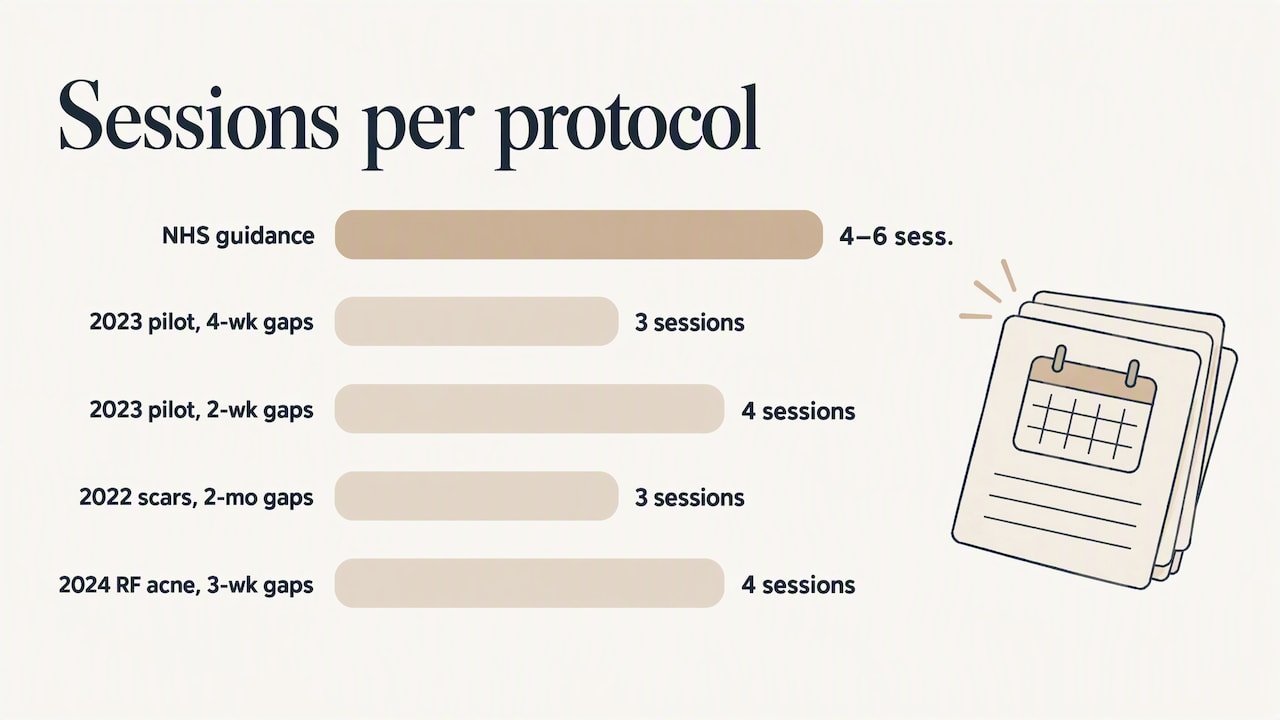
Microneedling is not an overnight change. The NHS leaflet says that normally four to six sessions are needed, at least six weeks apart, and that improvement may take up to three months or more than one treatment to notice. That is one hospital service’s guidance for its patients, not a rule for every skin concern or every device.
Published studies use a range of schedules, which tells you why there is no universal interval:
- A 2023 pilot study on acne used three sessions four weeks apart and four sessions two weeks apart, and reported no post-treatment complications in that study. It concerned a specific acne protocol.
- A 2022 study of atrophic facial acne scars used three sessions at two-month intervals, assessing participants two months after the last one.
- A 2024 study of radiofrequency microneedling for acne used four sessions three weeks apart.
These are small studies in specific groups, and they are not a plan for you. How many sessions, and how far apart, is a decision for your practitioner after assessing your skin and your goals. Results vary, and some people see more change than others.
Booking microneedling with Dermacy Clinic
If you are in Armthorpe, Doncaster or elsewhere in South Yorkshire and are considering treatment, the place to start is our microneedling page. It covers the Dermapen and radiofrequency options we offer, how a treatment is approached, and current prices and booking, so you can read about it before you decide. A consultation is where your suitability, your skin history and the aftercare for your particular session are talked through. We do not promise a fixed recovery time or a guaranteed result, because neither exists.
FAQ
How long does redness last after microneedling?
An NHS hospital leaflet says redness should improve after one to two days, and the AAD says common reactions usually settle within a few days to a week. Deeper treatments and sensitive skin can take longer. If redness is spreading, getting hotter or becoming more painful, contact your practitioner.
Is peeling after microneedling normal?
Yes, light flaking or peeling often appears after a couple of days. Moisturise and leave it alone rather than picking or scrubbing, as picking can cause marks and raise infection risk. If the skin is weeping, crusting yellow or looks like an open wound, get it checked.
Can I wash my face after microneedling?
You can bathe and shower as normal, according to the NHS leaflet, but avoid hot water and keep the skin clean. What you cleanse with, and when you start, depends on your practitioner’s instructions, especially in the first 24 hours when some protocols say to use only the gel provided.
When can I wear makeup and go back to the gym?
The NHS leaflet advises waiting 72 hours for makeup and for sweaty exercise, hot water, saunas and swimming, or longer if swelling or bleeding persists. Your clinic may set different timings depending on the device and depth used, so check your aftercare sheet.
When should I worry about a reaction?
Worsening pain, spreading redness, heat, pus, a wound that is not closing, fever or feeling unwell are reasons to contact your practitioner, your GP or NHS 111 the same day. Do not wait to see whether it improves by itself.
Sources
- Microneedling Post-treatment Information for patients, Chelsea and Westminster Hospital NHS Foundation Trust
- Microneedling can fade scars, uneven skin tone, and more, American Academy of Dermatology
- Microneedling Devices: Getting to the Point on Benefits, Risks and Safety, US FDA
- Study to Determine the Safety and Efficacy of Microneedling in acne, 2023
- An objective assessment of microneedling therapy in atrophic facial acne scars, 2022
- Efficacy and safety of microneedling radiofrequency in acne, 2024
Recommended
- Acne Marks vs Acne Scars: What to Know Before Microneedling
- Cosmelan Homecare and Peeling: What to Ask Your Practitioner
- Can You Wear Makeup After a HydraFacial?
This article provides general information and is not a diagnosis or personalised medical advice. Treatment suitability, risks and expected outcomes require an individual consultation. Results vary.