Standard microneedling uses fine needles to make controlled micro-injuries that prompt the skin to repair itself. RF microneedling does the same and adds radiofrequency heat delivered through the needles into the dermis. Heat is the whole difference, and it changes what the treatment is aimed at, how much it can affect the deeper layers of the skin, and what can go wrong. Neither treatment is better in every case. The right one depends on your concern, your skin and who is treating you.
This guide is for adults in Armthorpe, Doncaster and the wider South Yorkshire area who are weighing up the two options. It is general education, not a diagnosis or a treatment plan. Suitability is always decided at an individual consultation, and results vary from person to person.
TL;DR
- Standard microneedling creates micro-channels with needles alone. RF microneedling adds radiofrequency heat beneath the surface, which is intended to encourage deeper collagen remodelling and tightening.
- Standard microneedling is usually considered for texture, fine lines, enlarged-looking pores and some acne scarring. RF is more often discussed for skin laxity and firmness.
- RF carries an extra heat-related risk profile. In October 2025 the US FDA issued a safety communication about serious complications after certain uses of RF microneedling, so operator training and device choice matter.
- Neither treatment guarantees a result or makes scars disappear. Both need a proper assessment first, and some people should not have either.
Table of Contents
- How standard microneedling works
- How RF microneedling works
- The differences at a glance
- Which skin concerns suit which treatment
- What the evidence says about results
- Risks and side effects
- Who may not be suitable
- How to choose between them
- How this fits at Dermacy Clinic
- FAQ
- Sources
How standard microneedling works
Standard microneedling, also called collagen induction therapy, uses a pen or roller with fine needles to create controlled micro-injuries in the skin. The body responds by producing new collagen and elastin, according to the British College of Aesthetic Medicine. There is no heat involved. The effect comes from the mechanical injury and the repair that follows.
The American Academy of Dermatology lists the concerns it can help with as acne scars, dark spots, large pores, melasma, uneven texture and tone, wrinkles and fine lines. In practice the strongest cases are texture-based: rough or uneven skin, visible pores and some atrophic (indented) acne scars. Pigmentation is more nuanced, and we come to that below.
The depth of the needles is adjustable, and it is set according to the area. Skin on the forehead is thicker than skin around the eyes, so a competent practitioner does not use one setting everywhere.
How RF microneedling works
RF microneedling combines the same needle channels with radiofrequency energy. The energy is delivered through the needles into the dermis, so the tissue is heated as well as wounded. The BCAM describes this as an added thermal component that enhances dermal heating and remodelling, often with a greater tightening effect.
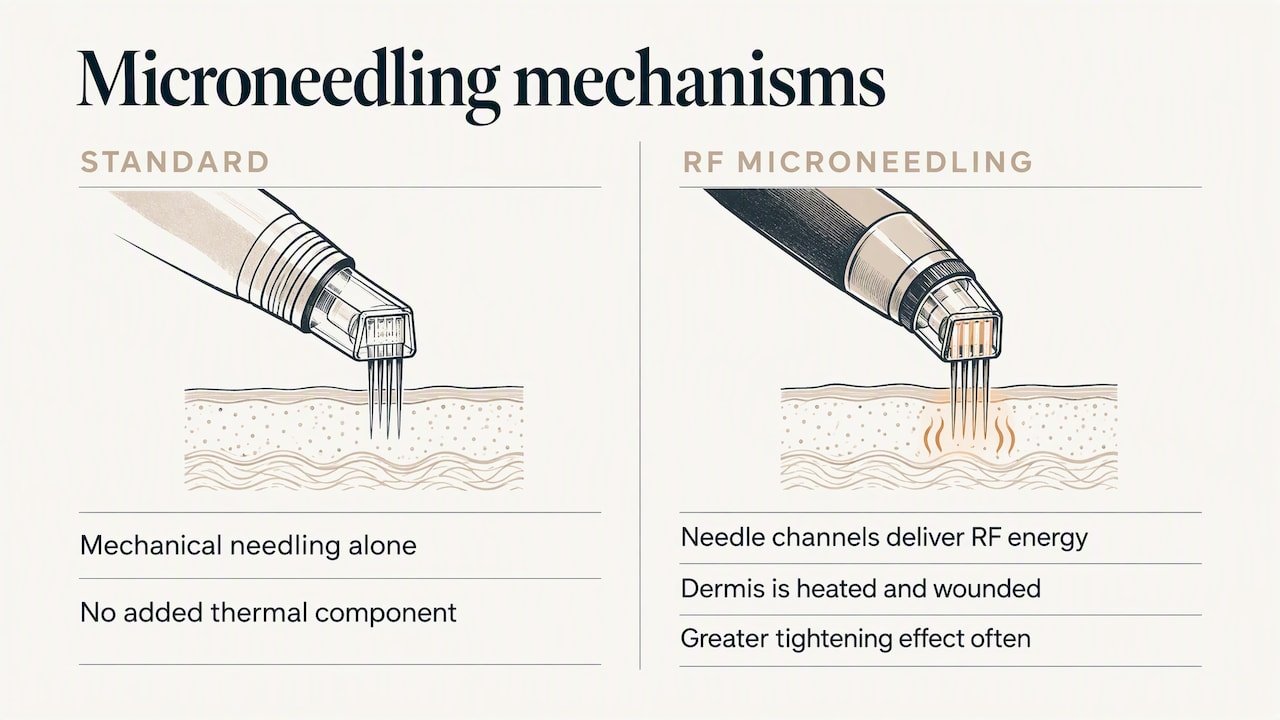
A 2023 review in Plastic and Reconstructive Surgery explains why: controlled thermal damage triggers a stronger fibrotic response, which is thought to lead to more tightening than mechanical needling alone. A more recent review describes RF microneedling as minimally invasive and able to deliver energy to deeper skin layers to support collagen remodelling.
Devices differ. Some deliver energy from the needle tip, some along an insulated shaft, and settings such as depth, energy, pulse length and number of passes all change the effect. The same review notes that parameters vary and that treatment should be individualised and performed by appropriately trained providers.
The differences at a glance
| Standard microneedling | RF microneedling | |
|---|---|---|
| Energy | Mechanical only | Mechanical plus radiofrequency heat |
| Main aim | Texture, fine lines, pores, some acne scarring | Firmness and tightening as well as texture |
| Depth of effect | Dermal channels | Heat reaches the deeper dermis |
| Heat-related risks | None from energy | Burns, uneven heating and fat-layer effects are possible if misused |
| Typical downside to plan for | Redness, tightness, peeling | Redness plus a higher chance of swelling |
| Evidence base | Larger and longer established | Growing, but smaller studies and varied designs |
This is a guide to general principles. A particular device or practitioner can sit outside these patterns, which is why the consultation matters more than the label.
Which skin concerns suit which treatment
Texture, pores and acne scarring
For uneven texture and enlarged-looking pores, standard microneedling is a well-established option. For acne scarring the picture is more careful. Studies of microneedling and fractional RF microneedling for scars report patient satisfaction between 50% and 100%, but satisfaction is not the same as a measured clinical result, and scar types respond differently. An NHS hospital patient leaflet is blunt that microneedling may not improve scar texture, tightening or colour and will not make a scar disappear.
Before choosing any needling treatment for breakouts, it helps to know whether you have flat marks or true indented scars. Our guide to acne marks versus acne scars explains the difference and why it changes the plan.
Laxity, firmness and early sagging
This is where RF is usually discussed. Because heat reaches deeper, RF is aimed at mild to moderate looseness, such as early jowling or crepey areas. One review calls it a credible alternative to fractional lasers with potentially shorter downtime, while noting small studies and variation in design. That is encouraging but not conclusive. RF microneedling will not replicate surgery, and it is not a substitute for a facelift for significant sagging.
Pigmentation
The AAD lists dark spots and melasma among the concerns microneedling may help. Pigmentation is also the area where needling carries a risk of backfiring, because any inflammation can darken skin in people prone to it (see the risks below). Melasma and stubborn pigmentation are best assessed first, and a dedicated pigmentation programme may be more appropriate than needling. Do not assume either type of microneedling is the right route for dark patches.
What the evidence says about results
It is tempting to read “RF is stronger” as “RF is better”. The research is more measured.
- A review of RF microneedling concluded it is effective and can be used repeatedly and safely, but also that its efficacy, safety and comparison with other energy-based devices remain unclear.
- A 2026 safety review says outcomes depend heavily on patient selection, device design, needle depth, energy, pulse duration, passes, anatomical site and operator technique, and that long-term evidence beyond 12 months is limited.
In plain terms, both treatments are credible, neither is a guaranteed fix, and the operator’s judgement is a big part of the outcome. Be wary of any clinic that tells you exactly how many sessions you will need before assessing your skin. Course length is individual.
Risks and side effects
Common effects of both
After standard microneedling the FDA lists dryness, roughness, tightness, redness, itching, peeling, discomfort, burning, bruising, bleeding and crusting. Less common risks include pigment changes, herpes reactivation, infection and persistent adverse effects. Because the skin barrier is deliberately breached, infection is possible with either treatment.
For RF, a 2023 review describes expected effects as mild, short-lived pain, redness and swelling, with bruising possible beyond pinpoint bleeding. A 2026 review reports that redness, swelling and discomfort usually resolve within a week. A 2021 systematic review adds that RF commonly causes pain, redness, swelling and bleeding.
Recovery varies by person and by settings, and day-two appearance is the question most people ask. For a realistic day-by-day picture, see our guide to microneedling recovery and aftercare. We keep that detail there rather than repeating it here.
Rarer risks, and why RF gets extra scrutiny
The same systematic review lists less common events including tram-track scarring, temporary numbness, scaling, crusting, pustules and post-inflammatory hyperpigmentation. The 2026 review adds persistent hyperpigmentation, granulomatous reactions and infection.
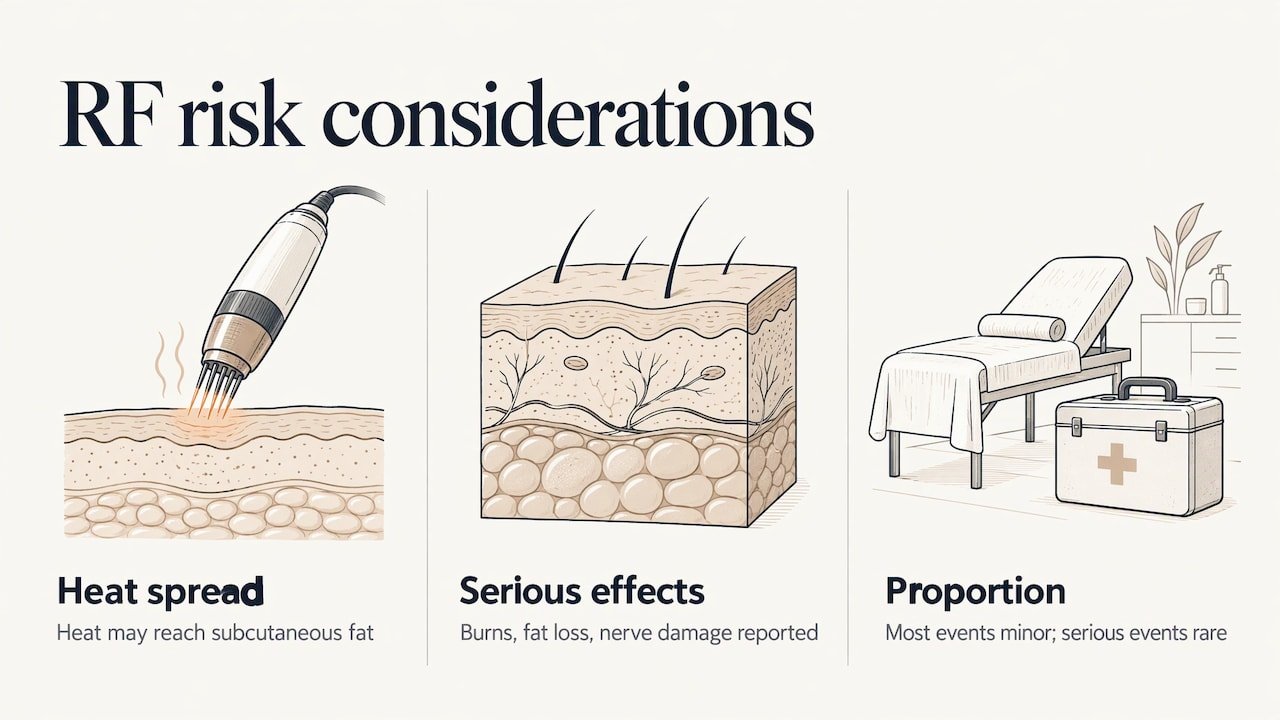
The additional concern with RF is heat. The 2026 review explains that heat can spread beyond the needle tip. Aggressive energy, longer pulses, repeated passes, inaccurate depth or thin tissue may let heat reach subcutaneous fat, so hollowing or contour change is a particular concern around thin-skinned areas such as the eye area and cheeks.
This is the background to the FDA’s safety communication of 15 October 2025. It says serious complications reported after certain dermatologic or aesthetic uses of RF microneedling include burns, scarring, fat loss, disfigurement and nerve damage, and that some cases needed medical treatment or surgical repair. That is a US regulator, and UK rules differ, but the mechanism is the same everywhere.
It is also worth keeping proportion. A dermatologist quoted by Healio said that in experienced, medically trained practice most adverse events are minor and transient and serious events are rare. The sensible reading is neither alarm nor complacency: RF is a treatment where training, device and settings really matter.
If you have a reaction that worries you, such as severe pain, spreading redness, pus, blistering or a fever, contact the clinic that treated you promptly or seek medical advice from your GP or NHS 111. Do not try to manage a complication yourself.
Who may not be suitable
An NHS hospital pre-treatment checklist asks about active skin cancer, local anaesthetic allergy, active skin infections, pregnancy or breastfeeding, keloid scars, sun exposure in the previous 7 days and laser treatment in the previous 21 days. The same leaflet advises trying to avoid aspirin or ibuprofen beforehand because they may increase bleeding. Check with your prescriber before changing any medicine rather than simply stopping it.
Other things to raise at consultation include a history of cold sores in the treatment area, a tendency to darken after skin injury, recent oral acne medication, and any implant or device. RF in particular needs a clear answer on implants and on how thin the tissue is in the area. A qualified practitioner should ask about all of this, and may decide that neither treatment is right for you.
How to choose between them
A practical way to think it through:
- Name your main concern. Texture, pores and some scarring point towards standard microneedling. Early looseness points towards a discussion about RF.
- Think about your skin type. If you darken easily after irritation, tell the practitioner, since heat and inflammation both raise the risk of pigmentation.
- Consider the area. Thin-skinned areas call for extra caution with heat.
- Match the ask to the evidence. If someone promises a facelift without surgery, step back.
- Ask who is treating you and with what. The device, the settings and the practitioner’s training all shape the outcome.
The UK’s 2023 JCCP and CPSA Code of Practice stresses appropriate practitioner skills, clinically validated and appropriately licensed products, a suitability assessment and accurate risk information. It is best-practice guidance rather than a statutory rule, but it is a good yardstick for the questions you ask any clinic.
Questions worth asking at a consultation
- Which device will be used, and is it designed for the area being treated?
- Who carries out the treatment, and what is their training?
- What are the realistic benefits for my concern, and what are the limits?
- What would make you advise against treatment?
- What aftercare will I be given, and who do I contact if I am worried?
How this fits at Dermacy Clinic
At Dermacy Clinic in Armthorpe, microneedling is assessment-led. Our page describes classic microneedling and Dermapen as the established route, and RF microneedling as a separate pathway with its own suitability criteria rather than a bolt-on. We have not yet published a confirmed RF device or price, so please check the page for the latest position rather than relying on this article. A visual skin analysis can support the consultation by documenting your skin, but it is a visual aid, not a diagnostic test, and not every plan uses it.
If you want to see current service details and book, start with our microneedling treatment page. It also links to the booking route once you have read it.
FAQ
Is RF microneedling better than standard microneedling?
Not in every case. RF adds heat, which is intended to give more tightening, so it is usually discussed for early laxity. Standard microneedling is well established for texture, pores and some acne scars. The better choice depends on your concern, skin and practitioner.
Does RF microneedling hurt more or take longer to recover from?
It can involve more swelling because heat is added, though comfort and recovery vary with settings, area and your skin. Reviews describe redness, swelling and discomfort that usually settle within a week. Your practitioner should explain what to expect for you.
Why are some professionals cautious about RF microneedling?
Because heat can spread beyond the needle tip, and misuse has been linked to burns, scarring and fat loss in reports to the FDA. Caution is mostly about training, device choice and settings, not a reason to assume every treatment is unsafe. Ask who is treating you and how.
Can either treatment treat pigmentation or melasma?
Microneedling is listed among options for dark spots and melasma, but inflammation can also worsen pigmentation in some people. Pigmentation needs assessing first, and another programme may suit you better. Results vary and no outcome is guaranteed.
How many sessions will I need?
There is no fixed number that suits everyone. It depends on your concern, how your skin responds and the device. Be cautious of anyone who sets a fixed course before assessing you.
Sources
- British College of Aesthetic Medicine: Microneedling Radiofrequency
- American Academy of Dermatology: Microneedling can fade scars, uneven skin tone, and more
- Radiofrequency Microneedling: Technology, Devices, and Clinical Applications (PMC)
- Effectiveness of Radiofrequency Microneedling (Aesthetic Plastic Surgery, 2026)
- Microneedling for the Treatment of Scars: An Update (PMC)
- Chelsea and Westminster NHS: Microneedling pre-treatment information
- Radiofrequency Microneedling: A Comprehensive and Critical Review (PubMed)
- Complications of radiofrequency microneedling (BMC Plastic and Reconstructive Surgery, 2026)
- FDA: Microneedling Devices
- FDA safety communication: Potential Risks with Certain Uses of RF Microneedling
- A Systematic Review Examining the Potential Adverse Effects of RF Microneedling (PMC)
- Healio: Is radiofrequency microneedling safe?
- JCCP and CPSA Code of Practice 2023
Recommended
- Acne Marks vs Acne Scars: What to Know Before Microneedling
- Microneedling Doncaster | Dermapen & RF
- Microneedling Recovery and Aftercare: What to Expect
This article provides general information and is not a diagnosis or personalised medical advice. Treatment suitability, risks and expected outcomes require an individual consultation. Results vary.