Laser hair removal may need maintenance sessions because it reduces hair rather than switching every follicle off for good. Some follicles respond more slowly, hormones can wake dormant ones, and finer hair can reappear over months or years. A maintenance session is a top-up for that regrowth. It is not a sign that the first course failed. Whether you need one, and when, depends on your hair, your skin and your body, and a qualified practitioner has to judge that for you.
This article covers the narrow question of what happens after the initial course. It looks at why regrowth happens, what influences it, what the NHS sources say about top-ups and when a reassessment is worth booking. Results vary from person to person, and nothing here is a promise of a particular outcome.
TL;DR
- Laser hair removal reduces hair growth. It does not guarantee that every hair is gone for ever, so some people choose occasional top-up sessions.
- One NHS trust says many people have top-ups once or twice a year after an initial course. That is a general pattern, not a schedule for you.
- Hormones, hair colour, skin type, body area and how you responded to your course all affect how much regrowth you see.
- A reassessment is useful when you notice regrowth that bothers you, a change in hair pattern, or a change in your health or medication.
- At Dermacy Clinic, any plan follows an individual assessment. See the laser hair removal page for current service details and booking.
Table of Contents
- What laser hair removal actually does
- Why hair can come back after a full course
- How often do people have maintenance sessions?
- What happens if you stop after the initial course?
- Can one session give lasting results?
- Keeping results between sessions
- Is repeated treatment safe over the long term?
- When a reassessment is worth booking
- Questions to ask at a maintenance review
- Booking a laser hair removal review at Dermacy Clinic
- FAQ
- Sources
What laser hair removal actually does
Laser hair removal uses light energy that is absorbed by pigment in the hair. The light turns to heat, and the heat damages the follicle so that it grows less hair. The North Bristol NHS Trust laser centre describes treatment as a course, and says most people need 4 to 6 sessions at the start to get the best results.
The word to notice is reduction. A 2006 Cochrane review, summarised in an NHS commissioning policy, found a short-term effect of roughly 50% hair reduction up to six months after treatment. That figure comes from older evidence and is not a prediction for any individual. It does show why clinicians talk about reduction and management rather than a one-off fix.
Another NHS source, a regional hair removal policy, notes that hair growth is reduced for a period of weeks to months after laser, IPL or electrolysis. It adds that several treatments may be needed to reach complete hair loss. Reduction is the realistic expectation, and the length of that reduction differs between people.
If you want the detail of the first stage, including how sessions are spaced, that belongs to a separate topic. Here we stay with what comes after.
Why hair can come back after a full course
There is no single cause of regrowth. Several things can combine, and they differ from one person to the next.
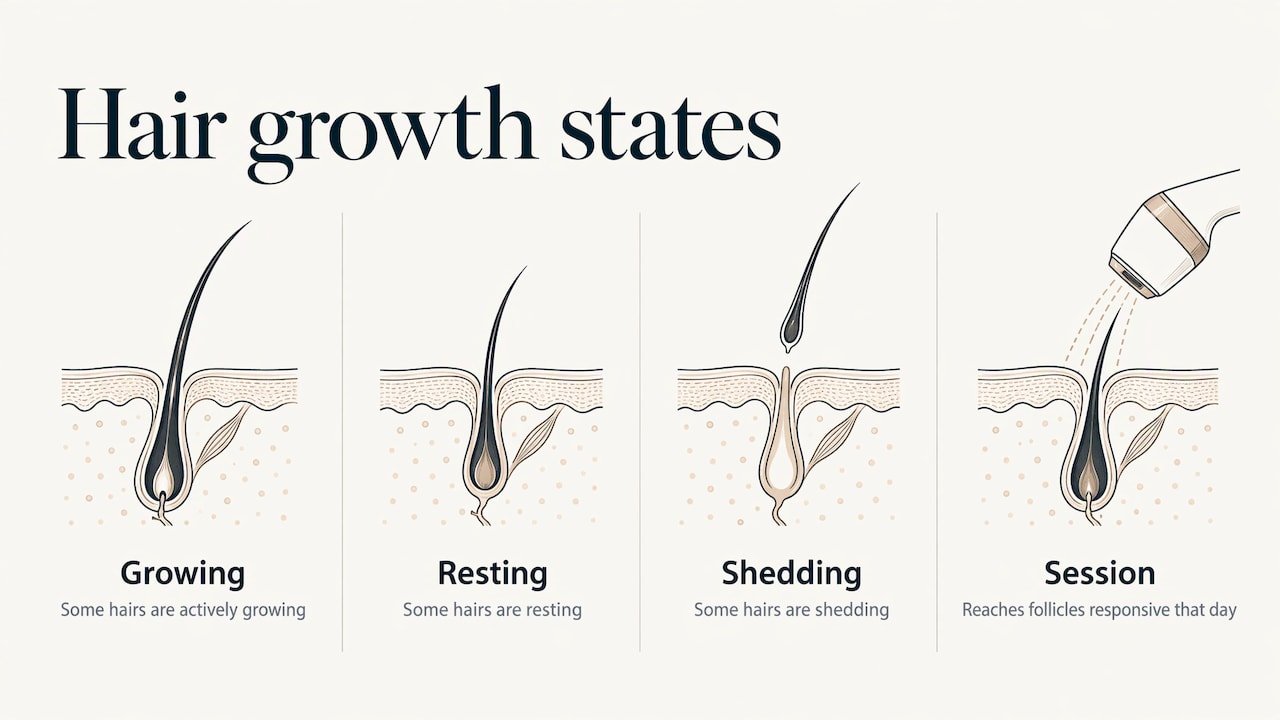
Hairs grow in cycles
The hairs on one area of your body are not all at the same stage at the same time. Some are actively growing, and others are resting or shedding. A treatment session reaches the follicles that are responsive on that day. That is one reason a course is spread across several appointments rather than done in one go. Even after a well-completed course, a few follicles may not have been affected enough, and they can produce hair later.
Hormones keep influencing growth
Hair growth is partly driven by hormones, and hormone levels are not fixed across a lifetime. Puberty, pregnancy, perimenopause, the menopause and some medical conditions can all change which follicles are active. The NHS policy summary mentioned above notes that hirsutism linked to polycystic ovary syndrome (PCOS) may be more resistant to laser hair removal. If you have PCOS or another hormonal condition, a conversation with your GP is the right place to start, alongside any cosmetic treatment.
This matters for maintenance because hormone-driven areas, often the face, neck and lower abdomen, can show new growth after a gap. The hair is not a sign that your earlier sessions did nothing. The underlying driver may simply still be active.
Hair colour and thickness
Laser relies on pigment, so hair colour and thickness affect how well a session works. Dark, coarse hair against lighter skin usually gives the light more to work with. Fine or pale hairs absorb less energy. Practitioners often see fine hair that was not obvious earlier become more noticeable once the thicker hair has gone. If that happens to you, it may be something to discuss at a review rather than a reason to worry.
Body area
Different areas behave differently. Underarms, legs and bikini areas do not follow the same pattern as the face or neck. That is why a single “every X months” rule does not hold for everyone. Your practitioner should look at the area you are treating rather than apply a one-size answer.
Your own response during the course
How well your hair thinned during the initial sessions is useful information. Someone whose hair thinned markedly and stayed away for a long time may need little or no top-up for a while. Someone who had a patchier response may want earlier reassessment. This is one reason a record of how you responded is helpful.
How often do people have maintenance sessions?
The honest answer is that it varies. The North Bristol NHS Trust says that many people then have top-up treatments once or twice a year to keep hair under good control. That is a useful reference point for what is commonly seen, and it is stated by an NHS service about its own patients.
It is not a fixed rule, and at Dermacy Clinic we do not set a standard maintenance timetable. Some people prefer to wait until regrowth bothers them. Others like a regular check. Both approaches are reasonable, and the right one depends on your hair, your goals and what your practitioner sees on the day.
A practical way to think about it:
| Situation | What it may mean for maintenance |
|---|---|
| Little regrowth and you are happy with the result | You may not need a top-up for some time |
| Fine hairs appearing in treated areas | A review can show whether these are suitable for treatment |
| Regrowth in hormone-sensitive areas | You may find top-ups more useful, and your GP can advise on any underlying cause |
| A long break after an unfinished course | A reassessment can decide whether to resume or restart |
| Change in medication or health | Tell your practitioner before any further session |
This table describes possibilities, not a plan. The aim is to help you know what to ask.
What happens if you stop after the initial course?
Stopping is a legitimate choice, and many people do. What you can expect is that hair grows back more slowly and often more finely than before, but not necessarily not at all. A Leeds and York NHS patient leaflet describes fewer hairs regrowing as treatment progresses, with the hair that returns being much finer.
One policy document also notes that NHS-funded hirsutism treatment is normally limited to a maximum of six sessions. That is a funding limit for a specific medical pathway, not a statement about how many sessions are right for a private cosmetic client. If you have stopped after six sessions and are seeing growth, the sensible step is a reassessment to see which areas, if any, would benefit from more treatment.
If you stop and later want to restart, tell your practitioner how long the gap has been. They can decide on suitability, and they will want to check your skin for tanning, any new medication and any changes since your last session.
Can one session give lasting results?
One session can reduce some growth, but it is unlikely to give the lasting smoothness most people are after. The reason links back to the cycles above: a single appointment only reaches the follicles that are responsive that day. This is why the initial stage is a course, and why a one-off appointment should be seen as the start of a process rather than a complete treatment. Individual response differs, so your practitioner is the right person to set expectations for your own hair.
Keeping results between sessions
What you do between appointments affects how safe and effective treatment is. The NHS guidance below applies equally during a maintenance phase.
Protect your skin from the sun
The North Bristol NHS Trust advises that skin should be as pale as possible for treatment. It recommends a high-factor sunblock on the area before and during the course, and no sun beds or fake tans. If you have a tan, the next treatment may need to be delayed.
That applies to top-up sessions too. If you are heading on holiday, read our guide to laser hair removal and sun exposure and plan your appointment around it. If you already have colour, our article on laser hair removal on tanned skin explains what to expect before you book.
Shave, but do not wax or pluck
The same NHS trust says you can continue to shave or cut the hair between treatments. It says not to wax, pluck or use depilatory creams. Plucking and waxing pull the hair out of the follicle, which removes the part the laser needs to target. Stick to shaving until your practitioner tells you otherwise.
Follow aftercare
Redness or tenderness after a session is common and usually settles. The Leeds and York leaflet gives redness, tenderness, itching, mild irritation, swelling or tingling as temporary effects that normally disappear within 48 hours. Our laser hair removal aftercare guide covers what to do and when to contact a professional. Anything that worries you, such as blistering, ongoing pain or marked colour change, should be seen by a qualified practitioner or your GP rather than managed at home.
Keep track of how your hair behaves
Note which areas regrow, how quickly, and whether the hair is finer or coarser. Photos taken in the same light are useful. Tracking hair changes over time gives you something concrete to bring to a review, instead of relying on memory.
Is repeated treatment safe over the long term?
People reasonably ask whether top-ups across several years carry extra risk. A peer-reviewed review of adverse effects of laser hair removal concluded that, when carried out by trained professionals, it is a safe procedure with a very low incidence of permanent sequelae. The two largest studies it describes showed temporary side effects and no long-term effects or scarring. The review dates from 2006, so it should be read as one piece of evidence rather than the final word.
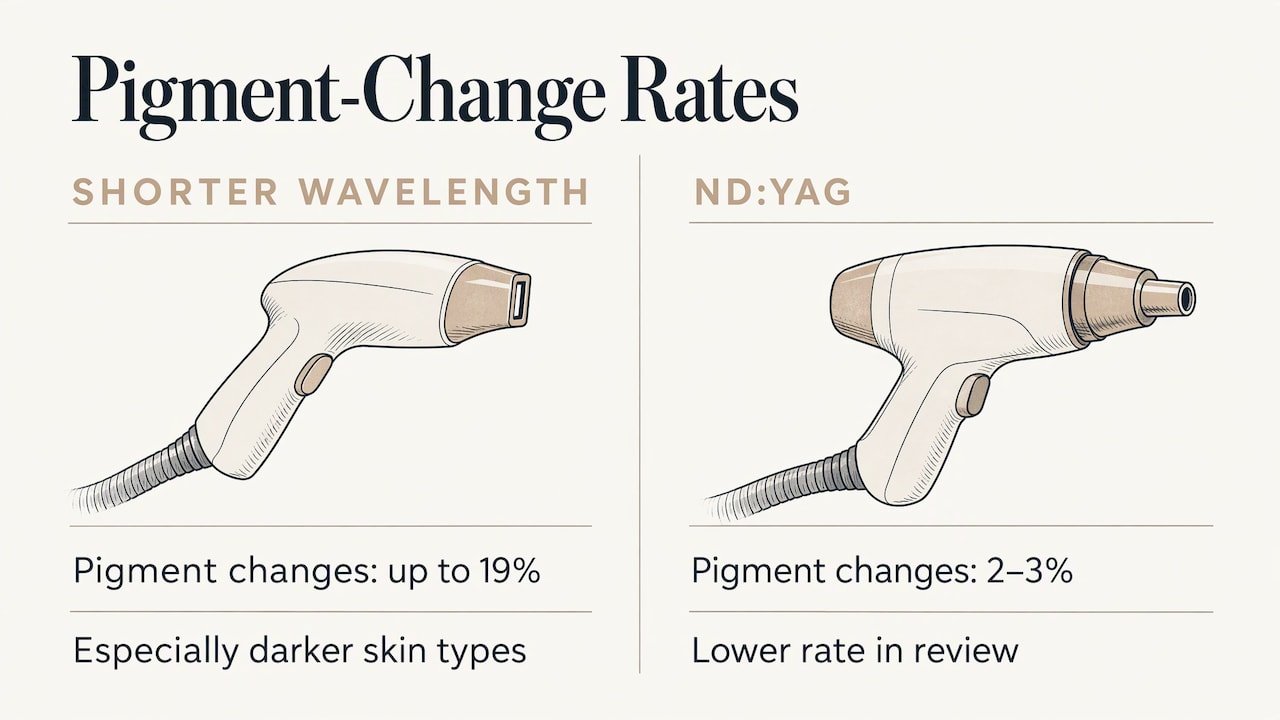
The same review reports that pigment changes were more common with shorter wavelength lasers, particularly in darker skin types, at up to 19%. The rate was lower, at 2 to 3%, with the neodymium-yttrium-aluminium-garnet laser. The NHS trust notes a low risk of pigment changes, which can appear as a lighter or darker patch. These are usually temporary but occasionally permanent. It adds that risk is higher with naturally dark skin or when treated with a suntan.
The practical lesson is that the device, the settings and the practitioner’s assessment of your skin matter. They matter at every session, not just the first. Tell your practitioner about any change in your skin, medication or sun exposure before each top-up.
On the clinic side, the MHRA’s guidance on lasers and intense light systems recognises that hair removal treatments can release a smoke plume. It recommends a dedicated smoke evacuation system rather than relying on face masks. It is reasonable to ask any clinic how it manages ventilation and safety.
When a reassessment is worth booking
You do not need a top-up on a calendar date. These are the situations in which a review is most useful:
- You notice regrowth that bothers you. A practitioner can look at the hair, the skin and the area to see whether treatment is suitable.
- The hair looks different. Finer, paler or patchy hair may need a different approach.
- Your health or medication has changed. Pregnancy, new medication, a hormonal condition or a skin condition should be discussed first. Your GP can advise on anything medical.
- Your skin has changed. A new tan, new pigmentation or a skin concern can affect whether treatment can go ahead.
- You stopped early. If you left a course unfinished, a review can decide whether to continue or begin again.
- You are unsure whether laser is still the right method. For a few stray hairs, other approaches may be discussed. Our comparison of laser and electrolysis explains how they differ, and the article on laser versus IPL covers the other common option.
Treatments can only go ahead if your practitioner judges them suitable on the day. That applies to a first session and a maintenance session alike.
Questions to ask at a maintenance review
Bring a few questions so you leave with a clear picture:
- Which areas are showing regrowth, and does it look like hair that can be treated?
- Are there factors, such as hormones, hair colour or skin tone, that may explain it?
- What does my skin need to look like before the next session?
- What should I avoid doing in the days before and after?
- How will we decide together when to review again?
There is no need to commit to a fixed number of future sessions. A good consultation lets you decide in stages.
Booking a laser hair removal review at Dermacy Clinic
Dermacy Clinic is a skin, laser and aesthetic clinic in Armthorpe, Doncaster. Our laser hair removal page sets out the service, current published prices and how to book. If you have already had a course elsewhere or with us and want to discuss regrowth, start there. We assess suitability individually, and outcomes vary. We do not promise permanent removal or a set number of top-ups. Men can see the page on laser hair removal for men.
FAQ
Do I always need maintenance sessions after laser hair removal?
No. Some people are happy with their result and do not book a top-up for a long time, while others prefer occasional sessions. One NHS trust says many people have top-ups once or twice a year. Your hair, hormones and skin influence what you will need, and a practitioner can advise after seeing the area.
Is the regrowth the same as before treatment?
Usually not exactly. Hair that returns is often finer and less dense than before, as described in an NHS patient leaflet. That varies between people and between body areas. If you see coarser regrowth, mention any hormonal or medication changes to your practitioner or GP.
What happens if I stop after six sessions?
Hair growth is typically reduced for weeks to months, but some people see further growth later. A regional NHS policy notes that more treatments may be needed to reach complete hair loss. A reassessment will show whether any areas would benefit from further sessions.
Is repeated laser hair removal safe?
A peer-reviewed review found a very low incidence of permanent side effects when carried out by trained professionals. Risks, including pigment changes, are higher with tanned or naturally dark skin. Always tell your practitioner about sun exposure and skin changes before a session.
Can I wax or pluck between sessions?
No. The North Bristol NHS Trust says you can shave or cut hair, but should not wax, pluck or use hair removal creams. These methods remove the hair root, which the laser needs to target.
Sources
- Hair removal, North Bristol NHS Trust (Bristol Laser Centre)
- Commissioning Policy: hirsutism and hair removal, Cheshire and Merseyside NHS
- Hair removal by IPL, laser or electrolysis, HNY Policy and Pathway Repository
- Facial hair reduction patient information, Leeds and York Partnership NHS Foundation Trust
- A review of the adverse effects of laser hair removal, PubMed
- Lasers, intense light source systems and LEDs: guidance, MHRA
Recommended
- Why You Need Laser Hair Removal Treatment
- Laser Hair Removal Aftercare: What to Do and When to Call
- Laser Hair Removal and Sun: Let Your Holiday Set the 4–6 Week Plan
- Laser Hair Removal on Tanned Skin: What to Know First
This article provides general information and is not a diagnosis or personalised medical advice. Treatment suitability, risks and expected outcomes require an individual consultation. Results vary.