
Microneedling and laser resurfacing both aim to improve skin texture by triggering repair, but they do it differently. Microneedling makes controlled punctures with fine needles and leaves the skin between them intact. Resurfacing lasers use light energy and heat, and the stronger types remove or damage skin tissue. In broad terms, lasers can produce bigger change per session with more downtime and more risk. Microneedling is usually gentler and needs more sessions. Which suits you depends on your skin tone, your concern and how much recovery time you can give it.
This guide covers the narrow question of how the two categories compare, so you can go into a consultation knowing what to ask. It is general information, not a diagnosis. Results vary, and a qualified professional needs to assess your skin before recommending anything.
TL;DR
- Microneedling works by wound-healing signals from needle punctures; resurfacing lasers use light and heat, and ablative types remove tissue.
- Lasers tend to change more per session but carry more downtime and more pigment risk, especially in darker skin.
- Microneedling usually needs a course of several sessions, spaced about six weeks apart, with gradual results.
- For acne scars, pores and texture, the evidence does not name one winner for everyone; scar type and skin tone matter most.
- Dermacy Clinic offers microneedling. Hair-removal lasers are a different technology and are not resurfacing treatments.
Table of Contents
- What each treatment actually does
- Side-by-side comparison
- Acne scars, pores and texture: what the evidence says
- Skin tone and pigmentation: the deciding factor for many people
- Downtime, side effects and risks
- How many sessions, and when will you see change?
- Cost and NHS availability
- A simple way to decide
- Microneedling at Dermacy Clinic
- FAQ
- Sources
What each treatment actually does
Microneedling: controlled punctures, intact skin in between
Microneedling uses very fine needles to create tiny channels in the skin. According to a StatPearls review, the punctures stimulate the wound-healing process, collagen and elastin, while causing relatively little damage to the epidermis, the outer layer. Because the surface stays largely intact, the skin between each puncture is not removed.
The British College of Aesthetic Medicine describes the aftermath as the body regenerating and repairing the skin below the surface, in the dermis. New collagen forms, new skin cells are generated and blood supply is enhanced. That takes time, so the process is progressive rather than immediate.
Laser resurfacing: light energy and heat
Laser resurfacing is a family of treatments, not one device. Broadly, two categories matter:
- Ablative lasers vaporise the outer layers of skin and heat the deeper layers. They are the strongest option and have the longest recovery.
- Non-ablative and fractional lasers deliver energy while sparing some or all of the surface, so recovery is shorter and the effect per session is usually milder.
The exact wavelength, energy, density and number of passes change both the benefit and the risk, which is why consultation-led selection is stressed in comparisons of these methods.
So is microneedling a type of resurfacing?
In the broad technical sense, yes. A 2022 review of resurfacing modalities lists laser, radiofrequency, microneedling and chemical peels together as non-surgical resurfacing options. In everyday clinic language, though, “laser resurfacing” usually means the heat-based, tissue-removing approach, and “microneedling” the needle-based, collagen-stimulating one. That is the comparison this article makes.
Side-by-side comparison
| Question | Microneedling | Laser resurfacing |
|---|---|---|
| Mechanism | Needle punctures trigger wound healing and collagen | Light energy and heat; ablative types remove tissue |
| Effect on the surface | Epidermis largely preserved | Varies from spared (non-ablative) to removed (ablative) |
| Typical pace | Gradual, builds over a course | Often more change per session |
| Recovery | Generally shorter | Generally longer, especially for ablative and fractional types |
| Pigment risk in darker skin | Considered lower | Higher; ablative lasers are generally avoided |
| Sessions | Usually a course | Fewer for stronger types, depending on the device |
This table describes the categories in general. It is not a statement about any single device or clinic, and individual outcomes differ.
Acne scars, pores and texture: what the evidence says
These are the three concerns people most often bring to this comparison, and the research is more nuanced than “one is better”.
Acne scars
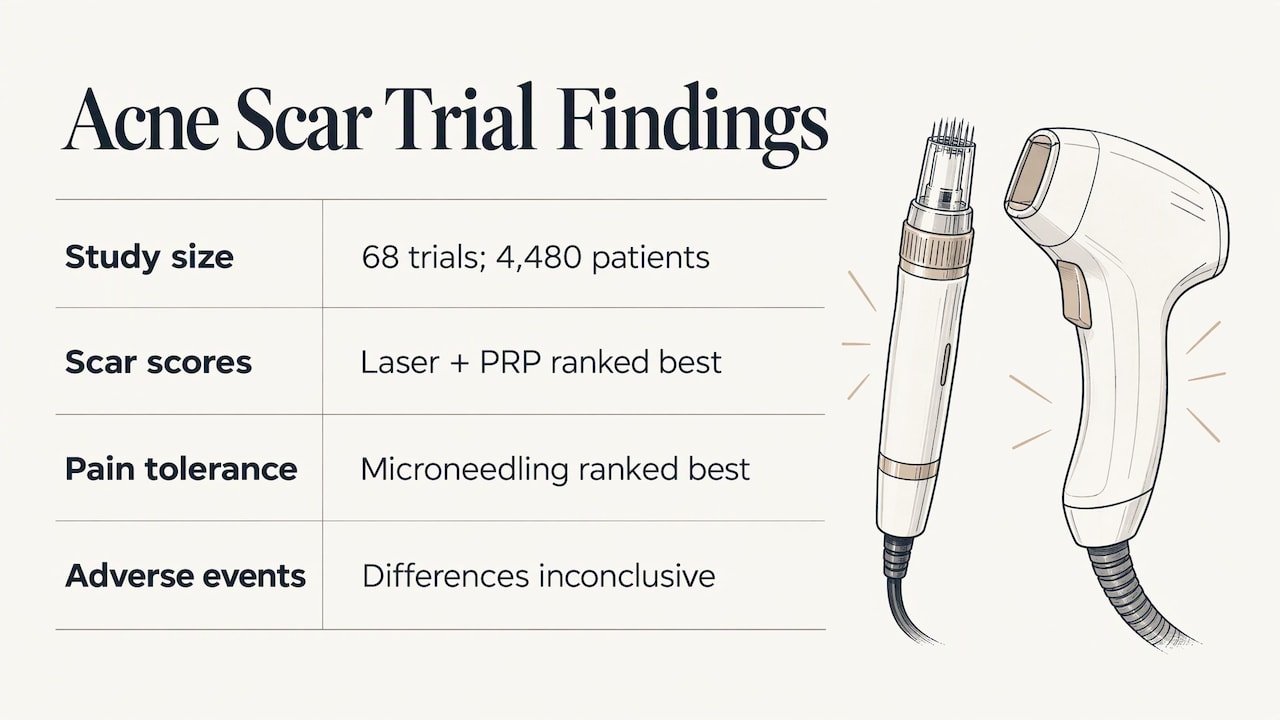
A network meta-analysis of 68 randomised controlled trials involving 4,480 patients ranked laser combined with PRP best for reducing acne-scar scores, while microneedling ranked best for pain tolerance. The differences in adverse events between treatments were not conclusive. So a laser-based approach may do more for scar scores in trials, and microneedling may be easier to tolerate. Neither result means one treatment is right for every scar.
Scar type matters too. Atrophic scars (the depressed kind) behave differently from raised or discoloured marks. If you are not sure whether you have post-acne marks or true scars, our guide to acne marks vs acne scars before microneedling explains the difference, and our acne scar treatment page covers the main service.
Enlarged pores and texture
A review of advances in acne scar treatment suggests microneedling may help smooth scarred skin, while picosecond laser with microlens array technology may improve enlarged pores and skin texture. Pore size is partly genetic and linked to oil production, so any treatment may improve their appearance rather than change them permanently. Be wary of anyone promising otherwise.
Fine lines and general texture
For mild roughness and early fine lines, the gentler end of the spectrum is often discussed first, because recovery is shorter and risk is lower. Deeper wrinkles and heavy sun damage are where stronger lasers are usually considered, with the trade-offs below. If sun damage is your main concern, start with what can be treated and what to check first, because discolouration and texture call for different approaches.
Skin tone and pigmentation: the deciding factor for many people
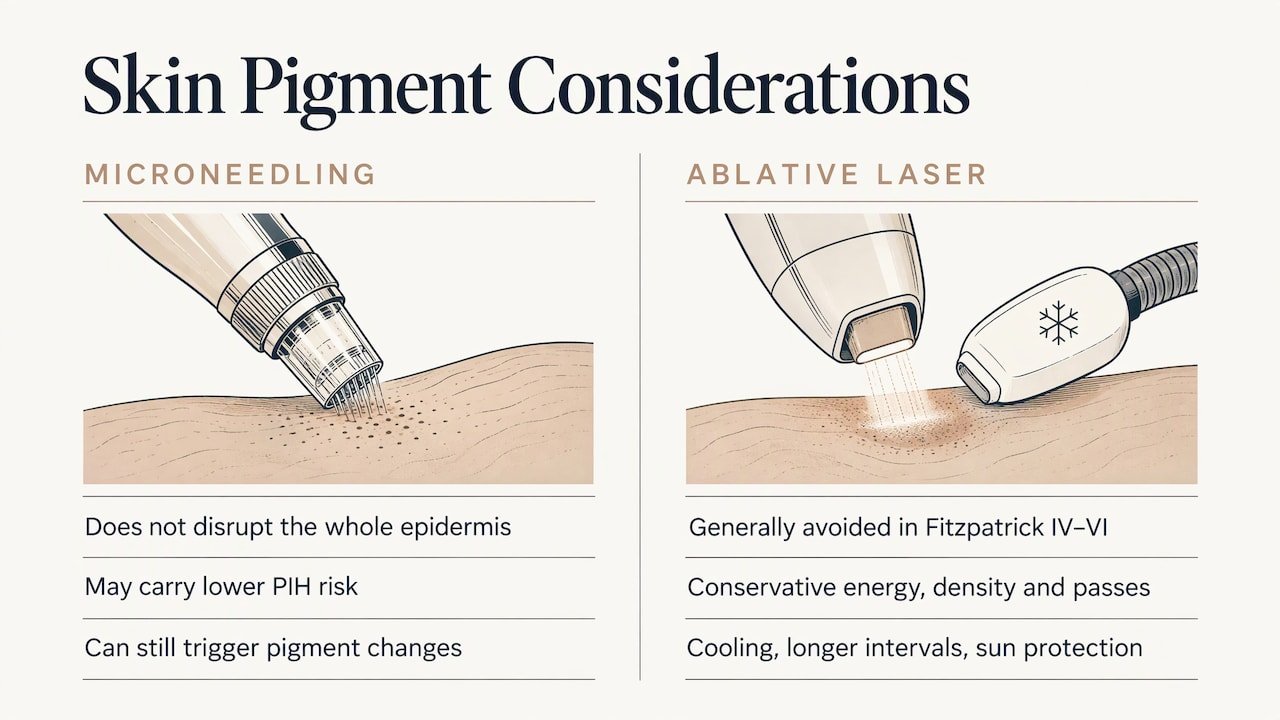
This is where the two categories diverge most. A review of non-invasive treatments for Fitzpatrick skin types IV to VI notes that darker skin has a higher risk of pigmentary complications. Microneedling does not disrupt the whole epidermis and may carry a lower risk of post-inflammatory hyperpigmentation (PIH, dark marks left after skin trauma). Ablative lasers are generally avoided in these skin types. If a laser is used, the same review recommends conservative energy, density and passes, cooling, longer intervals between sessions and strict sun protection.
It is not only about skin colour. Planning a laser should account for previous pigment problems, tanning, medication and your ability to manage aftercare. People with melasma or a history of PIH need a particularly conservative assessment. Any treatment that injures skin can trigger or worsen pigment in prone skin, microneedling included, which is why assessment comes first. If pigmentation is your main worry, see our pigmentation treatment page.
A tan matters. Recent sun exposure raises the risk with most energy-based treatments, so tell your practitioner about holidays, sunbed use and self-tan before booking.
Downtime, side effects and risks
Laser resurfacing
The same Fitzpatrick review lists laser risks including persistent redness, swelling, infection, acne or milia (small white cysts), pigment change and scarring. These complications are more likely in darker skin than in lighter skin. The stronger the laser, the longer and more visible the recovery tends to be. Ablative treatment typically means crusting and several days to weeks of healing, so you plan time off around it.
Microneedling
Microneedling is generally associated with redness, tightness and mild swelling that settle over a short period, though how long depends on needle depth and your skin. It is not risk-free. Infection, prolonged redness and pigment change are possible, and people with active skin infections, active acne flares in the area, eczema flares or certain medical conditions may not be suitable at that time. Your practitioner should go through your history first. For what to do afterwards, read our microneedling recovery and aftercare guide.
If you notice spreading redness, increasing pain, pus, fever or blistering after any skin treatment, contact the clinic that treated you promptly, or NHS 111 or your GP if you cannot reach them. Do not try to manage a suspected infection yourself.
How many sessions, and when will you see change?
Microneedling is a course-based treatment. Chelsea and Westminster Hospital NHS Foundation Trust says four to six sessions are normally required, at least six weeks apart, and it may take up to three months, or more than one treatment, before you notice an improvement. The British College of Aesthetic Medicine says three to four treatments about six weeks apart are common, with up to six for stretch marks, acne scars and other scarring, and that visible signs of repair can take up to six weeks to appear and continue over the following months.
The practical message: early swelling or glow is not the final result, and a single session is rarely the whole story. Because change is slow, comparing like with like helps. Taking photographs in the same light, at the same angle, before you start and at each visit makes progress easier to judge than memory does. A guide to tracking skin changes with photos explains how to keep such images organised over time.
Laser resurfacing is often described as quicker to show change per session, particularly for stronger devices, but the price of that is the recovery period and the risk profile above. Fewer sessions does not automatically mean less overall commitment once healing and sun avoidance are counted.
Cost and NHS availability
Cosmetic microneedling is generally not routinely funded by the NHS. A UK summary citing British Association of Dermatologists guidance says selected NHS specialist scar services may use it for clinically indicated burn, surgical or traumatic scars. For most cosmetic goals you would pay privately.
What drives the total is mainly the number of sessions in your course, the area treated, the device and depth used, and who carries out the treatment. Because a course rather than one visit is the norm, compare the likely cost of the whole course, not a single session. For current Dermacy Clinic pricing, use the treatment page rather than any figure quoted elsewhere.
A simple way to decide
Use these questions as a starting filter, then confirm with a professional assessment.
- What is your skin tone, and have you had dark marks after skin injury? If yes, lean towards the gentler option and a conservative plan.
- How much downtime can you take? If you need to be back at work looking normal within a couple of days, stronger lasers are a hard fit.
- How deep is the problem? Mild texture and shallow scarring are usually discussed in terms of a gentler course. Deep, established scars are where stronger options come up, with the trade-offs above.
- Can you avoid the sun strictly? Laser recovery demands it. If summer holidays are coming, timing matters.
- Are you patient with gradual change? Microneedling rewards a full course.
Some people end up combining approaches over time under professional guidance. That decision belongs in a consultation, not in a blog post.
Microneedling at Dermacy Clinic
Dermacy Clinic in Armthorpe, Doncaster, offers microneedling, and we do not offer or imply a resurfacing laser: our laser service is hair removal, which is a different technology with a different purpose. If microneedling sounds like the right fit for your concern, read about the treatment, suitability and current booking details on our microneedling page. Recommendations depend on an individual assessment, and results vary.
FAQ
Is laser or microneedling better?
Neither is better for everyone. Lasers tend to produce more change per session but carry more downtime and, in darker skin, more pigment risk. Microneedling is generally gentler and works gradually over a course. The right choice depends on your concern, skin tone and recovery time.
Is microneedling considered resurfacing?
In the broad sense, yes: a 2022 review lists it among non-surgical resurfacing modalities. In everyday use, “resurfacing” usually means heat-based lasers that treat the skin surface. Microneedling works mainly by stimulating repair below the surface.
Is microneedling safer for darker skin?
It is generally considered to carry a lower risk of pigment problems than ablative lasers, because it does not disrupt the whole epidermis. It is not risk-free, though, and people prone to melasma or dark marks need a careful assessment first. Always tell your practitioner about your pigment history.
How many microneedling sessions will I need?
NHS and professional sources describe courses of roughly three to six sessions, about six weeks apart, with up to six for scarring. Improvement can take weeks to months to appear. Your own plan should come from an individual assessment.
Sources
- Microneedling, StatPearls, NCBI Bookshelf
- Microneedling, British College of Aesthetic Medicine
- Evaluating resurfacing modalities in aesthetics, 2022 review
- Optimal treatment options for acne scars: network meta-analysis
- Advances in the treatment of acne scars
- Noninvasive cosmetic treatments for Fitzpatrick IV–VI
- Laser resurfacing vs RF microneedling, 2026 comparison
- Microneedling patient information, Chelsea and Westminster Hospital NHS Foundation Trust
- Microneedling in the UK: benefits, costs, results, risks and recovery
Recommended
- Acne Marks vs Acne Scars: What to Know Before Microneedling
- Microneedling Doncaster | Dermapen & RF | Dermacy
- Microneedling Recovery and Aftercare: What to Expect
This article provides general information and is not a diagnosis or personalised medical advice. Treatment suitability, risks and expected outcomes require an individual consultation. Results vary.