Laser can reduce hair growth along your cheek line and neckline, which makes shaving or trimming that edge easier. It cannot draw a line that stays perfect for life. Hair that sits just outside the treated zone keeps growing, hair inside it may thin or return unevenly, and your face changes with age. So the real decision is where to put the boundary and whether you will be happy with it in five years, not just whether laser works.
This guide covers that narrow question: how to choose a beard or neck boundary, what long-term grooming looks like afterwards, and what to expect from patch testing, consent and suitability. For the broader treatment, course details and current prices, see our laser hair removal for men page and the main laser hair removal service page.
TL;DR
- Laser reduces hair in the area treated. It does not guarantee a permanent result, and NHS-run laser services note that top-up sessions once or twice a year are often needed to maintain it.
- Choose a boundary you could live with if it stays exactly as it is. Start conservative: you can usually treat more later, but you cannot easily put hair back.
- Your natural growth pattern, face shape and how you like to wear your beard should guide the line, not a photo of someone else.
- Expect a skin assessment, a conversation about consent and a patch test before a full course. Ask who does the treatment and how the clinic manages risk.
- Redness and tenderness are common and short-lived. Blistering, scarring and pigment changes are less common but real, and more likely with darker or tanned skin.
Table of Contents
- What “beard line laser” actually means
- How to choose where the line goes
- Why the edge may never look “drawn on”
- Long-term grooming after the line is set
- Patch testing: what it is and what it tells you
- Consent and suitability: what a proper consultation covers
- Safety checks before you book anywhere
- A simple decision path
- Doing this at Dermacy Clinic
- FAQ
- Sources
What “beard line laser” actually means
People use the phrase for three different goals, and they need different planning.
Tidying the edges. You keep a full beard but remove or thin hair on the upper cheeks and the neck below the jaw, so the shape is cleaner and daily shaving of those areas is lighter.
Setting a neckline. You choose a point on the neck, often discussed as a finger or two above the Adam’s apple, below which hair is treated. Everything above stays.
Full facial hair reduction. You aim for a clean-shaven face. That is a different decision from shaping, and the main men’s treatment page covers it.
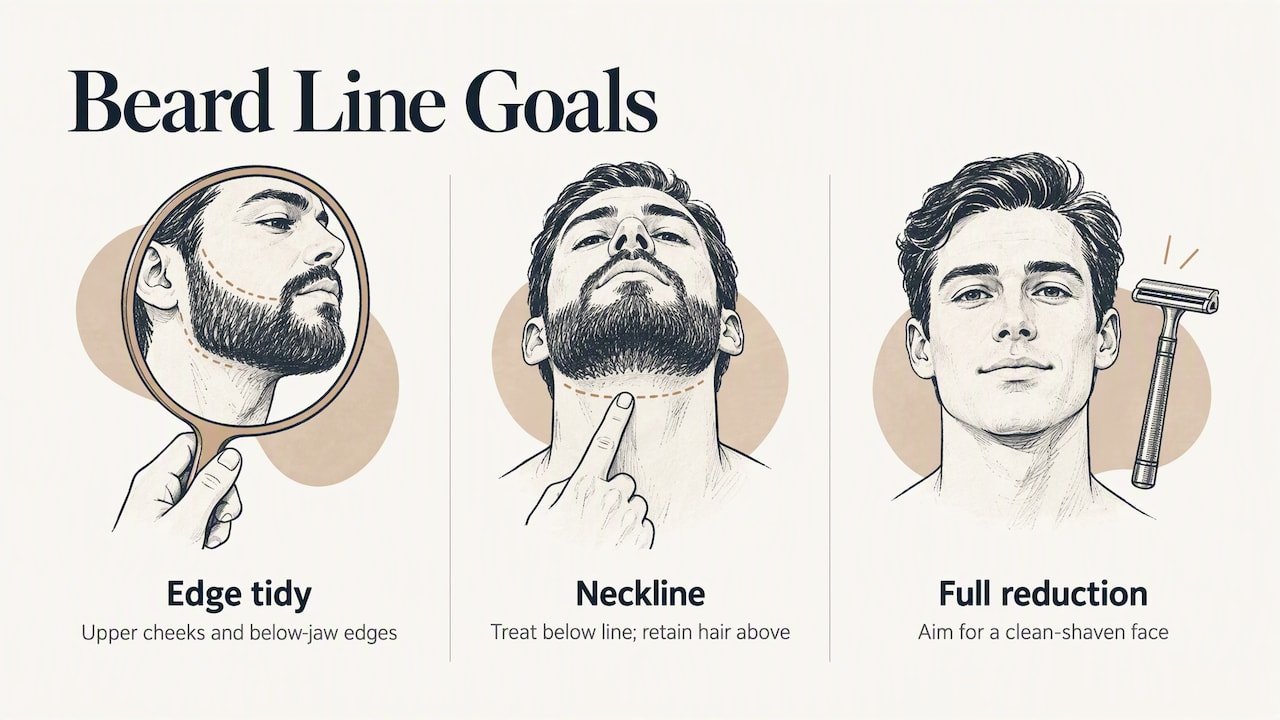
Shaping is the tricky one because it is the only version where the border between treated and untreated skin stays visible every day. Laser works by targeting pigment in the hair to damage the follicle, as described by North Bristol NHS Trust’s laser centre. It does not know where your “line” is. The line exists only because a practitioner marks it and treats up to it.
How to choose where the line goes
This is the part you cannot undo, so take your time. A few practical ways to decide.
Grow it out first
If you normally shave the neck every day, you may not have seen your natural growth for a while. Let the beard grow for two to four weeks before a consultation so your practitioner can see the real pattern: where the hair is dense, where it is patchy, and where it wanders towards the collar. Lines drawn on stubble can look different from lines drawn on a full beard.
Look at the whole face, not just the jaw
Your cheek line, jawline and neckline should work together. A cheek line set very high on a narrow face can look severe; a neckline set too low can leave a visible “shelf” of beard hanging under the chin. Photograph your face from the front, both sides and from below, and bring those to your consultation so you are discussing your own face, not a stock image.
Think about how your beard might change
Beards often become fuller, greyer or patchier over the years. This matters for two reasons:
- Grey, white and very fair hairs respond poorly to laser because there is little pigment to target. A boundary set today will not reliably treat hairs that turn grey later. NHS guidance on hair removal explains that how well a laser works depends on hair colour as well as the growth cycle.
- Your style may change. If you might want a shorter beard, a longer one or no beard in future, a conservative edge keeps your options open.
Start higher on the neck than you think, and move down later
It is easier to lower a neckline in a later session than to raise it. A cautious first line, with the option to refine, is a sensible way to avoid regret. Be wary of any suggestion that you must commit to the final line in the first appointment.
Check the line in a mirror before treatment
A reputable practitioner should mark the boundary on your skin, let you look at it from several angles, and adjust it with you. You are consenting to that specific line. If it looks wrong, say so before the laser is fired.
Why the edge may never look “drawn on”
Photos in adverts show crisp, precise borders. In real life the edge is often softer, for a few reasons.
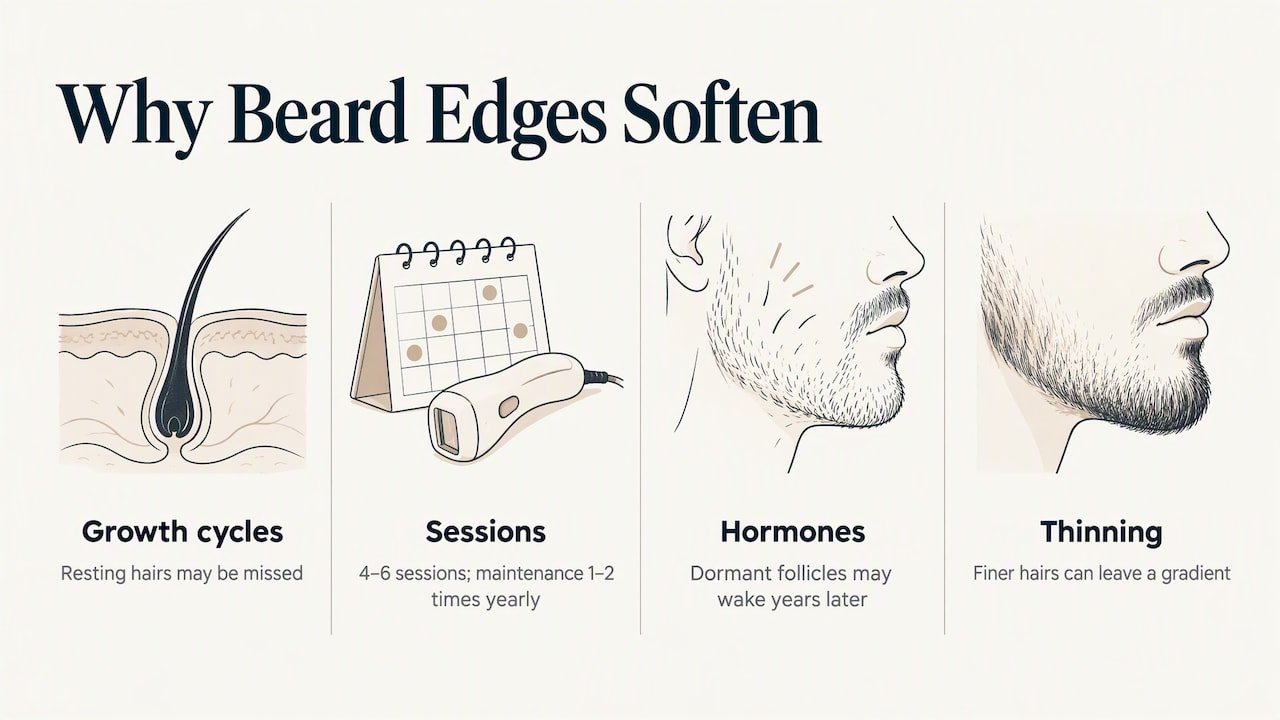
Hair grows in cycles. Laser is most effective on hairs in the active growth phase, so hairs that are resting at the time of a session are missed. This is why courses involve several sessions. The NHS trust page above says initial courses typically involve 4 to 6 sessions, with maintenance once or twice a year afterwards, though your own plan will depend on assessment.
Facial hair is influenced by hormones. Beard hair is androgen-sensitive, and some dormant follicles can wake up later. A boundary that looked settled can develop new stray hairs years on. The NHS notes hormone-related hair growth in its information on excessive hair growth; if you notice sudden or unusual changes in hair growth, speak to your GP rather than treating it as a grooming problem.
Thinned hair looks different from removed hair. After treatment some hairs become finer and lighter, not absent. Along a beard edge this can create a gradient rather than a hard line, which can look natural or can look patchy depending on your taste.
In practice, many men who treat a neckline continue to trim or shave a few strays between sessions. If you want zero maintenance and a ruler-straight border, laser is the wrong promise to expect. Our article on laser versus electrolysis in UK clinics explains how finer, lighter or stubborn strays are handled differently.
Long-term grooming after the line is set
A beard line is a long-term relationship with your razor or trimmer, not a one-off event.
- Keep shaving or trimming, only less. Clinics generally ask you to shave the treatment area before a session. The NHS guidance advises shaving about 24 hours before a session rather than on the day, and avoiding waxing, plucking and hair-removal creams between sessions, because the hair root needs to be present for the laser to work. Follow your own clinic’s instructions, as they may differ.
- Do not wax or pluck the edge to “tidy” it during a course. That removes the root the laser needs.
- Expect hair to look as though it is growing after the first sessions. The same NHS source explains treated hairs are pushed out as the skin heals, and typically shed within two to three weeks. It is not new growth.
- Plan top-ups. If you like a very sharp edge, budget time for occasional maintenance sessions, as suggested above.
- Protect treated skin from the sun. Sun exposure raises the risk of pigment changes. See our guides on laser and sun exposure and laser on tanned skin before booking around a holiday.
If you get razor bumps now
Many men consider laser because of irritation along the neckline. Shaving bumps, also called pseudofolliculitis, are inflammation caused by hairs trapped beneath the skin surface, and the British Association of Dermatologists has patient information on pseudofolliculitis. If your neck is sore, pus-filled or scarring, have it looked at by a GP or dermatologist first. Active inflammation or infection is something a practitioner will want to assess before laser is considered, and we cannot judge that from an article.
Patch testing: what it is and what it tells you
A patch test means a small area is treated first, usually in an inconspicuous spot, so the practitioner can see how your skin and hair respond before treating a larger area. For a beard line, ask where the test patch will be. A sensible location is somewhere representative, such as the neck or jaw edge, rather than a part of the face you can easily hide.
A few things to understand:
- A patch test is not a guarantee. It shows your immediate reaction. It cannot promise how you will respond across a course or how permanent the result will be.
- Timing matters. Your reaction may take a day or more to appear, which is why treatment does not usually go ahead on the same minute as the test.
- It informs the settings. Skin tone, hair colour, hair thickness and recent sun exposure all influence what a practitioner considers appropriate.
- Tell them everything. Mention recent tanning, self-tan, medications, skin conditions, a history of cold sores in the treatment area, scarring tendencies and anything you have applied to the skin.
If a clinic skips assessment and offers to start immediately on your face, that is a reason to ask more questions.
Consent and suitability: what a proper consultation covers
Consent for something permanent-looking on your face should be more than a signature. Before you agree, you should be able to answer these questions in your own words.
- Where exactly is the boundary, and have I seen it marked?
- What happens if I later dislike it? Be honest with yourself: treated hair may not return as it was.
- What outcomes are realistic for my hair colour and skin type? Coarse dark hair on lighter skin generally responds best. Lighter, finer or grey hair responds less.
- What are the risks? Common effects are temporary redness, swelling and tenderness that usually settle in a day or two. An NHS trust information leaflet also lists rarer risks such as blistering, scarring and pigment change, particularly with darker or tanned skin, and reports figures of roughly 1 in 800 for scarring and 17 in 100 for hyperpigmentation in the group it describes. Those figures come from one trust’s leaflet and will not match every clinic or skin type, so treat them as a prompt for questions, not a prediction.
- Who will treat me, and what are their qualifications? Ask directly.
- What aftercare will I follow, and who do I contact if something looks wrong? Read our laser hair removal aftercare guide so you know what normal looks like and when to call.
You are entitled to take the consent form home, to sleep on the decision and to say no after the consultation. No pressure to book on the day is a good sign.
Who may not be suitable
Suitability depends on individual assessment. Reasons a practitioner may advise waiting, adapting treatment or not treating include a recent tan, active skin infection or inflammation in the area, certain medicines or medical conditions, and hair that is too light to respond. If you are unsure whether a condition or medicine matters, ask your GP or pharmacist and tell the clinic. Treatment of darker skin tones needs particular care and appropriate equipment, so ask the clinic how it assesses and treats your skin type.
Safety checks before you book anywhere
Laser treatment is regulated differently depending on where you live. In England, some practitioners using lasers and intense pulsed light must register with the Care Quality Commission, as GOV.UK explains on its laser and IPL registration page. Official guidance on lasers, intense light sources and LEDs in aesthetic practice also covers matters such as skin assessment before treatment, sun avoidance during a course and protective equipment for both practitioner and client.
So it is reasonable to ask:
- Is the clinic or practitioner registered where required?
- What eye protection will I be given?
- Is a skin assessment done before the first treatment?
- Which device is used, and is it suitable for my skin and hair type?
- What is the plan if I react badly?
Our guide on how to choose a laser hair removal clinic goes through seven questions worth asking any provider.
A simple decision path
If you are still weighing it up, this order tends to work.
- Decide your goal: edge tidy, neckline only, or full reduction.
- Grow out your beard for a few weeks and take photos.
- Try the line first with a trimmer or a washable pencil for a couple of weeks. If you still like it after living with it, it is a better candidate for treatment.
- Book a consultation, not a treatment. Ask the questions above.
- Agree a conservative boundary, with the option to refine in later sessions.
- Plan around the sun, avoiding tanning before and during your course.
- Accept the limits. You may still shave a few hairs, and top-ups may be needed.
Doing this at Dermacy Clinic
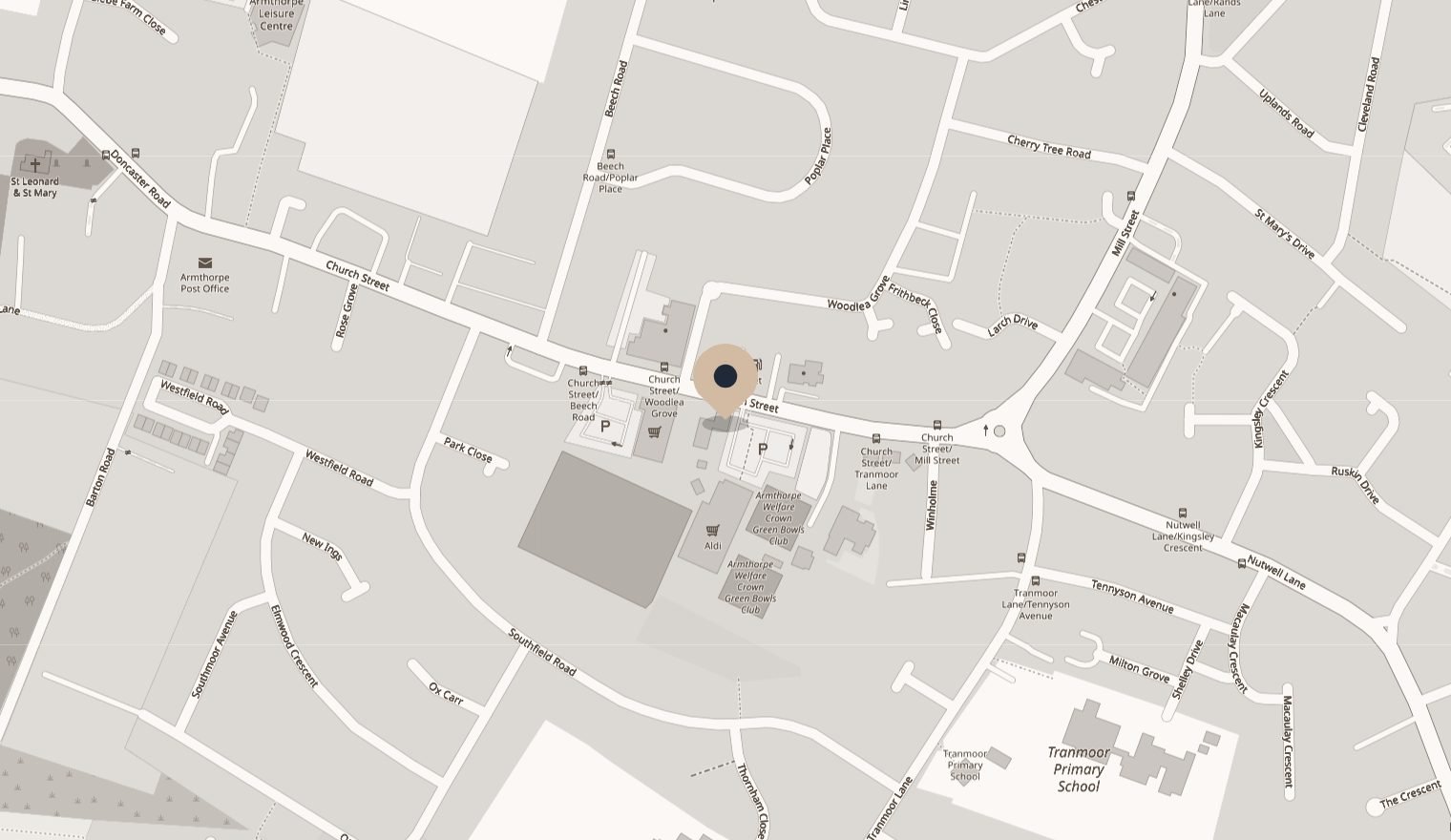
Dermacy Clinic is a skin, laser and aesthetic clinic in Armthorpe, Doncaster. If you would like to talk through a beard or neck boundary, start with our laser hair removal page, where you will find current service details and the route to book. Suitability is decided at an individual assessment and results vary, so use the consultation to ask every question in this article.
FAQ
Can laser hair removal give me a permanent beard line?
It can reduce hair in the treated area, often significantly, but permanence is not guaranteed. Some hairs regrow, new ones can appear later, and maintenance sessions are commonly needed, as the NHS trust page describes. Think of it as a long-lasting reduction that makes upkeep easier.
Will the line look unnatural?
It can if it is too sharp, too high or set without regard to your face shape. A softer, conservative boundary agreed after viewing it marked on your skin usually looks more natural. Because results vary, ask your practitioner to explain what a gradual edge would look like for your hair.
Can I treat just my neck and keep my beard?
Yes, many men treat only the neck and the edge of the cheeks while keeping the rest of the beard. The key is agreeing exactly where treatment stops. Do not wax or pluck the area during a course, and follow the clinic’s shaving instructions.
Does it hurt, and is there downtime?
Sensations vary from person to person, so no clinic should promise a painless treatment. Redness, swelling and tenderness are common and usually settle within 24 to 48 hours according to NHS trust information. Contact your clinic or GP if you notice blistering, worsening pain or signs of infection.
Is laser suitable for grey or light beard hair?
Often not. Laser targets pigment, so grey, white and very fair hairs respond poorly or not at all. If part of your beard is already greying, a practitioner can explain what may and may not respond, and the electrolysis comparison outlines what is used for stubborn strays.
Sources
- Hair removal, North Bristol NHS Trust
- Hair removal patient information, Sandwell and West Birmingham NHS Trust
- Excessive hair growth (hirsutism), NHS
- Pseudofolliculitis, British Association of Dermatologists
- Laser or intense pulsed light treatment registration (England), GOV.UK
- Lasers, intense light source systems and LEDs: guidance for safe use, GOV.UK
Recommended
- Why You Need Laser Hair Removal Treatment
- Laser Hair Removal for Men Doncaster
- How to Choose a Laser Hair Removal Clinic | 7 Questions
- Laser Hair Removal Aftercare: What to Do and When to Call
This article provides general information and is not a diagnosis or personalised medical advice. Treatment suitability, risks and expected outcomes require an individual consultation. Results vary.