
If this is your first HydraFacial, don’t book it for the last possible moment. There is no single number of days that suits everyone. The only published timing we can point to is that temporary redness, tightness or irritation usually settles within 72 hours, depending on skin sensitivity, so it makes sense to leave a gap well beyond that. A first treatment also tells you how your own skin responds. That is why a first appointment sits best well ahead of the date that matters, with a plan agreed with your practitioner.
This guide covers the narrow question: how to plan a first HydraFacial around a wedding, party, holiday photographs or any date you want your skin to look its best. It does not repeat the full procedure walk-through or the makeup question, and we link to those where they help.
TL;DR
- There is no universal “right” number of days. Allow a buffer well beyond the 72 hours in which temporary redness or tightness usually settles, and more if your skin is reactive.
- Do not make an event the first time you try the treatment. A first appointment is also a chance to see how your skin responds.
- Tell your practitioner about the event date, your skincare, recent sun, medication and any past reactions, so the plan fits you.
- Expect a fresher, smoother-looking surface, not a guaranteed result. Results vary, and suitability is decided at consultation.
- Book your assessment through the HydraFacial page at Dermacy Clinic for current details.
Table of Contents
- Why a first HydraFacial deserves its own plan
- How long before an event should you book?
- What happens at a first appointment
- What to tell your practitioner
- How to prepare in the days before
- Allowing for temporary redness, tightness and irritation
- What a HydraFacial can and cannot do for an event
- Can you combine it with other treatments?
- A simple planning timeline to adapt
- When to postpone or ask for advice first
- Book your first HydraFacial with Dermacy Clinic
- FAQ
- Sources
Why a first HydraFacial deserves its own plan
A HydraFacial is a cleansing, exfoliating and hydrating facial that uses a handheld device and serums. Many people think of it as a “no downtime” treatment. That phrase is a marketing shorthand, not a promise. Skin is individual, and the manufacturer’s own instructions describe temporary irritation, tightness or redness as something clients may experience, usually fading within 72 hours depending on sensitivity.
For a repeat client who has had several sessions, that picture is familiar. For a first-timer, it is unknown. You do not yet know whether your skin glows, flushes pink for an hour or stays slightly tight into the next day. Planning around that unknown is the whole point of this article.
Three things make a first appointment different:
- No personal baseline. You cannot predict how your skin reacts.
- A consultation matters more. Your practitioner needs to learn your skin, your products and your goals.
- You may want a second session. If your date is important, one visit may not be the whole plan, and that is a conversation to have early.
How long before an event should you book?
The honest answer is: as early as is practical, then keep a buffer. Online, you will see very different advice. Some pages suggest a few days before; others suggest a course of sessions weeks ahead. Those figures come from different clinics with different skin types and treatment philosophies, and none of them is a rule. We do not give a fixed number of days, because we would be guessing about your skin.
What we can say is how to think about it.
Start from the date and work backwards
Write down the event date. Then mark:
- The last point you would be comfortable having mild redness. For most people that is well before photographs, a speech or a big entrance.
- A buffer for the unexpected. A cold, a breakout, a change in products or a stressful week can all change how skin behaves.
- Time for a second visit, if wanted. Some people choose to start earlier so there is room to repeat or adjust.
Because the temporary effects described by the manufacturer usually pass within about 72 hours, the treatment should not be your final act before the event. Anything else, such as a reaction you were not expecting, needs room to settle and, if needed, a conversation with the practitioner.
Why “the day before” is a risk worth avoiding
Booking the day before leaves no margin. If your skin is pink, tight or simply not at its best, you have no time to let it calm down. It also makes it hard to adapt your routine. A first treatment is the one you are least able to predict, so it is the one that most benefits from distance from the big day.
Why “months ahead” is not automatically better either
A treatment far ahead gives you more room, but a HydraFacial is a surface-level, maintenance-style facial. Its look does not stay fixed. If you want your skin looking freshest near the date, your practitioner may suggest a lighter follow-up closer to it. That is a plan to discuss, not something to assume. We cannot tell you how long your results will last, because it differs between people and depends on your skin, your routine and your sun exposure.
What happens at a first appointment
We have a full explainer of the steps, results and aftercare in our HydraFacial treatment guide, so this is only the planning view.
At a first visit, expect time to talk before any treatment. Your practitioner will want to understand your skin, what you currently use, your concerns and what you hope to achieve. At Dermacy Clinic, visual skin analysis and progress photographs can support the consultation. The scan is a visual assessment, not a diagnostic test, and it does not detect or diagnose any skin disease. Whether it forms part of your visit depends on your individual assessment.
If you are planning around an event, say so at the start. “I have a wedding on this date” changes the conversation. It helps your practitioner decide whether the treatment suits you now, whether a different timing would be sensible or whether another approach is better for your skin.

What to tell your practitioner
The more specific you are, the better the plan. Bring this information:
- The event and its date. Also say what matters most: photographs, being comfortable, wearing makeup on the day.
- Your current skincare. Include exfoliating acids, retinoid creams, vitamin C and anything prescribed. Tell your practitioner which you use and how often.
- Recent sun exposure or tanning. Holidays, sunbeds and sunburn all matter for skin that is about to be treated.
- Other treatments. Say if you have recently had peels, microneedling, laser, injectables or waxing in the same area.
- Your skin history. Sensitivity, eczema, rosacea, acne, cold sores, pigmentation and any previous reaction to a facial.
- Medication and health conditions. Include anything you take regularly, and whether you are pregnant or breastfeeding.
It can help to write these down beforehand. A short visit preparation checklist shows how to organise questions and information before any professional appointment, and the same habit works well before a skin consultation.
If you have sensitive skin, read can sensitive skin have a HydraFacial before you book, then raise it at consultation. Suitability is always an individual decision made by the practitioner assessing you.

How to prepare in the days before
Your practitioner will give you instructions that fit your skin, and those take priority over anything general. As a starting point, the sensible preparation habits are about keeping your skin calm:
- Keep to your usual routine. Avoid launching new products shortly before your appointment. A new product is a new variable, and you want to be able to tell what caused any reaction.
- Ask about your active products. Whether to pause exfoliating acids or retinoids beforehand is a question for your practitioner, not a rule we set for everyone.
- Protect your skin from the sun. Sun-exposed or sunburnt skin is not a good starting point for a facial. Mention any recent burn and rebook if your skin is sore.
- Come with clean, comfortable skin. Tell the practitioner if you are wearing makeup; they will cleanse first.
- Keep your diary clear afterwards. Do not schedule a photo shoot, a make-up trial or another treatment straight after.
Allowing for temporary redness, tightness and irritation
The manufacturer’s instructions for the HydraFacial MD Elite state that clients may have temporary irritation, tightness or redness at the treated area, usually dissipating within 72 hours depending on skin sensitivity. That sentence is worth reading twice, because each part matters:
- Temporary. These effects are expected to pass.
- Usually. Some people take longer.
- Depending on skin sensitivity. Reactive, dry or easily flushed skin may need more time.
For event planning, that means the 72 hours is a minimum thinking window, not a target. If you have sensitive skin, a history of rosacea or flushing, or you are prone to breakouts, build in more space and ask what is realistic for you.
If you notice anything beyond mild, short-lived redness or tightness, such as persistent or worsening pain, swelling, blistering or signs of infection, contact the clinic that treated you or a healthcare professional promptly. Do not try to manage it yourself with home fixes.
Our separate article covers wearing makeup after a HydraFacial, so we leave that detail there.
What a HydraFacial can and cannot do for an event
Set expectations before you book. It helps to be clear about both sides.
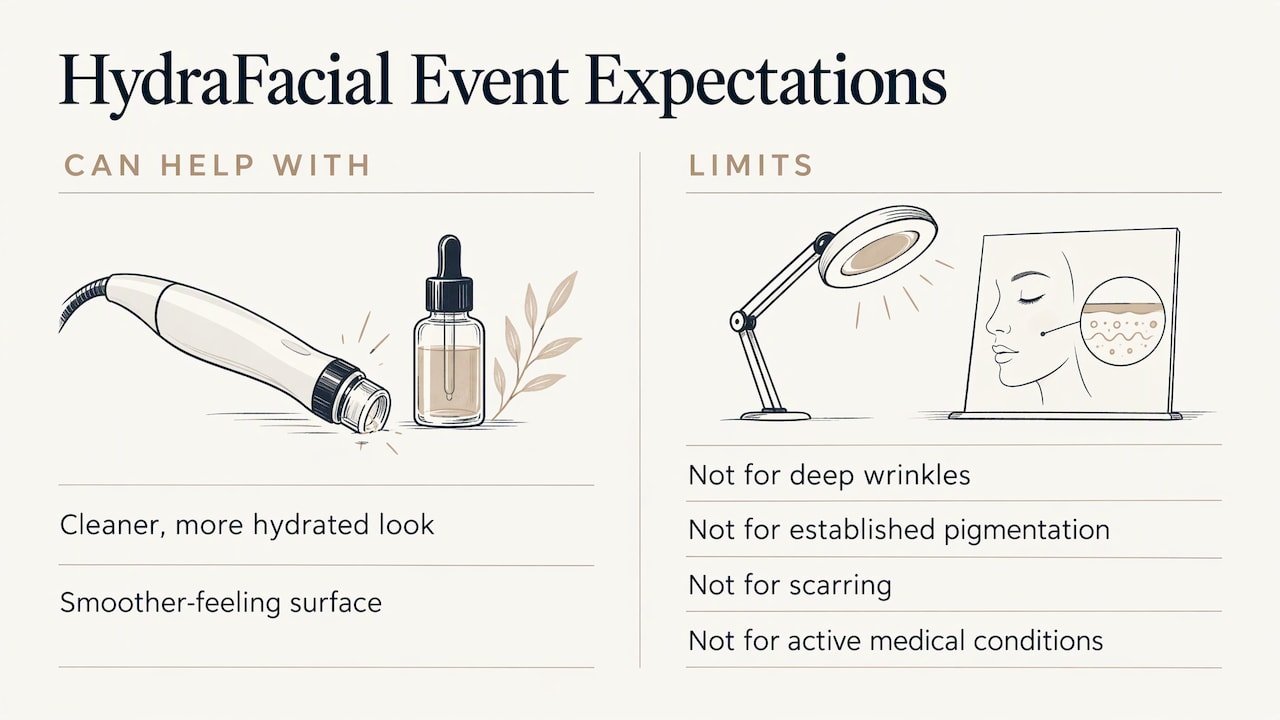
What people usually book it for: a cleaner, more hydrated look and a smoother-feeling surface. These are the changes most people hope to see after a facial of this kind. Results vary, and we cannot promise how your skin will look.
What it is not: a treatment for deep wrinkles, established pigmentation, scarring or active medical skin conditions. If your main concern is pigmentation, acne or rosacea, a facial may not be the right first step, and a consultation will help you work out the better route. For concerns that need medical assessment, your GP or a dermatologist is the right person to see.
It is also not an overnight fix. A single treatment will not change the underlying condition of your skin. If your event is a long way off and you want a bigger change, a longer plan made with your practitioner will serve you better than a single appointment.
Can you combine it with other treatments?
A common question is whether dermaplaning or other add-ons can be done at the same visit, and whether other treatments should be stacked before an event. We do not give a blanket yes or no. Whether treatments can be combined depends on your skin, the products you use and what your practitioner finds at consultation. Combining several things before an event also increases the chance your skin reacts, and it makes the cause harder to identify.
A sensible principle for a first-timer: do one thing at a time, and do not try anything new close to the date. Tell your practitioner about every treatment you have had or plan to have, including waxing, peels, laser and injectables. Treatments that affect the skin barrier or involve downtime should be planned with proper spacing, and your practitioner can advise on the order that suits you.
A simple planning timeline to adapt
This is a framework, not a schedule. We do not set a fixed treatment pattern, and your own plan will come from your consultation.
| Stage | What to do | Why it helps |
|---|---|---|
| As soon as the date is set | Book a consultation and say what the event is | Gives your practitioner room to plan |
| At consultation | Share skincare, sun, medication, history | Lets them judge suitability and timing |
| Before treatment | Keep your routine steady, protect from sun | Reduces unknowns |
| After treatment | Follow your practitioner’s aftercare advice | Helps skin settle |
| Before the event | Keep products simple, avoid anything new | Avoids last-minute reactions |
When to postpone or ask for advice first
Some situations call for a conversation before you book, or a delay. Raise these with a qualified professional rather than deciding for yourself:
- Sunburn, or very recent heavy sun exposure on the face.
- A flare of acne, eczema, rosacea or dermatitis.
- Cold sores or any active infection in the area.
- Open wounds, irritation or a recent reaction to a product or treatment.
- Recent facial treatments such as peels, microneedling or laser.
- Pregnancy or breastfeeding, or any new medication.
- A skin change you are worried about, such as a mole that has changed. A new or changing mole should be looked at by your GP, not treated as a cosmetic matter.
A good practitioner will not mind a postponement. A rescheduled facial costs far less than arriving at your event with irritated skin.
Book your first HydraFacial with Dermacy Clinic
Dermacy Clinic is a skin, laser and aesthetic clinic in Armthorpe, Doncaster, South Yorkshire. Our HydraFacial page has the current service details, the options available and the route to booking. Look there for up-to-date prices rather than relying on any figure quoted elsewhere. When you book, tell us about your event so we can talk through timing at your consultation. Recommendations depend on individual assessment and suitability, and results vary.
FAQ
How long before an event should you get a HydraFacial?
There is no universal number of days. The manufacturer’s instructions say temporary redness, tightness or irritation usually settles within 72 hours, depending on sensitivity. For a first treatment, allow a comfortable buffer beyond that and discuss your date at consultation.
Is it safe to have a first HydraFacial just before a wedding?
It depends on your skin, and only a practitioner can assess that. A first treatment is the one you can predict least, so many people choose to have it well ahead of the day. Tell your practitioner about the wedding date when you book.
Can you have dermaplaning and a HydraFacial at the same appointment?
Whether treatments can be combined depends on your skin and your practitioner’s assessment. We do not offer a blanket answer. Tell the practitioner about every treatment you have had or want, and avoid adding new things close to your event.
Does a HydraFacial work for pigmentation or acne before an event?
A HydraFacial is a facial, not a medical treatment for pigmentation, acne or rosacea. If these are your main concerns, a consultation can help identify the most suitable route. Persistent or worsening skin problems should be seen by your GP or a dermatologist.
Sources
Recommended
- HydraFacial Explained | Steps, Results and Aftercare
- Can You Wear Makeup After a HydraFacial?
- Can Sensitive Skin Have a HydraFacial? What to Know First
This article provides general information and is not a diagnosis or personalised medical advice. Treatment suitability, risks and expected outcomes require an individual consultation. Results vary.