
The best time to sort out skin booster aftercare is before the needle comes anywhere near your face. Ask the person who will treat you what to do in the first hours and days, what you should expect to see, what is not normal and who to phone, day or night, if something worries you. You should get the answers verbally and in writing, and you should have time to decide before you go ahead.
This guide gives you the questions in a sensible order, explains why each one matters and shows what a clear answer looks like. It does not replace the advice of your own practitioner, who knows your skin, your health history and the exact product they plan to use.
TL;DR
- “Skin booster” is a broad label, not one uniform treatment, so start by asking exactly what product is being used and what it is meant to improve.
- Ask for aftercare in writing, covering the first 24 hours, makeup, exercise, skincare and other treatments, because instructions differ between products and people.
- Swelling, bruising and tenderness are common after injectable treatments and usually settle, but how long they last varies from person to person.
- Severe or increasing pain, skin turning white, mottled, dusky or blue, or any change in vision needs urgent attention. Vision changes are an emergency.
- Ask for an out-of-hours contact and a complication plan at the consultation, not after something goes wrong.
Table of Contents
- Why aftercare questions belong in the consultation
- First, pin down what is actually being injected
- Questions about suitability and your own health
- The aftercare questions themselves
- Questions about who is treating you and what happens if something goes wrong
- When to seek help after treatment
- A short checklist to take to your consultation
- Skin boosters at Dermacy Clinic
- FAQ
- Sources
Why aftercare questions belong in the consultation
Most people think of aftercare as a leaflet handed over at the end of an appointment. In practice it is part of the decision to have the treatment at all. If a practitioner cannot explain what recovery looks like, what the risks are and what happens if something goes wrong, you do not yet have enough information to say yes.
The NHS guidance on choosing who will do your cosmetic procedure suggests booking a consultation with the person who will actually carry out the procedure. It lists what to ask: how many procedures they have done, what qualifications and training they have, the most common complications, what aftercare to expect, what to do if something goes wrong and how much it will cost including any further treatment.
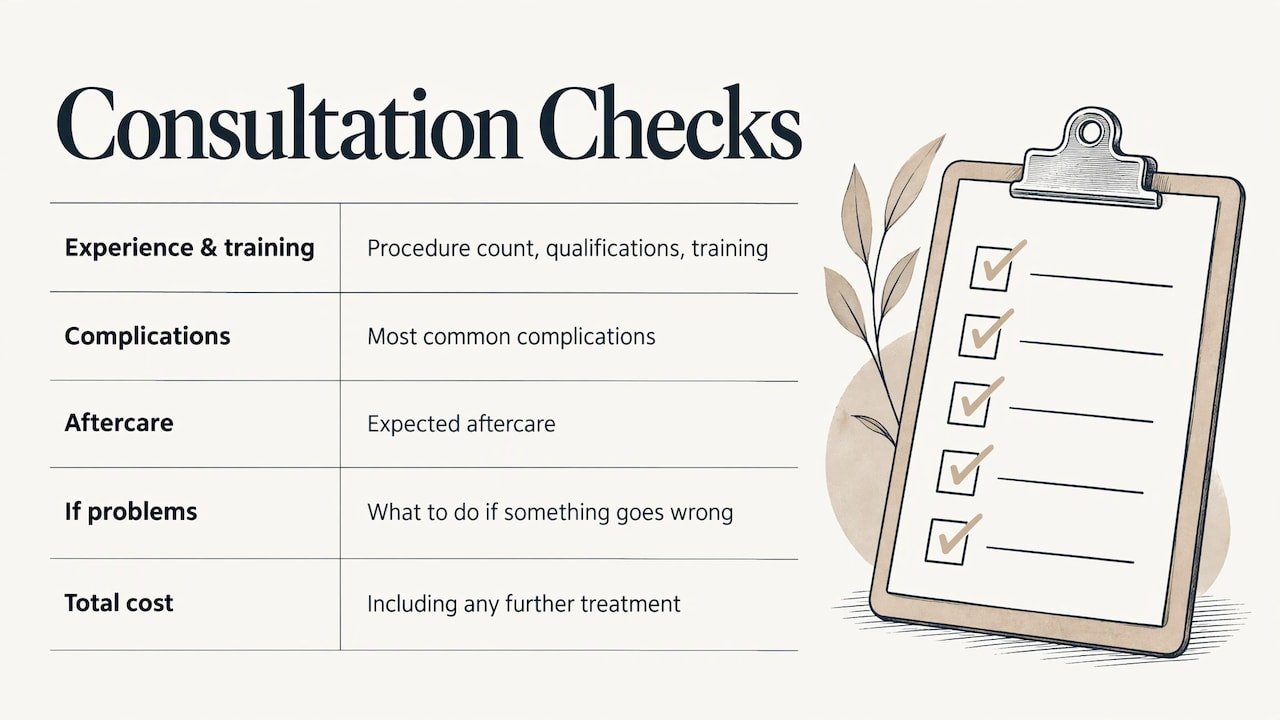
It also says your practitioner should give you time to decide, and that you can ask for take-away information such as a leaflet from the manufacturer of the product they will use. That leaflet is a useful anchor for aftercare questions, because it describes the specific product rather than the category.
City of Wolverhampton Council makes a similar point in its guidance on non-surgical aesthetic procedures: aftercare is a vital part of the treatment process, and you should receive clear instructions both verbally and in writing.
First, pin down what is actually being injected
Aftercare depends on the product and the technique, so the first question is not about aftercare at all.
“Skin booster” is a consumer-facing description. Products sold under that heading can differ in their composition, how they are placed in the skin, how much evidence sits behind them and how subtle or visible the result is. Aftercare for one may not suit another.
Before you talk about recovery, ask:
- What exact product will you use, and why that one for me? Ask for the product name, not just the category.
- Is it licensed or CE or UKCA marked? Telford & Wrekin Council’s aesthetic procedures guidance advises checking the name of the product and whether it is licensed.
- What is it intended to improve? Hydration, fine surface texture and general skin quality are different aims from restoring lost volume or treating a skin condition.
- Can I have the manufacturer’s information leaflet? The NHS says you can ask for this.
- How subtle or visible will the change be, and how many sessions are usually discussed? Answers vary by product and by person, so a sensible practitioner will talk in ranges and explain their reasoning.
This matters for aftercare because every instruction that follows, from makeup to exercise to how long you wait before another treatment, should relate to that product and to your skin.
Questions about suitability and your own health
A good consultation looks at you before it looks at a price list. Telford & Wrekin Council says a pre-consultation should review your medical history and give you the chance to understand potential risks and complications, including allergies and medical conditions. It also advises not accepting treatment on the day of the consultation.
Useful questions at this stage:
- Is a skin booster the right answer for my concern? If your main worry is surface dryness, irritation or a flare of a skin condition, an examination and a conversation about everyday skincare may come first. PatientPulse makes this point: an injection should not be the automatic answer to a broad word such as “dullness”.
- What would you suggest if I chose not to have an injection? A confident practitioner can explain the alternatives, including changing your routine or considering a different treatment.
- Do my medical history, medicines or allergies change anything? Bring a list, along with your current skincare products and any history of reactions.
- Are there times I should postpone? For example, if you have a skin infection, a cold sore, or a major event coming up soon. Your practitioner should say how these affect timing.
Your answers shape the aftercare. Someone who bruises easily, or who has a big event in two weeks, needs a different conversation from someone with a flexible diary.
The aftercare questions themselves
These are the questions to put to the practitioner once you understand the product. Write the answers down or ask for them in writing.
What should I do in the first hours and days?
Ask for a clear picture of the first day, then the first week. Typical topics include:
- Whether you can touch or wash the area, and when.
- Whether you should sleep in a particular position for the first night or two.
- How long to avoid heat, such as saunas, hot showers and sunbeds.
- What to do about sun protection once the skin has settled.
If you read different timings online, treat them as general. Aftercare sheets from different providers disagree on details, because products, techniques and people differ. The sheet from the person treating you, for the product they used, is the one to follow.
When can I wear makeup?
“Can I wear makeup after a skin booster?” is one of the most common questions people ask, and the honest answer is that it depends on the product and how your skin looks at the time. Ask for a specific time, ask whether mineral or lightweight makeup is different from full coverage, and ask whether brushes and sponges need to be clean or new.
If you have a work event or a social occasion planned, say so at the consultation. That is much easier than asking the day before.
When can I exercise, and what about skincare and other treatments?
Ask three separate things:
- Exercise: when can you return to normal activity, and is there a difference between a walk and a hard workout?
- Skincare: which products should you pause, such as retinoids or exfoliating acids, and for how long? Which gentle products are fine to keep using?
- Other treatments: how long should you wait before facials, peels, microneedling, laser or other injectables in the same area?
The third point is often forgotten. If you are already having other skin treatments, tell the practitioner and ask for a sensible order and spacing. Do not guess.
If your practitioner recommends keeping to a simple, gentle routine while your skin settles, ask which specific products they are happy for you to use. Some people like to browse a natural skincare range in advance, but check each product against your practitioner’s advice before using it on treated skin.
How long should I expect swelling, bruising and marks?
Most swelling, bruising and tenderness after injectable treatments is normal and settles over days. According to Cosmetic Journal, swelling is usual for the first 24 to 72 hours and bruising is typically visible for around five to ten days. Those are general ranges, not promises. You may recover faster or slower, and the area treated, the technique and your own tendency to bruise all play a part.
Ask your practitioner:
- What is typical for this product and area?
- What would be unusual enough that I should call you?
- Can I take anything for tenderness, and is there anything I should avoid? Do not take medicines or supplements to manage side effects without checking with your practitioner or pharmacist first.
- Is there a time when you will review me, and will you want photographs?
When will I see the result, and how long does it last?
Results are gradual and vary. Ask how soon you can expect to notice anything, how a reasonable practitioner judges whether it has worked and what maintenance might be recommended. Be wary of anyone who promises a fixed outcome.
Online sources quote different numbers of sessions and different lengths of effect. Rather than trusting a figure from a general website, ask your practitioner what applies to the product you are being offered, and what that means for cost over time. The NHS advice includes asking about the cost of any further treatment, which is the natural follow-on question.

Questions about who is treating you and what happens if something goes wrong
Aftercare is only as good as the person behind it. These questions cover the practical side of safety.
Who will treat me, and what is their training?
Ask who will actually carry out the injections, how long they have been qualified, how often they perform this exact treatment and what training they have for it. North Somerset Council’s cosmetic procedures checklist includes asking for proof of training or registration, whether they belong to a professional body and whether they are insured for complications.
The British College of Aesthetic Medicine’s “Vet it before you get it” campaign, reported by the Patient Safety Learning hub, focuses on credentials, clinical supervision, insurance, product safety, emergency protocols and clinic governance. It advises asking whether the practitioner is medically qualified and registered with a body such as the GMC, GDC, NMC or GPhC, and checking the register yourself rather than relying on a clinic’s own biography.
Is a prescriber involved where one is needed?
Some products used in aesthetic medicine are prescription-only. City of Wolverhampton Council advises that treatments requiring a prescription need a face-to-face consultation with a suitably qualified prescriber, such as a doctor, dentist, prescribing nurse or pharmacist. It also says not to accept treatment on the day of the consultation. If you are unsure whether the product being discussed needs a prescription, ask, and ask who the prescriber is.
What is the complication plan, and who do I call out of hours?
This is the most overlooked aftercare question. Ask:
- Who do I contact if I am worried, and what is the number out of hours?
- How quickly would you expect to see me if there is a problem?
- What is your protocol for managing complications?
- Are you insured for complications?
Write the number into your phone before you leave. If something does seem wrong, the Cosmetic Journal advises phoning your practitioner straight away and describing what you see in specific words, for example pain out of proportion, colour change, cold skin or vision change.
When to seek help after treatment
This section is general information and not a diagnosis. If you are worried about your own skin after treatment, contact the person who treated you or a qualified health professional.
According to Cosmetic Journal:
- Seek urgent attention for severe or increasing pain, skin that turns white, mottled, dusky or blue, or any change in vision.
- If your vision is affected, treat it as an emergency and seek urgent medical attention. Do not wait for a call back from the clinic.
- Contact your practitioner promptly for signs of infection such as spreading redness, heat, pus or fever.
Do not try to fix a suspected complication yourself, and do not rely on advice from social media. Your practitioner’s job is to assess and manage it. If you cannot reach them and the symptoms are serious, use emergency services.
A short checklist to take to your consultation
Copy this into your phone.
| Topic | What to ask |
|---|---|
| Product | Exact name, licence or marking, what it is meant to improve, manufacturer leaflet |
| Suitability | Is it right for my concern, my health history and my medicines? What are the alternatives? |
| First days | What to do and avoid, sleeping, heat, washing, touching |
| Makeup and skincare | When, which products to pause, which are fine |
| Exercise and other treatments | When to resume, how long to wait before other procedures in the area |
| What is normal | Typical swelling, bruising and marks for this product, and how long |
| Problems | Out-of-hours contact, complication plan, insurance, review appointment |
| Practitioner | Qualifications, registration, how often they do this treatment |
| Cost | Total cost including any follow-up sessions |
| Time | Can I go home and think about it before deciding? |
Skin boosters at Dermacy Clinic
At Dermacy Clinic in Armthorpe, Doncaster, skin boosters and Profhilo are discussed through a consultation, where suitability is assessed individually and results vary. You can read about the service, see current details and book your next step on our skin boosters and Profhilo page. Bring this checklist with you and ask each question that matters to you.
If you are also thinking about other treatments, our guides on microneedling recovery and aftercare and who to see for skin concerns may help you plan the order and timing.
FAQ
Can I wear makeup after a skin booster?
Many practitioners ask you to wait a set period before applying makeup, but the length varies with the product and your skin. Ask for the exact time at your consultation and get it in writing. If your skin is swollen, sore or marked, it is sensible to ask whether it is safe to apply anything at all.
How many sessions will I need?
It depends on the product, the concern and how your skin responds, and general websites quote different numbers. Ask your practitioner how many sessions they usually discuss for the product they propose, how they judge whether it is working and what the total cost would be including any follow-up.
How long do swelling and bruising last?
Swelling is commonly seen in the first 24 to 72 hours and bruising for roughly five to ten days after injectable treatments, according to Cosmetic Journal. Individual recovery varies. Contact your practitioner if swelling or pain is increasing rather than settling.
What signs mean I should get help straight away?
Severe or increasing pain, skin turning white, mottled, dusky or blue, and any change in vision need urgent attention. If your vision is affected, seek emergency medical help without waiting for a call back. Spreading redness, heat, pus or fever should prompt a prompt call to your practitioner.
Should I decide on the day of the consultation?
No. The NHS advises that your practitioner should give you time to decide, and councils advise against accepting treatment on the day of a consultation for prescription-only treatments. Taking time lets you read the product leaflet and compare the answers you have been given.
Sources
- Choosing who will do your cosmetic procedure, NHS
- Non-surgical aesthetic procedures: what you need to know, City of Wolverhampton Council
- Aesthetic procedures, Telford & Wrekin Council
- Cosmetic procedures, North Somerset Council
- “Vet it before you get it”, British College of Aesthetic Medicine campaign, Patient Safety Learning hub
- Recognising a complication after injectables, Cosmetic Journal
- Skin Boosters: Products, Evidence, Risks and Costs, PatientPulse
Recommended
- Cosmelan Homecare and Peeling: What to Ask Your Practitioner
- Microneedling Recovery and Aftercare: What to Expect
- Can You Wear Makeup After a HydraFacial?
This article provides general information and is not a diagnosis or personalised medical advice. Treatment suitability, risks and expected outcomes require an individual consultation. Results vary.