
A skin analysis scan can show you how your skin looks right now: visible pigmentation, redness, texture and signs of ageing, recorded in a consistent way. It cannot diagnose a skin disease, detect skin cancer or prove that a treatment will work for you. At Dermacy Clinic in Armthorpe, Doncaster, we use visual skin analysis and progress photographs to support a consultation, not to replace clinical judgement. This guide explains where the line sits, so you know what to expect and when to seek a different kind of appointment.
TL;DR
- A scan is a visual record of surface features such as pigmentation, redness, texture and signs of ageing. It helps a consultation, and it is not a medical test.
- It does not diagnose disease or detect cancer. A mole or patch that is new, changing or worrying should be seen by a GP.
- Readings vary with lighting, hair, facial expression, skin pressure and how the device is used, so one scan is a snapshot rather than proof.
- Used well, repeat photographs help you and your practitioner compare changes over time and talk through options.
- Suitability for any treatment is decided in consultation, and results vary from person to person.
Table of Contents
- What a skin analysis scan actually is
- What a scan can show you
- What a scan cannot tell you
- Free online skin analysis: how far can you trust it?
- How scan results guide skincare and treatment choices
- Getting a more reliable scan
- When to see a GP or dermatologist instead
- Seeing what a scan shows for your own skin
- FAQ
- Sources
What a skin analysis scan actually is
A skin analysis scan is an imaging step. A device or camera system photographs the face, sometimes under different lighting, and software or a practitioner reviews what the images show. A peer-reviewed review of computer-assisted facial imaging describes these systems as offering objective, quantitative evaluation of features including pigmentation, inflammation, vascular changes, skin texture, the severity of ageing and follow-up after treatment.
That description matters for what it leaves out. The scan records appearance. It does not look beneath the skin the way a biopsy does, and it does not know your medical history, your medicines or your family background. Those come from conversation and examination.
At Dermacy Clinic, we describe the scan as a visual assessment that supports consultation. It is not a diagnostic test, and not every treatment plan involves it. Whether it is useful for you depends on your concern, and we talk that through at the appointment.
What a scan can show you
A good scan is most useful for surface-level features you can already see, but find hard to describe or compare.
Pigmentation and uneven tone
Imaging can make dark patches, freckling and uneven tone easier to see and record. A study of an advanced imaging device found it agreed with two other devices when assessing pigmentation and redness, which suggests this is a feature these systems handle reasonably well. The same authors still say more studies are needed before redness readings can be matched against clinical expertise.
Seeing where pigmentation sits is a starting point, not an answer. Sun damage, post-acne marks and melasma can look similar on an image but are managed differently, which is why an assessment has to follow. If pigmentation is your main concern, our guide to sun damage on the face and what to check first covers the questions worth asking.
Redness, texture and visible ageing
Scans can highlight areas of redness, rough or uneven texture, and the visible extent of lines and wrinkles. This can help you see which concern is most noticeable and which is less so. It can also reveal differences between one side of the face and the other that are easy to miss in a mirror.
Skin type versus a temporary condition
Many people say “I have oily skin” when their skin is really reacting to a harsh product, or “I have dry skin” when it is dehydrated after a cold week. A scan alone does not settle this. Research on structured aesthetic check-ups describes the skin biotype (normal, seborrheic, dry or sensitive) as built from medical history, daily habits, clinical findings and instrumental measurements together, not from a single reading.
In practice, the scan adds one piece of evidence. The questions about your routine, products, sleep, sun exposure and past reactions add the rest.
Change over time
The most practical use of a scan is comparison. Photographs taken in the same way at different visits let you and your practitioner look at what has changed, stayed the same or got worse, instead of relying on memory. Reviews of imaging systems list therapeutic follow-up among their uses, as in the same facial imaging review. Progress photographs also document your starting point, which is helpful when results build slowly.
What a scan cannot tell you
It cannot diagnose a skin condition
A picture of your skin, however detailed, is not a diagnosis. A review in Frontiers in Immunology notes that for inflammatory skin lesions of unclear cause, the traditional diagnostic gold standard is dermato-histopathology, meaning a tissue sample examined under a microscope. It adds that dermatoscopy and functional testing support diagnosis but are limited largely to specialist dermatology departments, and need training to use and interpret correctly.
So a cosmetic scan will not tell you whether a rash is eczema, psoriasis or something else, whether acne is hormonal, or whether a patch is a skin condition needing medical treatment. If a skin problem is painful, spreading, bleeding, weeping or not settling, start with your GP.
It cannot detect skin cancer
This is the most important limit. Facial imaging for appearance is not a cancer check. The British Association of Dermatologists has warned that the accuracy of AI tools meant to support skin cancer diagnosis may be overestimated when studies do not reflect real clinical practice, and that a systematic review of smartphone apps found serious flaws.
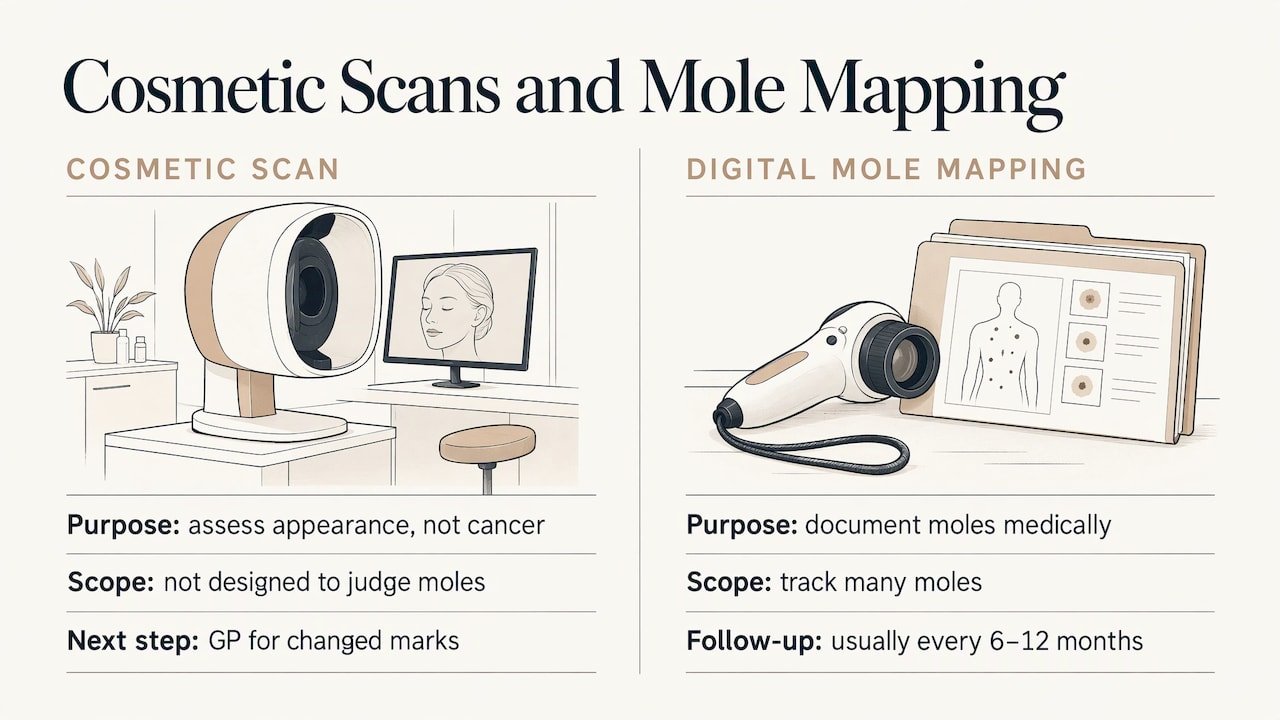
The NHS says the first sign of melanoma is often a new mole or a change in an existing mole, and advises telling a GP about any mole, freckle or area of skin that has recently changed. Features to look out for include an uneven shape or edges, a mix of colours and a larger size. None of that is something a beauty-clinic scan is designed to judge. If you are worried about a mole or mark, book a GP appointment rather than a cosmetic one.
If you have lots of moles and want them tracked, that is a medical service. NHS trusts describe digital mole mapping as a specialist photo documentation system, with follow-up usually every 6 to 12 months. It is arranged through healthcare services, which is a different thing from a skin analysis scan.
It cannot prove a treatment will work
A scan can show that you have uneven pigmentation. It cannot promise that a peel, a HydraFacial or a pigmentation programme will clear it. Skin responds differently depending on its type, the cause of the concern, how you look after it between visits and how consistently you protect it from the sun. Outcomes vary, and any honest practitioner will say so.
It is not perfectly consistent
Imaging readings depend on conditions. The facial imaging review notes that results may vary considerably because of environmental and postural factors, and that wrinkle and texture analysis in white light can be affected by untidy hair and facial expression. It also says redness is hard for most systems to recognise fully, especially when it is diffuse or fades gradually, which can make the data imprecise.
The 2024 device comparison adds more variables: hair colour and length, stretching of the skin, incomplete contact and the pressure of the device can all change reflectance and therefore the readings. A scan is a useful guide, but you should not treat any number or score on it as a precise measurement of your skin.
Free online skin analysis: how far can you trust it?
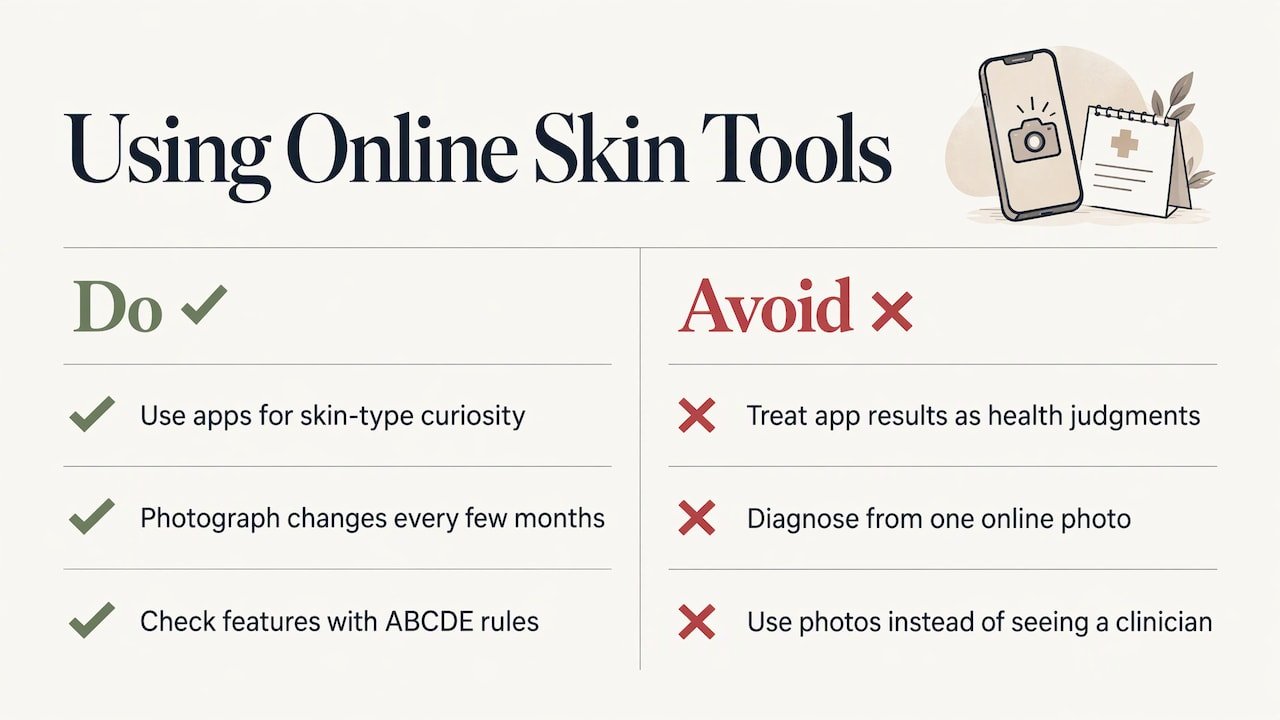
Many people ask whether a phone app or an online tool can do the same job. For general curiosity about your skin type or routine, they can start a conversation. For anything that looks like a health judgement, they are weaker than they appear.
The British Association of Dermatologists notes that some app makers claim to classify, monitor and treat a range of skin disorders, but many are flawed in design because the images used to build them do not represent the full range of skin disorders. In other words, a confident-looking result on your phone is not evidence that it is right. The same applies to a photograph sent to someone online: a single picture is not enough to diagnose a skin condition.
If you do want to record changes yourself, NHS guidance for people with a concerning lesion says that taking photographs over time can be more reliable than memory, and suggests doing so every few months with a phone camera. The same page points to the ABCDE rules (Asymmetry, Border, Colour, Diameter, Evolution) as a way to spot features that need attention. Photos for your own records do not replace seeing a clinician if something changes.
How scan results guide skincare and treatment choices
Here a scan earns its place. It gives the consultation a shared reference point, so the conversation moves from “my skin looks tired” to “these are the areas that bother me most, and this is what we can see”.
In a consultation, a practitioner will typically combine several things:
- What you tell us. Your concerns, routine, products, medicines, skin history and goals.
- What we see. The scan images and a visual examination of your skin.
- What is suitable. Whether a treatment makes sense for your skin and circumstances, or whether you should see your GP or another professional first.
- What is realistic. The likely pace, the limits and the fact that outcomes vary.
The scan feeds into step two. It does not make the decision. For example, if the images show uneven pigmentation, the next questions are about cause, history and sun exposure. If melasma is a possibility, a programme such as Cosmelan may be discussed alongside pigmentation care at the clinic. If the concern is dullness or congestion, a facial or peel may be a better fit. In both cases, the treatment follows the assessment, not the other way round.
Getting a more reliable scan
Because readings shift with conditions, a little preparation makes your results easier to compare from one visit to the next. The research above points to the main variables, and some are within your control:
- Arrive with a clean, bare face so makeup and sunscreen do not change what the camera sees.
- Tie hair back away from the forehead and cheeks, since hair can interfere with wrinkle and texture analysis.
- Keep a neutral expression while the photographs are taken, as expression changes how lines appear.
- Tell us what you used recently, such as exfoliating acids, retinoids or a recent peel, and any recent sun exposure, because these change redness and tone.
- Try to attend under similar conditions each time, so later images are a fair comparison with the first.
If you want further practical tips on reducing avoidable variation before an AI-based scan, these AI scan preparation tips cover the same principle for hair analysis.
When to see a GP or dermatologist instead
A cosmetic consultation is for appearance-led concerns. Seek medical advice first if you notice:
- a new mole, or a mole that changes in size, shape or colour;
- a sore or patch that does not heal, or that bleeds, crusts or itches persistently;
- a rash that is painful, spreading or not responding to over-the-counter care;
- a family history of skin cancer combined with new or changing marks;
- skin changes that appeared alongside other symptoms or a new medicine.
Your GP can examine the area, decide whether you need an urgent referral and refer you to a dermatologist where appropriate. Once a medical cause has been ruled out or treated, an aesthetic assessment can pick up from there if you want it. The point is sequencing: diagnosis first, cosmetic planning second.
Seeing what a scan shows for your own skin
If you are in Armthorpe, Doncaster or nearby and want to talk through a visual skin analysis, Dermacy Clinic offers a skin analysis at £30 one-off. It is a consultation-supporting visual assessment, with progress photographs for later comparison, and it is not a diagnostic test. Whether it suits you, and which treatments might follow, depends on your skin and your goals, and results vary. For current service details and to book, use our contact page, or see the full range on our homepage.
FAQ
Can a skin scan diagnose acne, pigmentation or another skin condition?
No. A scan records how your skin looks, which can help describe pigmentation, redness and texture. Diagnosis needs a clinical examination and, for some conditions, further tests. If you are unsure what a skin problem is, see your GP.
Can a skin analysis scan detect skin cancer?
No. A cosmetic skin analysis is not a cancer check, and we never describe ours as one. The NHS advises telling a GP about any new or changing mole or area of skin. Specialist services such as digital mole mapping are arranged through healthcare providers.
How accurate is a skin analysis scan?
It is a helpful guide, but not a precise measurement. Studies note that lighting, posture, facial expression, hair, skin stretching and device pressure can all affect readings. That is why comparing images taken under similar conditions is more useful than relying on a single score.
Is a free online skin analysis worth using?
It can be a starting point for thinking about your routine, but it should not be used to judge a skin condition. The British Association of Dermatologists has raised concerns about the design and accuracy claims of some skin apps. For a concerning mark, see a GP.
Will a scan tell me which treatment I need?
Not on its own. It gives your practitioner a visual record to discuss with you, alongside your history, goals and a face-to-face examination. Suitability is decided in consultation, and outcomes vary.
Sources
- The mechanism and application of computer-assisted full facial imaging systems (PMC, 2023)
- The Whys and Hows of Aesthetic Medicine: Anamnesis, Skin Biotype and check-up protocol (PMC, 2025)
- A comparative study of an advanced skin imaging system (PMC, 2024)
- British Association of Dermatologists position statement on AI (July 2021)
- Non-invasive approaches for the diagnosis of inflammatory skin diseases (Frontiers in Immunology, 2019)
- Symptoms of melanoma skin cancer (NHS)
- Digital mole mapping patient information (University Hospitals Southampton NHS Foundation Trust)
- Skin Analytics Service FAQs (University Hospitals Sussex NHS Foundation Trust)
Recommended
- Acne Marks vs Acne Scars: What to Know Before Microneedling
- Dermatologist or Aesthetician: Who Should You See?
- RF Microneedling vs Microneedling: Key Differences
- Can Sensitive Skin Have a HydraFacial? What to Know First
This article provides general information and is not a diagnosis or personalised medical advice. Treatment suitability, risks and expected outcomes require an individual consultation. Results vary.